


Court’s Decision
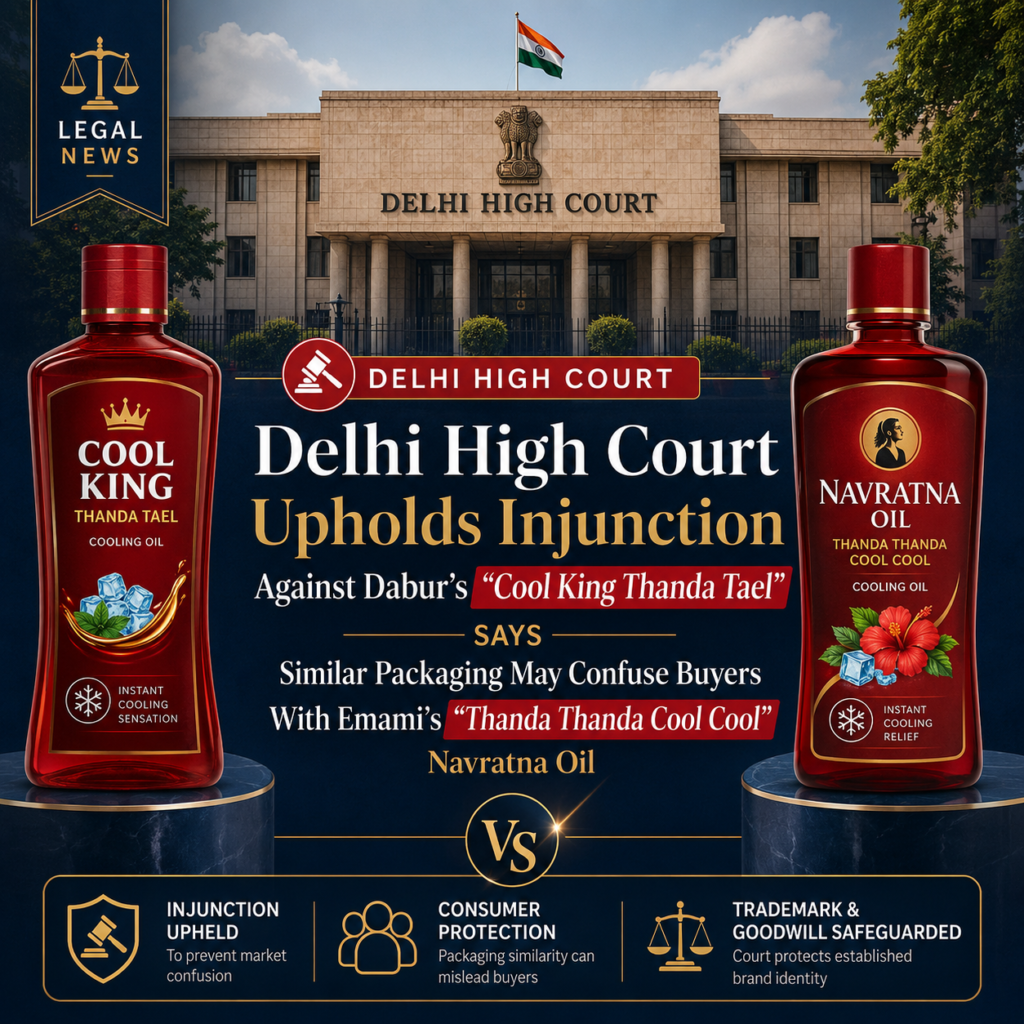
The Delhi High Court refused to interfere with the Single Judge’s order granting temporary injunction in favour of Emami in its passing off action concerning Navratna Oil’s trade dress. The injunction restrained Dabur from selling its product “Cool King Thanda Tael” in the impugned trade dress or any deceptively similar trade dress to Navratna Oil.
The Division Bench held that, at the prima facie stage, the factors for interim injunction were available in favour of Emami, and the learned Single Judge had rightly granted injunction. The Court observed that the learned Single Judge had exercised discretion properly and that it was not a case where settled principles for grant of interim injunction had been ignored.
Facts
Emami claimed that its Navratna Oil was launched in January 1989 with the catch phrase “Thanda Thanda Cool Cool”, and that it had been in continuous and uninterrupted use of the product and packaging for decades. It claimed substantial goodwill, multiple trademark registrations, copyright registrations, design registrations, and a strong market presence in the cooling oil segment.
Emami alleged that Dabur launched “Cool King Thanda Tael” in 2023 with a trade dress deceptively similar to Navratna Oil. The dispute was ultimately confined at the interim stage to passing off, as Emami gave up claims relating to bottle design infringement, copyright infringement, trademark infringement, and disparagement for that stage.
The Court considered the visual features of both products, including the red packaging, placement of elements, use of cooling/ayurvedic imagery, Hindi expressions such as Raahat, Aaram and Tarotaazgi, and the overall impression created by the competing products.
Issues
The principal issue before the Division Bench was whether the learned Single Judge was justified in granting an interim injunction in a passing off claim based on alleged similarity in overall trade dress and get-up.
The Court also considered whether the presence of Dabur’s house mark, the use of common descriptive elements, third-party use of similar features, and alleged differences in packaging were sufficient to displace the interim injunction.
Appellant’s Arguments
Dabur argued that the Single Judge had ignored settled principles for grant of interim injunction. It submitted that the case was only one of passing off and not trademark infringement, copyright infringement, design infringement or disparagement.
It contended that Emami had failed to establish the classic passing off elements: goodwill, misrepresentation and likelihood of damage. Dabur also argued that elements such as red colour, hibiscus flower, herbs, ice blocks, “cool”, “thanda” and cooling oil imagery were common to the trade and could not be monopolised by one entity.
Dabur further argued that its house mark “Dabur” was prominently displayed and was a well-known mark, which would dispel confusion. It also relied on the cooling tube feature and other alleged differences to argue that consumers would not mistake its product for Navratna Oil.
Respondent’s Arguments
Emami argued that Navratna Oil had long-standing goodwill and market recognition in the cooling oil segment. It relied on decades of use, sales figures, advertising expenditure and market share to argue that the overall red trade dress and packaging had become distinctive of its product.
It submitted that Dabur’s adoption of similar packaging was not accidental. Emami argued that the commonality in arrangement, visual impression, cooling imagery, Hindi expressions, and overall get-up showed that Dabur was attempting to ride on the goodwill of Navratna Oil.
Emami also contended that the mere existence of small third-party players using some similar features does not dilute its rights, particularly when those products had different packaging and insignificant market presence.
Analysis of Law
The Court reiterated that in a passing off action, the product must be examined from the standpoint of overall similarity and consumer impression. The focus is not on dissecting every element separately, but on whether the overall get-up is likely to deceive an average consumer with imperfect recollection.
The Court noted that Emami was not claiming monopoly over red colour, herbs, hibiscus or cooling-related words in isolation. The claim was based on the combination and arrangement of these elements, which formed the overall trade dress.
The Court further reiterated the appellate standard in injunction matters. Relying on Wander Ltd., it held that an appellate court should not interfere with the discretion of the court of first instance unless the discretion is shown to be arbitrary, capricious, perverse, or contrary to settled principles of law.
Precedent Analysis
The Court referred to Wander Ltd. v. Antox India, which lays down that appellate courts should be slow to interfere with discretionary interim injunction orders unless the discretion is exercised perversely or contrary to law.
The Court also considered the principles governing interim injunctions in trademark and passing off matters, including prima facie case, likelihood of confusion, balance of convenience, irreparable injury, and public interest.
The Court noted that in such cases, the court must assess the cumulative effect of all relevant factors rather than treat each visual element in isolation.
Court’s Reasoning
The Court found that Navratna Oil had been in the market much prior to Dabur’s impugned product and had built substantial goodwill. The Court noted that Navratna had claimed a major share in the cooling oil segment and that the Single Judge had considered sales and market material while granting injunction.
The Court observed that the similarity was not limited to one feature. It noted that expressions such as Ayurvedic Oil / Ayurvedic Tel, Herbs / Jadi Buti, Raahat, Aaram, and Tarotaazgi were found on Dabur’s bottle in a manner matching Emami’s product. The yellow “New” banner on the left side was also found similar.
The Court also found that Dabur had not offered a convincing explanation for why it changed the get-up of its earlier products to the impugned “Cool King Thanda Tael” packaging. The Court specifically observed:
“So, it follows that the possibility of the appellant’s goods being passed off as goods of the respondent/plaintiff cannot be ruled out.”
The Court rejected Dabur’s argument that third-party use of some similar elements defeated Emami’s claim. It agreed with Emami that the packaging of third-party products was different and that in passing off, the court must consider the overall appearance rather than isolated features.
The Court also held that the presence of the Dabur house mark was not sufficient, at this stage, to negate the overall similarity and likelihood of passing off.
Conclusion
The Delhi High Court held that the Single Judge’s grant of temporary injunction did not suffer from arbitrariness, perversity, or disregard of settled legal principles. The Court found that, at the prima facie stage, Emami had shown sufficient goodwill, overall similarity, likelihood of confusion, and the necessary factors for interim protection.
Accordingly, the injunction against Dabur’s sale of “Cool King Thanda Tael” in the impugned trade dress was sustained.
Key Takeaway
In a passing off dispute, a brand may not claim monopoly over individual common elements like colour, herbs, flowers or descriptive words. But if the overall combination, arrangement and trade dress creates a similar market impression, courts can protect that get-up. A well-known house mark may not always cure deceptive similarity if the total packaging appears to ride on another product’s goodwill.