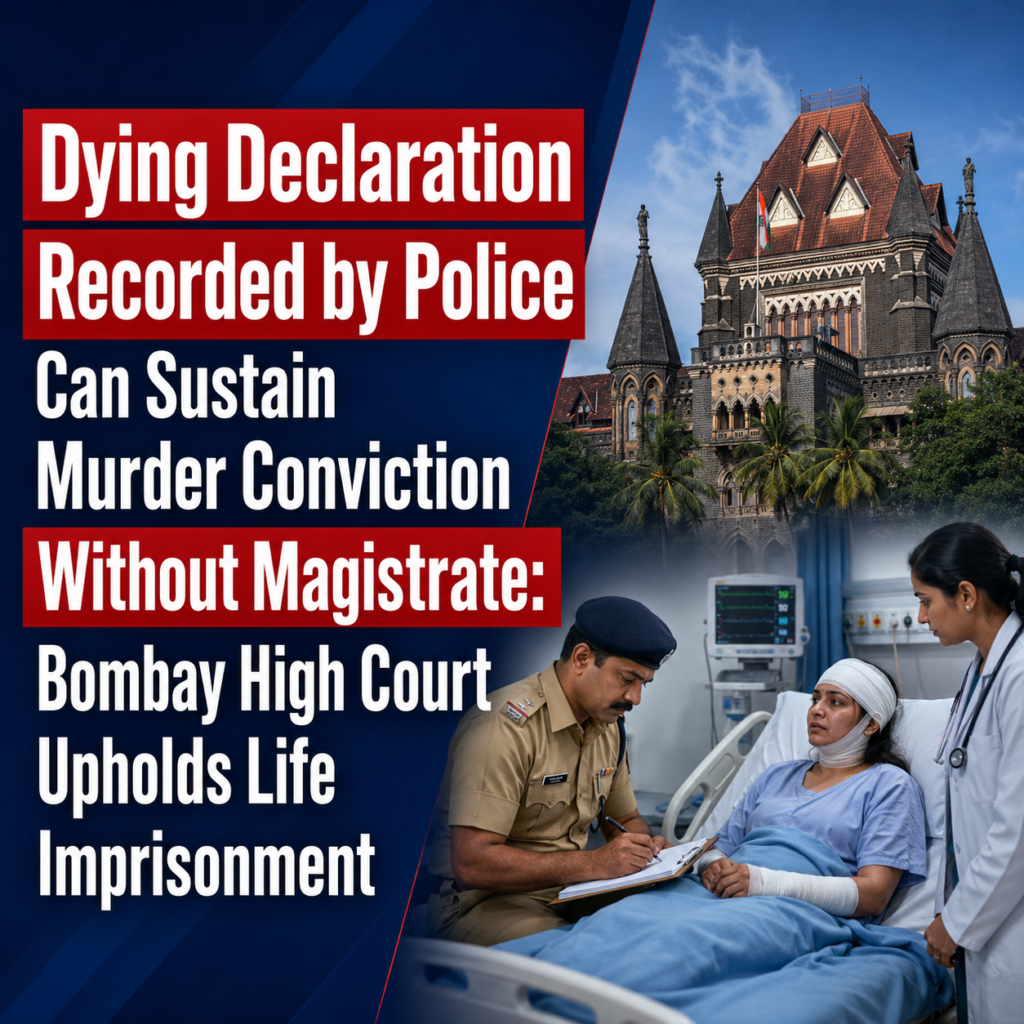
Mother-in-Law Set Daughter-in-Law Ablaze Over Money for Mortgaged Jewellery; Bombay High Court Upholds Murder Conviction and Life Sentence
Facts
Meenabai Lobaji Gaikwad, the appellant, was the mother-in-law of Savitra Vijay Gaikwad. Savitra had married the appellant’s son, Vijay Gaikwad, in June 2006. The appellant had reportedly begun residing with the couple approximately four months before the incident.
According to the prosecution, the appellant had mortgaged certain gold ornaments with a jeweller and repeatedly demanded money from Savitra to redeem them. Since Savitra and her husband were already facing financial difficulties, they could not immediately arrange the amount. This allegedly led to frequent quarrels and ill-treatment.
On 17 April 2013, another quarrel allegedly took place over the money required to release the ornaments. The prosecution claimed that the appellant became angry, brought a can of kerosene, poured it over Savitra and set her on fire before leaving the house.
Neighbours gathered at the spot and informed Savitra’s husband, who extinguished the fire and arranged for her treatment. She was initially taken to YCM Hospital and was subsequently shifted to Sassoon General Hospital, Pune.
Savitra suffered approximately 77% burns. While undergoing treatment, she made a statement to a police officer in the presence of a doctor, accusing the appellant of pouring kerosene on her and setting her ablaze. She also made substantially similar oral statements to her maternal uncle and to the owner of the brick kiln where her husband worked.
The recorded statement was initially treated as the first information report for an offence under Section 307 IPC. After Savitra died from complications arising from the burn injuries on 21 April 2013, the case was converted to one under Section 302 IPC.
The Sessions Court at Pune convicted the appellant of murder and sentenced her to imprisonment for life with a fine of ₹10,000. She challenged the conviction before the Bombay High Court.
Issues
- Whether the deceased’s dying declaration was truthful, voluntary and reliable enough to sustain the appellant’s conviction.
- Whether a dying declaration recorded by a police officer, instead of a Special Executive Magistrate, was legally admissible.
- Whether the declaration could be rejected because it was not recorded in a question-and-answer format.
- Whether the deceased was mentally and physically fit to make the statement despite suffering extensive burn injuries.
- Whether the possibility of tutoring, prompting or influence by relatives created reasonable doubt.
- Whether the initial medical history referring to accidental burns supported the appellant’s defence that the injuries resulted from a stove explosion.
- Whether the appellant’s age and prolonged incarceration justified any interference with the conviction or sentence.
Petitioner’s Arguments
The appellant contended that she had been falsely implicated and that the evidence was insufficient to sustain a conviction for murder.
She principally challenged the dying declaration on the ground that it had been recorded by a police officer and not by a Special Executive Magistrate. According to her, the absence of a Magistrate reduced the authenticity and evidentiary value of the statement.
The appellant also argued that the declaration was not recorded in a question-and-answer format. She submitted that a narrative statement recorded by a police officer could not safely form the basis of a murder conviction.
It was further argued that the doctor had not used the precise words “mentally fit to make a statement” in his endorsement. The absence of an independent medical fitness certificate and the absence of a separate endorsement at the conclusion of the statement were relied upon to question the declarant’s condition.
The appellant pointed to the medical record stating that the history given at the time of admission was one of accidental burns. She maintained that Savitra had sustained burns due to an explosion of a stove and denied pouring kerosene or lighting a matchstick.
She also asserted that her relationship with Savitra had been cordial and denied any continuing dispute between them.
Lastly, the appellant sought leniency on the ground of her advanced age and the fact that she had remained in custody for more than 13 years.
Respondent’s Arguments
The State argued that the dying declaration was credible, voluntary and legally sufficient to sustain the conviction.
It submitted that the deceased had been examined by a doctor before the statement was recorded and was found conscious and properly oriented to time, place and person. The doctor remained present throughout the recording and again examined her after its completion.
The prosecution emphasised that no relative or other person was present while the police officer recorded the statement. This, according to the State, ruled out the possibility of tutoring or prompting.
The recorded declaration was also corroborated by oral dying declarations made independently to the deceased’s maternal uncle and to the owner of the brick kiln while she was being taken for treatment.
The State contended that there is no legal rule requiring every dying declaration to be recorded by a Magistrate or in a question-and-answer format. Once the Court is satisfied about the declarant’s fitness and the voluntary character of the statement, conviction may be based on it even without corroboration.
The prosecution also relied upon the jeweller’s evidence to establish that the appellant had mortgaged ornaments, thereby supporting the motive disclosed by the deceased.
It opposed any leniency, emphasising that a 24-year-old woman had been intentionally set on fire and had lost her life.
Analysis of the Law
A dying declaration is admissible because the person making it is unavailable for cross-examination due to death. However, precisely because the accused has no opportunity to test the statement through cross-examination, courts must scrutinise it with particular care.
A dying declaration may form the sole basis of conviction when the Court is satisfied that:
- The declarant was conscious and mentally fit;
- The statement was voluntary;
- It was not the product of tutoring, prompting or imagination;
- The declarant had a proper opportunity to identify the assailant;
- The account is coherent and consistent; and
- The surrounding evidence does not create a reasonable doubt about its truthfulness.
Corroboration is not an inflexible legal requirement. It is principally a rule of prudence applicable when the declaration suffers from suspicion, inconsistency or another material infirmity.
There is also no mandatory statutory requirement that a dying declaration must be recorded by a Magistrate. A police officer, doctor or another person may record it, provided the Court is satisfied that proper precautions were taken and the declarant was capable of making the statement.
Similarly, the law does not prescribe a compulsory question-and-answer format. A narrative declaration does not become inadmissible merely because the questions asked were not separately reproduced.
In burn cases, the percentage of burns is not by itself decisive. Even a severely injured person may be capable of giving a reliable statement. The controlling consideration is the quality of evidence concerning the declarant’s consciousness, orientation and mental fitness at the relevant time.
A medical endorsement is important but no particular verbal formula is mandatory. An endorsement that the patient was conscious and oriented to time, place and person may sufficiently establish fitness even if it does not reproduce the exact expression “mentally fit to make a statement.”
Precedent Analysis
Irfan @ Naka v. State of Uttar Pradesh
The Supreme Court explained that a dying declaration can sustain a conviction when it inspires complete confidence. Courts must examine whether it was made at the earliest opportunity, whether the declarant was fit and whether the statement was affected by tutoring, prompting or imagination.
The Bombay High Court found that the safeguards identified in Irfan @ Naka were satisfied. The deceased’s account was consistent, made while she was conscious and supported by the evidence of the doctor and other witnesses.
Paniben v. State of Gujarat, AIR 1992 SC 1817
This decision consolidated the governing principles relating to dying declarations. It held that a truthful and voluntary declaration can form the sole basis of conviction, while a suspicious or infirm declaration requires corroboration.
The Court found the present declaration truthful and voluntary. It nevertheless noted that it was also materially corroborated by the deceased’s oral statements to two independent witnesses.
Laxman v. State of Maharashtra, (2002) 6 SCC 710
The Supreme Court held that a formal medical certificate is not an absolute prerequisite. The essential question is whether the person recording the declaration was satisfied that the declarant was in a fit condition to speak and whether the evidence as a whole establishes that fitness.
The doctor’s evidence that Savitra remained conscious and oriented throughout the recording satisfied this requirement.
Purshottam Chopra v. State (Government of NCT of Delhi), AIR OnLine 2020 SC 15
This precedent clarified that the law neither prescribes a particular person who alone may record a dying declaration nor mandates a fixed format. Although recording by a Magistrate is desirable for greater assurance, its absence is not fatal.
The High Court applied this principle to reject the objections that the statement had been recorded by a police officer and was not in a question-and-answer format.
Uka Ram v. State of Rajasthan, AIR 2001 SC 1814
The Supreme Court held that once a dying declaration is found to be truthful, voluntary and free from extraneous influence, conviction may be based upon it without further corroboration.
The High Court relied upon this principle while holding that the declaration was independently sufficient and, in any event, had been corroborated.
Raju Devade v. State of Maharashtra, AIR 2016 SC 3209
This decision held that where multiple dying declarations exist, each declaration must be evaluated independently. One declaration cannot automatically be rejected merely because another declaration also exists.
The deceased’s written and oral declarations in the present case were mutually consistent and strengthened the prosecution case.
Piraji Madhav Kumbhargave v. State of Maharashtra, Criminal Appeal No.327 of 2023
The appellant relied upon this Bombay High Court decision, where reliance upon dying declarations was found unsafe because of material variations, failure to examine crucial witnesses and absence of important medical evidence.
The Court distinguished that case. In the present matter, the declarations were consistent, the recording doctor and police officer were examined, the deceased’s fitness was established and the statement was corroborated by oral declarations.
Court’s Reasoning
The Court found complete consistency between the written dying declaration and the oral statements made by the deceased to her maternal uncle and the brick-kiln owner.
The maternal uncle stated that Savitra specifically accused the appellant of demanding money to redeem mortgaged ornaments and thereafter pouring kerosene over her and setting her on fire. His cross-examination did not materially weaken that account.
The brick-kiln owner, who helped take Savitra to the hospital, gave a substantially identical account of what she told him during the journey. His evidence remained virtually unchallenged.
The doctor testified that, before recording began, Savitra was conscious and oriented to time, place and person. He remained present throughout the process and examined her again after it was completed. The Court held that this was equivalent in substance to certifying her mental fitness.
The police officer had taken precautions before recording the declaration. He obtained the doctor’s endorsement, excluded relatives and other persons from the room, recorded the statement in the doctor’s presence, read it over to the deceased and obtained her thumb impression.
The absence of a Special Executive Magistrate was not fatal because the law does not restrict the recording of a dying declaration to a Magistrate. Evidence also showed that attempts were subsequently made to call the Magistrate and the concerned medical officer.
The fact that the declaration was recorded narratively rather than in a question-and-answer form did not affect its admissibility or reliability. The Court held that substance, voluntariness and the declarant’s fitness were more important than formal structure.
The initial reference to accidental burns in the medical history did not outweigh the detailed, consistent and medically supported dying declarations identifying the appellant.
The post-mortem evidence established that Savitra died from complications following extensive burns and that the injuries were sufficient to cause death in the ordinary course.
The jeweller’s testimony also supported the prosecution’s case that ornaments had in fact been mortgaged, providing corroboration for the motive stated by the deceased.
The Court therefore concluded that the Sessions Court had properly appreciated the evidence and that the conviction did not warrant interference.
Conclusion
The Bombay High Court held that a voluntary and reliable dying declaration may form the sole basis of conviction even when it is recorded by a police officer and is not in a question-and-answer format.
In the present case, the deceased was medically found to be conscious and oriented throughout the recording. Her written declaration was consistent with the oral declarations made to other witnesses and was supported by the medical evidence and proof concerning the mortgaged jewellery.
The Court rejected the defence of accidental stove burns and found no material indicating tutoring, prompting or fabrication.
Accordingly, the Court upheld the appellant’s conviction under Section 302 IPC and the sentence of imprisonment for life with a fine of ₹10,000. The criminal appeal was dismissed, and the connected interim application was disposed of.
Case Details
Case: Smt. Meenabai Lobaji Gaikwad v. State of Maharashtra
Court: High Court of Judicature at Bombay, Criminal Appellate Jurisdiction
Case Number: Criminal Appeal No.852 of 2019 with Interim Application (St.) No.11514 of 2026
Judges: Justice Manish Pitale and Justice Shreeram V. Shirsat
Date: 23 June 2026
Result: Appeal dismissed. Conviction under Section 302 IPC, life imprisonment and fine of ₹10,000 were upheld; the connected interim application was disposed of.