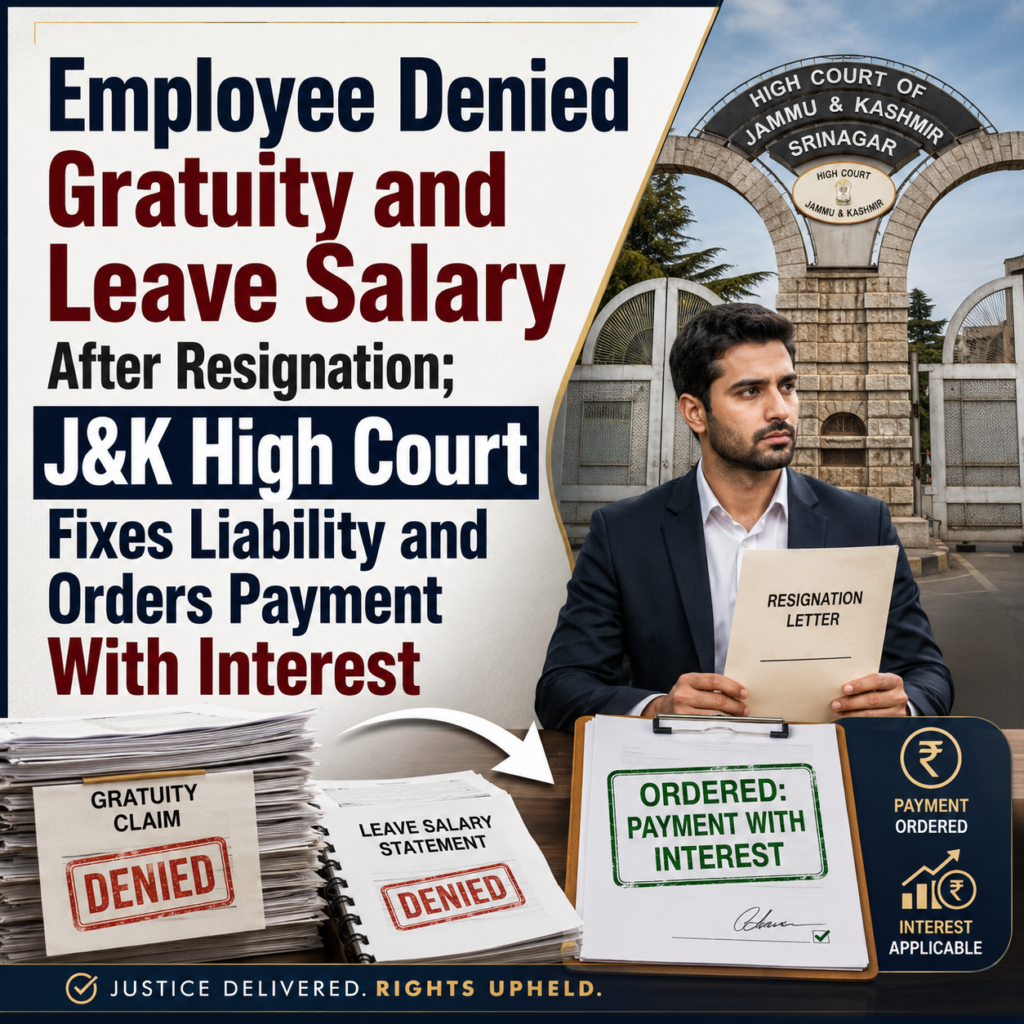
Parent Organisation Cannot Delay Gratuity Over Deputation Dispute; J&K High Court Orders Payment With 10% Interest
Facts
M. Naseer U Zaman was appointed as a Techno-Economic Analyst with the Jammu & Kashmir and Ladakh Financial Corporation (“JKLFC”) on 20 December 2010. He was subsequently sent on deputation to the Jammu and Kashmir Power Development Corporation (“JKPDC”) under a government order dated 19 March 2013, where he worked for a substantial period.
After his resignation was accepted, the petitioner joined the State Bank of India in Mumbai. Although JKLFC released his provident fund amount of ₹6,52,798, his gratuity and leave salary remained unpaid.
JKLFC maintained that the benefits could not be released until JKPDC contributed its proportionate share for the period during which the petitioner had worked with it. JKPDC, on the other hand, denied liability and contended that the parent organisation alone was responsible for determining and paying the petitioner’s service benefits.
The petitioner therefore approached the High Court seeking payment of gratuity and leave salary, together with interest for the delay.
Issues
- Whether JKLFC, as the parent organisation, or JKPDC, as the borrowing organisation, was responsible for paying the petitioner’s gratuity.
- Which organisation was required to calculate and release the petitioner’s leave salary for the period of deputation.
- Whether the petitioner was entitled to interest because of the prolonged delay in payment of gratuity and leave salary.
- Whether an employee’s admitted service benefits could be withheld because of an internal dispute regarding the allocation of liability between the parent and borrowing organisations.
Petitioner’s Arguments
The petitioner contended that his gratuity and leave salary were admitted service benefits that had remained unpaid for several years after the acceptance of his resignation.
He argued that the respondents could not withhold his lawful dues merely because they were unable to resolve their internal dispute over which organisation was ultimately required to bear the financial burden.
Regarding leave salary, the petitioner relied upon Rule 12 of Schedule XVIII of the Jammu and Kashmir Civil Service Regulations, read with the note referring to the government instructions under Article 185-B. He submitted that these provisions required the borrowing organisation to assess, sanction and initially release the leave salary, after which it could seek reimbursement from the parent organisation.
The petitioner also sought statutory interest on the delayed gratuity under Section 7(3-A) of the Payment of Gratuity Act, 1972.
Respondent’s Arguments
JKLFC—Parent Organisation
JKLFC submitted that the petitioner’s provident fund amount had already been released.
It stated that the gratuity and leave salary had been considered for payment, but the process was delayed because the petitioner had served with JKPDC for a substantial part of his employment.
According to JKLFC, the Finance Department had advised that the petitioner’s benefits should be released after obtaining the necessary contribution from JKPDC for the period during which he worked there. JKLFC therefore sought proportionate payment from JKPDC.
It denied negligence or mala fides and attributed the delay to the need for inter-departmental coordination.
JKPDC—Borrowing Organisation
JKPDC argued that under Rule 12(a) of Schedule XVIII of the J&K Civil Service Regulations, the petitioner’s claim had to be decided and paid by his parent organisation.
It relied upon a speaking order dated 30 January 2023, through which it had concluded that the petitioner had no enforceable right to claim service benefits directly from JKPDC.
Accordingly, JKPDC maintained that the entire liability rested with JKLFC.
Analysis of the Law
Liability for Gratuity
The Court examined Article 240-BB of the J&K Civil Service Regulations and held that gratuity was the liability of the parent organisation.
Since JKLFC was the petitioner’s parent organisation, it was legally obligated to calculate and pay the gratuity. Its attempt to postpone payment pending consultation with the Finance Department and JKPDC amounted to an abdication of its statutory responsibility.
The Court further relied upon Section 7(3-A) of the Payment of Gratuity Act. Under this provision, where gratuity is not paid within 30 days from the date on which it becomes payable, the employer becomes liable to pay simple interest until actual payment.
Applying the notified rate, the Court held that JKLFC was liable to pay interest at 10% per annum from the expiry of 30 days after acceptance of the petitioner’s resignation until actual payment.
Liability for Leave Salary
Rule 12 of Schedule XVIII provides that, where an employee is deputed to a corporation, company or autonomous body, the parent department ordinarily regulates matters concerning leave, provident fund advances and disbursement of leave salary.
However, the note appended to Rule 12 incorporates the government instructions under Article 185-B. Those instructions prescribe the payment mechanism applicable where an employee is working under a borrowing or foreign employer.
Under that mechanism:
- The borrowing organisation must determine the leave admissible to the employee.
- It must sanction and initially pay the leave salary.
- It may thereafter submit a reimbursement claim to the parent organisation.
- The parent organisation must verify the claim and reimburse the amount within the prescribed period.
The Court therefore distinguished between ultimate financial responsibility and the immediate mechanism of payment. Although reimbursement could be claimed from JKLFC, JKPDC was first required to calculate, sanction and release the petitioner’s leave salary.
Precedent Analysis
The judgment did not rely upon or discuss any judicial precedents.
The Court decided the matter through a direct interpretation of:
- Rule 12 of Schedule XVIII of the J&K Civil Service Regulations;
- the government instructions referred to under Article 185-B;
- Article 240-BB of the J&K Civil Service Regulations; and
- Section 7(3-A) of the Payment of Gratuity Act, 1972.
The decision is therefore principally a statutory and regulatory interpretation of the respective obligations of a parent organisation and a borrowing organisation in deputation cases.
Court’s Reasoning
The Court observed that the material facts were not disputed. The petitioner had worked under both organisations, and neither respondent disputed that gratuity and leave salary remained unpaid.
The disagreement was only over which organisation was required to make the payment. The Court held that such an internal dispute could not justify withholding an employee’s lawful benefits for several years.
On gratuity, the statutory scheme clearly imposed responsibility upon JKLFC as the parent organisation. The Court criticised JKLFC for unnecessarily engaging in inter-departmental correspondence instead of discharging its obligation.
On leave salary, the Court held that JKPDC’s complete denial of liability was inconsistent with the procedure under the Civil Service Regulations. JKPDC was required to determine and pay the leave salary first and could thereafter recover the amount from JKLFC through reimbursement.
Since the petitioner had been deprived of both amounts for a prolonged period, the Court also awarded interest against both organisations.
Conclusion
The High Court disposed of the writ petition with the following directions:
- JKLFC was directed to release the petitioner’s gratuity forthwith, in accordance with the applicable rules.
- JKLFC was also directed to pay interest at 10% per annum on the gratuity, calculated from 30 days after acceptance of the petitioner’s resignation until actual payment.
- JKPDC was directed to calculate and release the petitioner’s leave salary within one month.
- JKPDC was permitted to claim reimbursement of the leave salary amount from JKLFC.
- JKPDC was directed to pay interest at 6% per annum on the leave salary from the date of filing of the writ petition until actual realisation.
The ruling makes it clear that an employee’s admitted service benefits cannot be indefinitely withheld while the parent and borrowing organisations dispute their respective financial responsibilities.
Case Details
Case: M. Naseer U Zaman v. Managing Director, J&K and Ladakh Financial Corporation & Others
Court: High Court of Jammu & Kashmir and Ladakh at Srinagar
Case Number: WP(C) No. 2973/2022
Judge: Hon’ble Mr. Justice Sanjay Dhar
Date: 30 April 2026
Result: Writ petition disposed of; JKLFC directed to pay gratuity with 10% interest, and JKPDC directed to release leave salary within one month with 6% interest and a right to seek reimbursement.