

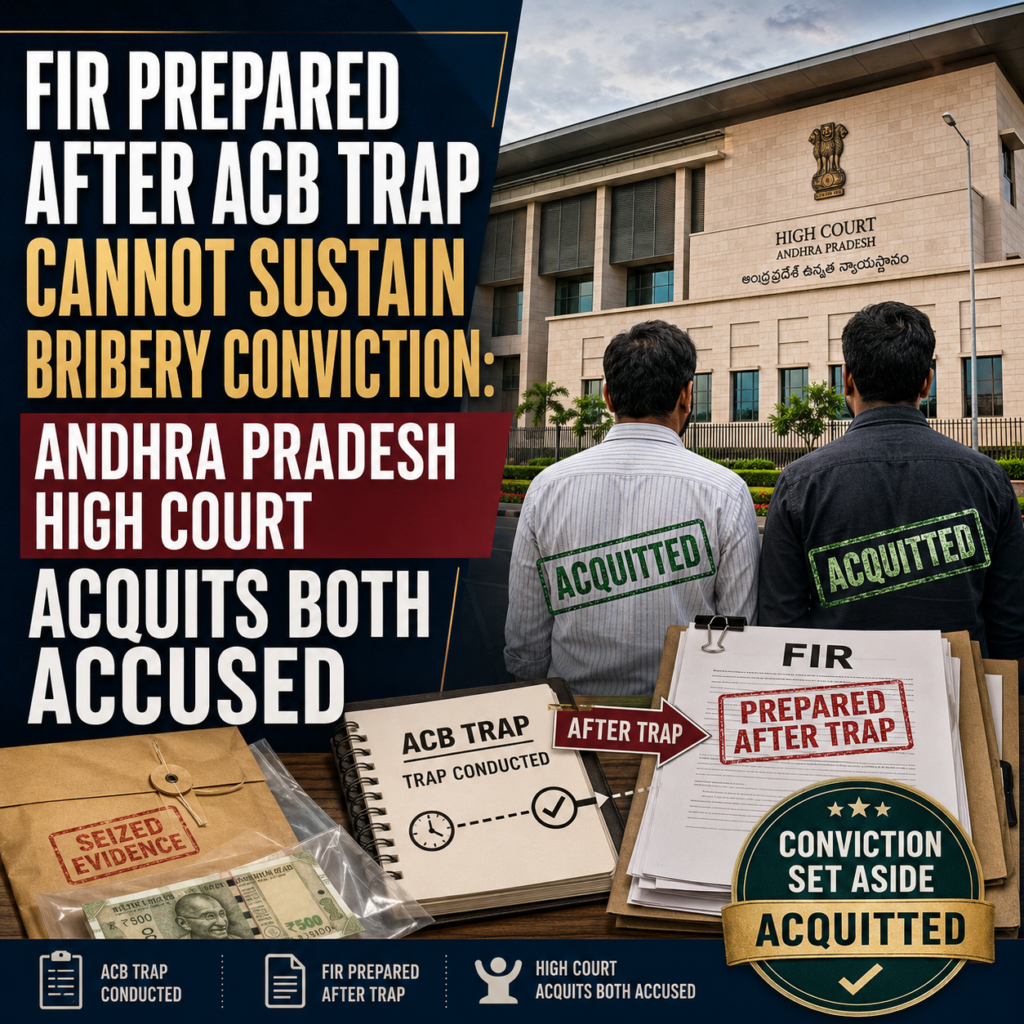
Andhra Pradesh High Court Acquits Government Employee and Hamali as FIR Was Created After Corruption TrapFacts
Y. Ramachandrappa, Accused No. 1, was serving as a government stockist at the Mandal Level Stock Point, Gorantla, Ananthapur District. His duties included processing transport bills relating to the supply of essential commodities to fair price shops. B. Srinivasulu, Accused No. 2, was a private person working as a hamali.
The complainant was a transport contractor who had submitted bills for ₹63,000 for transporting essential commodities during October 2002. According to the prosecution, Accused No. 1 delayed processing those bills and demanded ₹6,000 as illegal gratification, later reducing the amount to ₹5,000.
A trap was allegedly arranged by the Anti-Corruption Bureau. The prosecution claimed that, during the trap, the complainant paid ₹5,000 to Accused No. 2 on the instructions of Accused No. 1. The amount was recovered from Accused No. 2, and the chemical test conducted on his fingers produced a positive result.
The Special Court convicted Accused No. 1 under Sections 7 and 13(1)(d) read with Section 13(2) of the Prevention of Corruption Act, 1988. He was sentenced to one year’s rigorous imprisonment for each offence and fined ₹2,000 on each count.
Accused No. 2 was convicted under Section 12 of the Prevention of Corruption Act and sentenced to six months’ rigorous imprisonment with a fine of ₹500.
Both accused challenged their convictions before the Andhra Pradesh High Court. The appeals were decided through a common judgment.
Issues
- Whether the FIR was genuinely registered before commencement of the trap proceedings and investigation.
- Whether an FIR prepared after the trap and commencement of investigation could be treated as a valid FIR under Section 154 CrPC.
- Whether the complainant’s statement, recorded after commencement of investigation, was hit by Section 162 CrPC.
- Whether the inconsistencies concerning the time and place of preparation of the FIR, pre-trap and post-trap proceedings rendered the prosecution case unreliable.
- Whether the ₹5,000 recovered from Accused No. 2 represented illegal gratification or legitimate transport hire charges payable to owners of vehicles engaged by the complainant.
- Whether the prosecution had proved demand and acceptance of illegal gratification beyond reasonable doubt.
- Whether the convictions recorded by the Special Court were sustainable when material defence evidence had been disregarded.
Petitioner’s Arguments
The appellants argued that the FIR was prepared only after the trap proceedings had been completed.
The complainant stated that he approached the ACB office at about 4:00 p.m. on 26 November 2002. However, the investigating officers claimed that he had approached them at 10:00 a.m. that day and that the FIR was registered at 6:00 p.m.
The appellants highlighted that the complainant had allegedly met Accused No. 1 at Gorantla at 8:00 a.m. and would then have had to travel approximately 110 kilometres to Ananthapur. It was therefore improbable that he could have reached the ACB office by 10:00 a.m.
The complainant also admitted that he signed his statement and other documents at about 4:30 p.m. on 27 November 2002. The FIR bore the date 27 November 2002 below the signature of the registering officer and was received by the Special Court only on 28 November 2002 along with the pre-trap and post-trap documents.
According to the appellants, these circumstances showed that the FIR and trap records had been prepared together at the ACB office after completion of the alleged trap. The investigation had therefore commenced before registration of the FIR.
The appellants further contended that the amount recovered from Accused No. 2 was not a bribe. It represented hire charges payable to owners of additional lorries used for transporting essential commodities on behalf of the complainant.
The complainant owned only one lorry but was required to undertake approximately 120 trips a month. He admitted that four or five additional vehicles were hired each day during October 2002.
The defence examined two lorry owners who confirmed that they had transported food grains on behalf of the complainant and had not received their transport charges. The amount paid to Accused No. 2 was therefore consistent with payment of vehicle hire charges and not illegal gratification.
Respondent’s Arguments
The State supported the judgment of the Special Court and contended that the prosecution had established demand and acceptance of illegal gratification.
According to the prosecution, Accused No. 1 demanded ₹5,000 for processing the complainant’s transport bills. During the trap, he directed the complainant to hand over the amount to Accused No. 2.
The tainted currency was recovered from Accused No. 2, and the sodium carbonate test conducted on his fingers yielded a positive result.
The prosecution maintained that the pre-trap and post-trap procedures were validly conducted and that the inconsistencies concerning timings were not sufficient to discredit the entire prosecution case.
It was also contended that the defence theory concerning hire charges was an afterthought. The transport bills submitted by the complainant did not mention the additional vehicles or corresponding hire liabilities.
Analysis of the Law
FIR Must Precede Investigation
Section 154 CrPC contemplates that the first information relating to commission of a cognizable offence must be recorded before commencement of the investigation.
The FIR sets the criminal law in motion and marks the starting point of the investigative process. A statement recorded after the investigation has already begun cannot subsequently be converted into an FIR.
Any information obtained after commencement of investigation ordinarily assumes the character of a statement under Section 162 CrPC and is subject to the limitations imposed by that provision.
The Court found that the prosecution’s chronology was inconsistent with the oral and documentary evidence. The complainant could not reasonably have reached the ACB office at 10:00 a.m. after allegedly meeting Accused No. 1 at 8:00 a.m. at a place approximately 110 kilometres away.
More importantly, the complainant admitted that he signed his statement and the trap documents together at approximately 4:30 p.m. on 27 November 2002.
The FIR also carried the date 27 November 2002 beneath the signature of the registering officer and reached the Special Court on 28 November 2002 along with the trap proceedings. These circumstances indicated that the FIR had been created only after the alleged trap.
Effect of a Post-Investigation FIR
The High Court held that the complainant’s statement, having been recorded after commencement of investigation, was hit by Section 162 CrPC.
The entire prosecution was materially affected because the trap proceedings were projected as having followed a lawfully registered FIR, whereas the evidence showed that the records had been subsequently prepared at the ACB office.
The Court described such an exercise as a form of “table investigation,” where records are prepared later to create an appearance of procedural regularity.
A conviction founded upon such legally defective and unreliable proceedings could not be sustained.
Proof of Demand and Acceptance
In a corruption prosecution, recovery of tainted currency or a positive chemical test is not sufficient by itself. The prosecution must prove that the amount was demanded and accepted as illegal gratification.
The defence is not required to prove its alternative explanation beyond reasonable doubt. It is sufficient if the defence version is reasonably probable from the evidence.
The complainant admitted that several additional lorries had been hired because his single vehicle could not complete the required number of trips. The evidence of the defence witnesses and official movement registers supported this factual position.
Therefore, the explanation that the amount represented unpaid transport hire charges was reasonably probable and created a serious doubt regarding the prosecution’s allegation of bribery.
Precedent Analysis
T.T. Antony v. State of Kerala, (2001) 6 SCC 181
The High Court relied upon the Supreme Court’s explanation of the nature and function of an FIR.
The Supreme Court held that an FIR under Section 154 CrPC is the earliest information of a cognizable offence which sets the criminal law in motion and marks commencement of investigation.
Information obtained after investigation has commenced cannot be treated as a fresh FIR. Such subsequent information ordinarily falls within Section 162 CrPC.
The precedent also emphasised the need to balance investigative powers with citizens’ fundamental rights under Articles 19 and 21 of the Constitution. Police authorities cannot abuse their investigative powers by manufacturing or retrospectively preparing records.
Applying this principle, the High Court concluded that the purported FIR in the present case had come into existence only after the trap proceedings and was therefore legally invalid.
Court’s Reasoning
The High Court found serious and irreconcilable inconsistencies in the prosecution’s account of when the complainant approached the ACB and when the FIR was prepared.
The complainant stated that he went to the ACB office at about 4:00 p.m. on 26 November 2002. In contrast, the ACB officers claimed that he arrived at 10:00 a.m.
Considering the distance between Gorantla and Ananthapur, the Court held that the prosecution timeline was inherently improbable.
The complainant’s admission that he signed the documents on 27 November 2002 at 4:30 p.m. strongly indicated that the complaint, FIR and trap proceedings had been prepared together after the alleged trap.
The delayed receipt of all documents by the Special Court at the same time on 28 November 2002 further supported this conclusion.
The Court held that the investigating officer had transgressed his authority and retrospectively prepared records to present an apparently regular investigation.
On the nature of the money, the Court found that the Special Court had improperly rejected material defence evidence.
The complainant himself admitted that:
- he owned only one lorry;
- one lorry was insufficient for the required transport work;
- several additional vehicles had been hired;
- the vehicles of the defence witnesses had transported food grains on his behalf; and
- the bills did not disclose that other vehicles had been used.
The defence witnesses’ evidence was therefore supported by the complainant’s own admissions and official movement records.
The trial court’s finding that the defence witnesses were merely set up by the accused was described as perverse and unsupported by the evidence.
The High Court concluded that the amount paid to Accused No. 2 could reasonably have represented transport hire charges. Consequently, the prosecution failed to establish that it was illegal gratification.
The defective FIR, fabricated chronology, unreliable trap documentation and probable defence explanation cumulatively rendered the convictions unsafe.
Conclusion
The Andhra Pradesh High Court allowed both criminal appeals and set aside the judgment dated 18 January 2008 passed by the Special Judge for SPE and ACB Cases, Hyderabad.
Y. Ramachandrappa was acquitted of the offences under Sections 7 and 13(1)(d) read with Section 13(2) of the Prevention of Corruption Act, 1988.
B. Srinivasulu was acquitted of the offence under Section 12 of the Prevention of Corruption Act.
The Court directed that any fine paid by the appellants be refunded and their bail bonds be cancelled.
The judgment establishes that an FIR retrospectively prepared after commencement of investigation cannot sustain a corruption prosecution. It also reiterates that recovery of money is insufficient where the defence provides a probable lawful explanation and the prosecution fails to prove demand and acceptance of a bribe beyond reasonable doubt.
Case Details
Case: Y. Ramachandrappa v. State of Andhra Pradesh, with B. Srinivasulu v. State of Andhra Pradesh
Court: High Court of Andhra Pradesh at Amaravati
Case Number: Criminal Appeal Nos. 123 and 124 of 2008
Judge: Hon’ble Mr. Justice B. V. L. N. Chakravarthi
Date: 5 May 2026
Result: Both appeals allowed; corruption convictions set aside and both appellants acquitted, with refund of fine amounts.

READ ALSO: Trade Licence Not Required to Register Partnership Firm of Advocates: Calcutta High Court