


Court
Supreme Court of India
Case
Shishu Pal @ Shish Ram & Ors. v. Surjeet & Ors.
Citation
2026 INSC 634
Bench
Justice Sanjay Karol and Justice Nongmeikapam Kotiswar Singh
Date of Judgment
11 June 2026
Court’s Decision
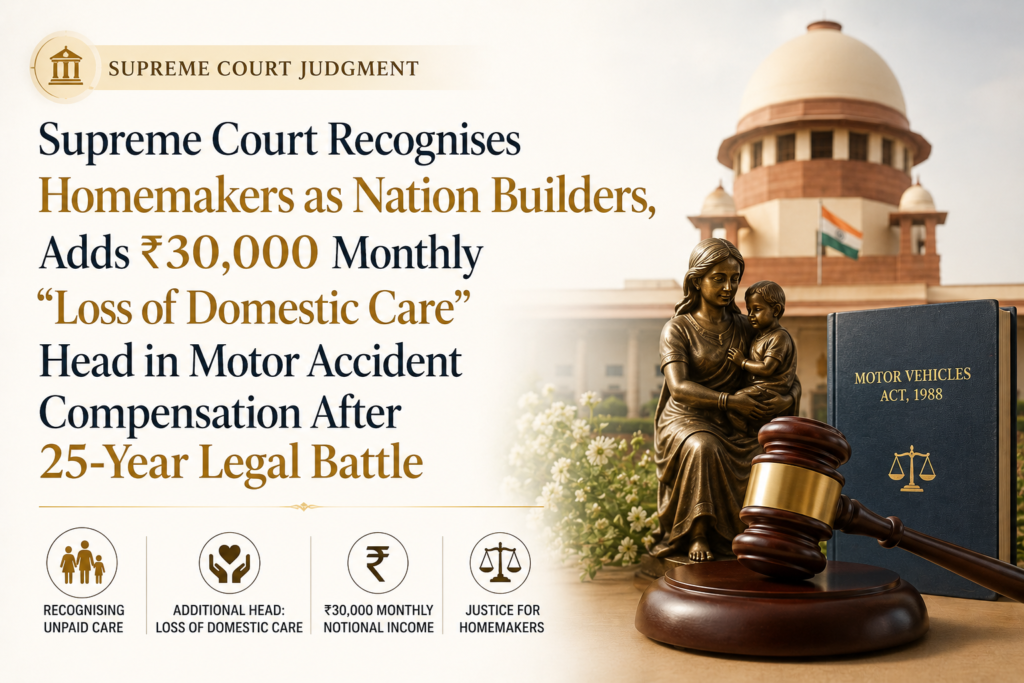
The Supreme Court allowed the appeal filed by the claimants and enhanced the compensation in a motor accident death claim from ₹8,43,400 awarded by the High Court to ₹62,77,900.
The Court recognised the economic value of a homemaker’s unpaid domestic work and directed that in cases involving the death of a homemaker, compensation must include an additional head called “loss of domestic care”.
The Court fixed ₹30,000 as the amount under this head, to be treated as a stand-in monthly income where the homemaker had no proved monetary income. This amount is to be revised by 10% cumulatively every three years.
The Supreme Court also issued important directions to Motor Accident Claims Tribunals and High Courts for reducing delay in MACT compensation cases.
Facts
The deceased, wife of the claimant, was travelling from Sirsa to Fatehabad on 25 November 2001 when the accident occurred due to the rash and negligent driving of respondent no. 1.
The Motor Accident Claims Tribunal, Sirsa allowed the claim petition on 18 December 2003 and awarded compensation of only ₹2,42,000.
The claimants approached the Punjab and Haryana High Court seeking enhancement. The High Court, by order dated 11 December 2024, enhanced the compensation to ₹8,43,400 with 7.5% interest from the date of filing of the claim petition.
The High Court further directed that if payment was not made within three months, interest would increase to 9% per annum, and if payment was not made within six months, interest would increase to 12% per annum.
Still dissatisfied, the claimants approached the Supreme Court.
Issues
- Whether the compensation awarded for the death of a homemaker was just and fair.
- Whether the unpaid labour of a homemaker can be monetised for the purpose of motor accident compensation.
- Whether “loss of consortium” alone sufficiently compensates the family for the death of a homemaker.
- Whether an additional head of “loss of domestic care” should be recognised.
- Whether long delay in MACT compensation matters requires institutional directions.
Petitioner’s Arguments
The claimants sought enhancement of compensation on the ground that the deceased was a homemaker and her contribution to the household had not been properly valued.
The claimants had also stated that the deceased earned ₹3,000 per month from knitting and stitching. However, the Supreme Court noted that this claim was not supported by material evidence.
Respondent’s Arguments
The judgment does not record detailed separate submissions of the respondents. However, the award was ultimately directed to be satisfied by the respondent Insurance Company, and the interest conditions imposed by the High Court were left unchanged.
Analysis
The Supreme Court observed that it is ironic to describe a homemaker as dependent on earning members when, in reality, the functioning of the household substantially depends on the homemaker.
The Court held that a homemaker’s contribution is not merely emotional or informal. It includes cooking, cleaning, household management, care work, support to children, support to the spouse, and the invisible labour that enables other family members to participate in the workforce.
The Court observed that homemakers are “nation builders” because they lay the foundation for the productivity of earning members and the future development of children.
The Court also referred to the Supreme Court’s Handbook on Combating Gender Stereotypes, which discourages use of the word “housewife” and prefers the term “homemaker”.
The Court noted that compensation under “loss of consortium” primarily addresses emotional loss. It does not fully capture the economic and managerial contribution of a homemaker inside the household. Therefore, a separate head of “loss of domestic care” was necessary.
Precedent
The Supreme Court referred to several earlier judgments recognising the value of a homemaker’s contribution.
In Lata Wadhwa v. State of Bihar, the Court had approved compensation for deceased housewives by applying a notional income and multiplier method.
In Arun Kumar Agrawal v. National Insurance Co. Ltd., the Court had held that gratuitous services rendered by a wife and mother cannot be compared to the work of a servant or employee.
In Rajendra Singh v. National Insurance Co. Ltd., the Court had considered notional income for a deceased housewife.
In Kirti v. Oriental Insurance Co. Ltd., the Court had referred to the Time Use Survey and recognised that women spend significantly more time on unpaid domestic and caregiving work than men.
The Court also referred to National Insurance Co. Ltd. v. Pranay Sethi for conventional heads such as consortium, loss of estate, and funeral expenses, including 10% enhancement every three years.
The Court further referred to Rajesh v. Rajbir Singh and Magma General Insurance Co. Ltd. v. Nanu Ram to explain the nature of consortium and why it is different from the economic loss caused by the death of a homemaker.
Reasoning
The Supreme Court held that homemakers suffer from an inherent disadvantage in compensation calculation because their work does not usually have a salary slip, income tax return, or fixed market value.
The Court held that notional income often undervalues the true contribution of homemakers. Their role blends economic, emotional, managerial, and caregiving contributions.
To address this undervaluation, the Court created an additional compensation head called “loss of domestic care”.
The Court clarified that ₹30,000 shall be added under this head when the three major elements are present:
- Contribution of the homemaker to smooth functioning of the household;
- Loss of maternal support for children;
- Loss of spousal support or support and care to parents of the deceased adult child.
The Court further clarified that where the homemaker has no proved monetary income, ₹30,000 shall operate as a stand-in monthly income. Where the homemaker was also part of the paid workforce, this amount shall be added in addition to the proved monthly income.
Compensation Calculation
The Court treated the deceased as a homemaker with no proved monetary income because the alleged income of ₹3,000 per month from knitting and stitching was unsupported.
The compensation was recalculated as follows:
Loss of domestic care / monthly income: ₹30,000
Yearly income: ₹3,60,000
Future prospects, age 35 years, at 40%: ₹1,44,000
Total yearly income after future prospects: ₹5,04,000
Multiplier of 16: ₹80,64,000
Deduction of 1/4th: ₹20,16,000
Loss of dependency: ₹60,48,000
Loss of consortium: ₹48,400 x 4 = ₹1,93,600
Loss of estate: ₹18,150
Funeral expenses: ₹18,150
Total compensation: ₹62,77,900
The amount was directed to be paid by the respondent Insurance Company. The interest rates and conditions fixed by the High Court were kept unchanged.
Delay in MACT Cases
The Supreme Court strongly criticised long delays in motor accident compensation cases.
The Court noted that the present case was pending before the High Court for nearly 20 years. The appeal was filed in 2004 and decided only in December 2024.
The Court also noted that the High Court file had been affected by a fire incident in 2011, but still questioned why reconstruction and disposal took so many years.
On the basis of a large table of MACT appeals, the Court observed that an unhappy picture emerges and that in almost 50% of the matters, pendency was over four years.
The Court stated that MACT cases arise from beneficial legislation and should not remain pending before High Courts beyond four years, except in courts facing exceptional pendency or vacancies.
Directions Issued by the Supreme Court
The Supreme Court issued the following directions:
- Claim petitions must be filed with supporting proof wherever compensation is claimed under specific heads.
- Age proof is essential for compensation calculation. Official proof of date of birth must be annexed, excluding Aadhaar card.
- In disability cases, a certificate from a competent doctor must be attached, recording both percentage of disability and opinion on functional disability.
- If income is claimed and ITRs, salary slips, or employer salary certificates with stamp and seal are available, they must be filed.
- If medical expenses are claimed, bills duly attested by the clinic, hospital, or nursing home must be attached.
- If attendant charges are claimed and the attendant is already employed, a notarised affidavit disclosing monthly salary must be filed.
- Chief Justices of High Courts were requested to issue directions for listing oldest pending MACT appeals first, especially those pending for more than four years.
- Chief Justices may consider increasing the number of benches handling MACT compensation matters depending on pendency.
- Tribunals should use the summary procedure under Section 169 of the Motor Vehicles Act wherever possible. If summary procedure is not adopted, reasons should be recorded.
- In death cases involving homemakers, compensation must include “loss of domestic care”.
- Conventional heads under Pranay Sethi, including consortium, loss of estate, and funeral expenses, must be strictly followed along with 10% enhancement every three years.
- The Court expressed hope that the word “housewife/homemaker” would in future be recognised as “Nation Builder”.
Conclusion
The Supreme Court allowed the appeal and enhanced the compensation to ₹62,77,900.
The judgment is significant because it recognises the unpaid domestic labour of homemakers as an economic contribution and not merely an emotional or household role.
The Court held that loss of consortium is not enough to compensate the death of a homemaker because consortium mainly deals with emotional loss. The economic and domestic care contribution of a homemaker must be separately recognised.
Implications
This judgment is likely to have a major impact on motor accident compensation law in India.
For the first time in a structured manner, the Supreme Court has created an additional head of compensation called “loss of domestic care” for death cases involving homemakers.
The ruling strengthens the principle that homemakers are not dependants without economic value. Their unpaid labour contributes to the family, the workforce, and the nation.
The judgment will also impact MACT practice because claimants will now be expected to file proper proof with claim petitions, and High Courts have been directed to prioritise old MACT appeals.
Most importantly, the Supreme Court has sent a clear message: homemakers are not invisible dependants; they are nation builders whose contribution must be legally and economically recognised.