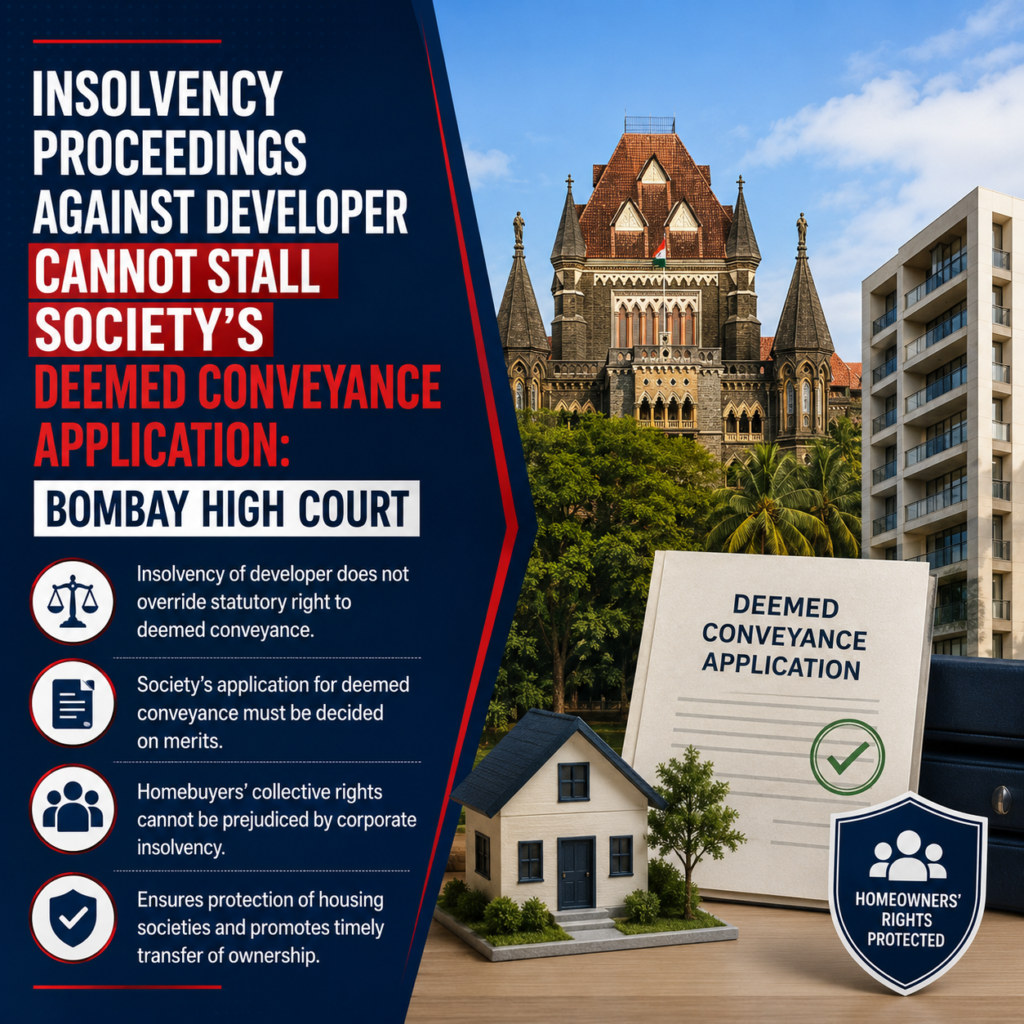
Bombay High Court Restores Society’s Deemed Conveyance Application Rejected Due to Developer’s Insolvency
Facts
Darshan Mandir Co-operative Housing Society Limited was formed by purchasers of flats in a building situated at Borivali West, Mumbai.
The original landowner, Gautam Builders (India), had entered into a development agreement with Darshan Enterprises in 1983. Darshan Enterprises constructed the building, sold the flats and executed agreements with the purchasers under the Maharashtra Ownership Flats Act, 1963.
The society was registered in 1991, and the building received its Occupancy Certificate in 2001.
Under the agreements with the flat purchasers, the developer had undertaken to procure conveyance of the land and building in favour of the society. However, no conveyance was executed.
The society later learnt that Vas Infrastructure Limited claimed to have acquired rights in the property and intended to use transfer of development rights arising from the land.
The society filed a civil suit challenging the subsequent conveyance and initially sought conveyance of the property. It later deleted the conveyance relief from the suit and filed a separate application under Section 11 of MOFA for unilateral deemed conveyance.
Meanwhile, Canara Bank initiated Corporate Insolvency Resolution Proceedings against Vas Infrastructure Limited under the Insolvency and Bankruptcy Code, 2016. The NCLT admitted the insolvency petition, appointed an Interim Resolution Professional and imposed a moratorium under Section 14 of the IBC.
The Interim Resolution Professional opposed the society’s deemed conveyance application.
The Competent Authority rejected the application solely because insolvency proceedings were pending. It granted liberty to the society to apply again after conclusion of the CIRP or after obtaining permission from the NCLT.
The society challenged that order before the Bombay High Court.
Issues
- Whether the pendency of Corporate Insolvency Resolution Proceedings against a promoter or subsequent purchaser prevents the Competent Authority from deciding a deemed conveyance application under Section 11 of MOFA.
- Whether the moratorium under Section 14 of the IBC bars grant of unilateral deemed conveyance.
- Whether deemed conveyance amounts to transfer or alienation of an asset of the corporate debtor.
- Whether the society was required to approach the NCLT under Section 60(5) of the IBC before pursuing its application.
- Whether the statutory obligation to convey land and building under MOFA survives insolvency proceedings.
Petitioner’s Arguments
The society argued that the Competent Authority had wrongly refused to exercise jurisdiction under Section 11 of MOFA.
It submitted that mere pendency of CIRP could not suspend the statutory right of flat purchasers to obtain conveyance.
The society contended that Vas Infrastructure was not the original developer. The original promoter was Darshan Enterprises, which had constructed the building, executed agreements with flat purchasers and undertaken the obligation to convey the property.
According to the society, the subsequent conveyance in favour of Vas Infrastructure was itself under challenge and could not defeat the rights created in favour of flat purchasers under MOFA.
The society argued that the promoter was under both a contractual and statutory duty to convey the land and building.
It submitted that proceedings for deemed conveyance were not recovery proceedings and did not seek enforcement of any monetary claim against the corporate debtor.
The Competent Authority merely performs the statutory act that the promoter had failed to perform.
It was further argued that MOFA is a welfare legislation intended to protect flat purchasers and prevent promoters from indefinitely retaining title to exploit future FSI or TDR.
The society sought setting aside of the rejection order and restoration of its deemed conveyance application.
Respondent’s Arguments
The Interim Resolution Professional argued that Vas Infrastructure had stepped into the shoes of the promoter after acquiring rights in the property.
It was submitted that Section 14 of the IBC prohibited:
- institution or continuation of proceedings against the corporate debtor;
- transfer or alienation of its assets;
- enforcement of security interests; and
- recovery of property in its possession.
According to the respondent, grant of deemed conveyance would transfer property belonging to the corporate debtor and would therefore violate the moratorium.
The respondent also relied on Section 238 of the IBC, which gives the Code overriding effect over inconsistent laws.
It was argued that IBC would prevail over MOFA in the event of conflict.
Alternatively, the respondent submitted that the society could approach the NCLT under Section 60(5) of the IBC and seek exclusion of the property from the insolvency estate.
It was further contended that the society was not left without a remedy because it could file a fresh application after completion of the insolvency process.
Analysis of the Law
The Court examined Section 11 of MOFA, Section 14 of the IBC and the relationship between statutory duties under welfare legislation and insolvency proceedings.
Statutory Duty Under MOFA
Section 11(1) of MOFA imposes a mandatory obligation on the promoter to perfect title and convey the promoter’s right, title and interest in the land and building to the society or association of flat purchasers.
Rule 9 of the Maharashtra Ownership Flats Rules requires execution of conveyance within the prescribed period.
Where the promoter fails to perform that duty, Sections 11(3) to 11(5) permit the society to obtain unilateral deemed conveyance through the Competent Authority.
The deemed conveyance mechanism was introduced to address widespread failure by developers to transfer title and their practice of retaining land to exploit future development potential.
Scope of the IBC Moratorium
Section 14 of the IBC prohibits certain proceedings and dealings involving the corporate debtor during the moratorium.
However, the Court distinguished between:
- proceedings for recovery of money or enforcement of debt; and
- statutory proceedings undertaken to enforce public or welfare obligations.
A deemed conveyance application is not a debt-recovery action. It does not seek payment from the corporate debtor.
It is a statutory process intended to perfect title in favour of persons who have already purchased the flats and acquired corresponding rights in the land and building.
Whether Deemed Conveyance Transfers a Corporate Asset
The Court held that once a developer constructs the building, sells all flats and forms a society, the developer’s title in the land is substantially diluted or divested.
The promoter cannot exploit the development potential, sell all the flats and yet continue to claim full ownership of the land.
The act of deemed conveyance does not necessarily transfer an unencumbered asset belonging to the corporate debtor.
It formally records and perfects rights that have already accrued to the flat purchasers under MOFA.
Harmonious Construction of MOFA and IBC
Section 238 of the IBC applies only where there is a genuine and irreconcilable inconsistency between the IBC and another law.
The Court found no such conflict.
The IBC protects the insolvency process and the value of the corporate debtor’s assets, while MOFA protects flat purchasers and compels developers to perform statutory conveyance obligations.
Both statutes could operate simultaneously.
Precedent Analysis
Santoshkumar Motilal Bhansali v. Competent Authority
The Court relied directly on this Bombay High Court decision, which held that Section 14 of the IBC does not bar a Competent Authority from exercising powers under Section 11 of MOFA.
The decision recognised that deemed conveyance is not a monetary claim or recovery proceeding but enforcement of a statutory obligation in specie.
It held that statutory rights of flat purchasers and statutory duties of authorities continue despite insolvency or moratorium.
Anudan Properties Private Limited v. Mumbai Metropolitan Region Slum Rehabilitation Authority
This judgment examined the interaction between the IBC and the Maharashtra Slum Areas Act.
It held that insolvency proceedings do not immunise a developer from non-monetary regulatory consequences under welfare legislation.
The Court drew a distinction between monetary claims, which may be frozen or extinguished under insolvency law, and statutory or regulatory obligations, which continue to operate.
The Supreme Court had dismissed the Special Leave Petition against this decision.
Arunkumar H. Shah HUF v. Avon Arcade Premises Co-operative Housing Society Limited
The Supreme Court recognised that a certificate of deemed conveyance does not finally determine every question of title.
An aggrieved promoter or claimant may still institute a civil suit and establish independent title over any portion of the property.
The Bombay High Court relied on this principle to hold that deemed conveyance does not cause irreversible prejudice to the corporate debtor.
Alchemist Asset Reconstruction Co. Ltd. v. Hotel Gaudavan Pvt. Ltd.
The respondent relied on this judgment concerning arbitration proceedings initiated during the IBC moratorium.
The Court distinguished it because arbitration is an adversarial proceeding against the corporate debtor, whereas a deemed conveyance application is a statutory mechanism activated by the promoter’s failure to perform a duty.
Tata Consultancy Services Ltd. v. SK Wheels Pvt. Ltd.
The respondent relied on this judgment to argue that the NCLT could decide disputes concerning property of the corporate debtor under Section 60(5) of the IBC.
The Court held that the society was not required to approach the NCLT because the Competent Authority remained legally empowered to decide the deemed conveyance application.
Court’s Reasoning
The Court noted that Darshan Enterprises, and not Vas Infrastructure, was the original promoter.
Darshan Enterprises had constructed the building, sold the flats and undertaken the obligation to convey the property to the society.
Nearly the entire development potential of the land had already been utilised. Only a negligible portion of built-up area remained unused.
The Court observed that it was highly questionable what enforceable proprietary rights remained for Vas Infrastructure to acquire.
Prima facie, Vas Infrastructure had acquired property that was already statutorily required to be conveyed to the society.
The Court held that a purchaser who steps into the shoes of the original promoter also takes over the promoter’s statutory obligations.
It could not rely on its own insolvency proceedings to defeat the society’s pre-existing statutory rights.
The Court emphasised that the purpose of deemed conveyance was to prevent developers from indefinitely withholding title in the hope of exploiting future FSI, TDR or changes in development regulations.
Allowing the IBC moratorium to suspend such proceedings would enable defaulting developers to misuse insolvency law and indefinitely delay conveyance.
The Court also highlighted the practical consequences for ageing buildings in Mumbai.
Societies often require title to undertake redevelopment. Denying deemed conveyance merely because a developer is under CIRP could prevent redevelopment of dangerous or dilapidated buildings and place occupants at risk.
The Competent Authority was therefore required to decide the society’s application on merits.
The Court clarified that it was not granting deemed conveyance itself and was not finally deciding the competing title claims.
All parties, including the IRP, remained free to raise their objections before the Competent Authority.
Conclusion
The Bombay High Court allowed the society’s writ petition and set aside the Competent Authority’s order dated 4 September 2025.
The Court restored the society’s deemed conveyance application and directed the Competent Authority to decide it expeditiously on its own merits.
The Court held that:
- pendency of CIRP does not suspend the statutory duty to convey property under MOFA;
- the moratorium under Section 14 of the IBC does not bar adjudication of a deemed conveyance application;
- deemed conveyance is not a debt-recovery proceeding;
- it does not necessarily amount to alienation of an asset of the corporate debtor;
- Section 238 of the IBC does not override MOFA because the two statutes are not irreconcilably inconsistent;
- the society need not first approach the NCLT under Section 60(5); and
- all objections concerning the extent of conveyance and title must be decided by the Competent Authority on merits.
Case Details
Case: Darshan Mandir Co-operative Housing Society Limited v. District Deputy Registrar, Co-operative Societies, Mumbai & Others
Court: Bombay High Court
Case Number: Writ Petition No. 16318 of 2025
Judge: Justice Sandeep V. Marne
Date: 22 June 2026
Result: Rejection of deemed conveyance application set aside; application restored for fresh and expeditious decision on merits