

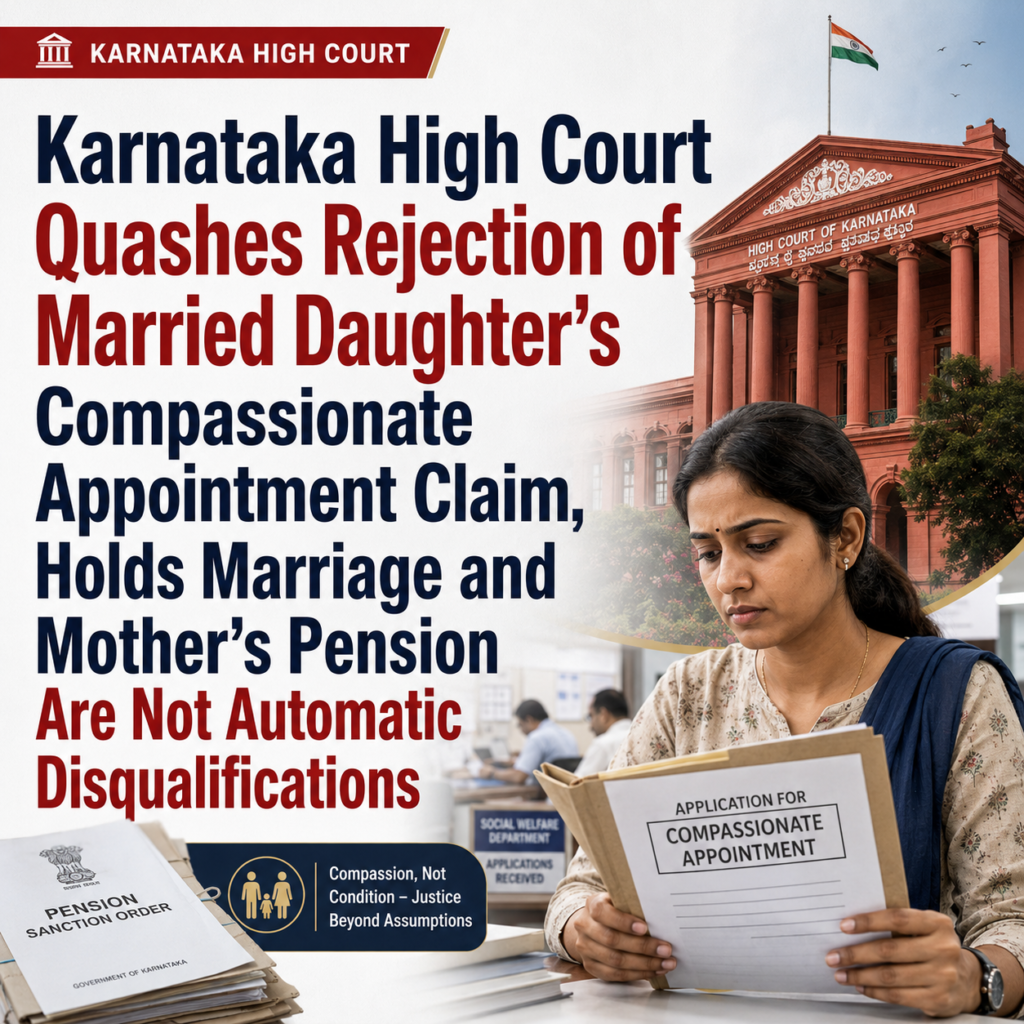
Marriage Is Not an Automatic Disqualification for Compassionate Appointment: Karnataka High Court
Facts
The petitioner, Smt. Savitha R., was the daughter of a Group-D government employee who worked as a Cook at the Pre-Matric ST Boys’ Hostel, Nelagatenahatti, Challakere Taluk.
Her father died while in service on 25 February 2014.
The petitioner applied for appointment on compassionate grounds on 27 December 2014, within the prescribed period under the Karnataka Civil Services (Appointment on Compassionate Grounds) Rules, 1996.
At the time of her father’s death and at the time of her application, the petitioner was married.
Under the unamended 1996 Rules, a married daughter was not included within the definition of the family member eligible for compassionate appointment.
By an endorsement dated 12 March 2021, the authorities rejected the petitioner’s request on two grounds:
- she was a married daughter; and
- her mother was a retired government servant receiving pension.
Meanwhile, the 1996 Rules were amended by notification dated 9 April 2021. The amended definition of “family” included daughters who were unmarried, married, divorced or widowed, provided they had been dependent upon and living with the deceased government servant.
The petitioner challenged the rejection before the Karnataka State Administrative Tribunal.
Although the Tribunal recognised that a married daughter could be entitled to compassionate appointment, it nevertheless rejected her application by an order dated 21 January 2022.
The petitioner then approached the Karnataka High Court under Articles 226 and 227 of the Constitution.
Issues
- Whether the petitioner’s application for compassionate appointment could be rejected solely because she was a married daughter.
- Whether the 2021 amendment including married daughters within the definition of “family” applied to the petitioner’s pending claim.
- Whether an amendment made by substitution must be read as if it formed part of the Rules from their inception.
- Whether the pension received by the petitioner’s mother automatically disqualified the petitioner from compassionate appointment.
- Whether the Tribunal was justified in rejecting the application despite recognising that married daughters are eligible.
- Whether the authorities were required to reconsider the petitioner’s dependency and family income under Rules 4, 5 and 6 of the 1996 Rules.
Petitioner’s Arguments
The petitioner argued that the 2021 amendment to the Karnataka Civil Services (Appointment on Compassionate Grounds) Rules expressly included married daughters within the definition of “family.”
According to her, the amendment was made by substitution and not merely by insertion.
She contended that a substituted provision must be read as if it had existed from the date the original Rules came into force.
Therefore, her application could not be rejected merely because she was married at the time of her father’s death.
The petitioner further argued that the authorities had wrongly rejected her claim merely because her mother was a retired government employee receiving pension.
She submitted that the authorities were required to assess the family’s income and financial condition under Rule 4 and the other eligibility conditions under Rules 5 and 6.
The mere fact that her mother received pension did not automatically establish that the family was free from financial hardship.
The petitioner therefore sought quashing of the Tribunal’s order and the rejection endorsement, with a direction to reconsider her claim.
Respondent’s Arguments
The State opposed the petition.
It argued that when the petitioner’s father died in 2014 and when she applied for compassionate appointment, the Rules did not permit appointment of a married daughter.
The petitioner’s request had also been rejected before the amended provision came into force.
According to the State, the subsequent amendment could not be applied retrospectively to revive or validate her claim.
The State further argued that the petitioner was not entitled to compassionate appointment because her mother was a retired government servant receiving pension.
It therefore sought dismissal of the writ petition.
Analysis of the Law
Nature of Compassionate Appointment
The Court reiterated that compassionate appointment is not a matter of inheritance or an automatic right.
It is a special exception to the normal recruitment process, intended to provide immediate financial assistance to the dependent family of a government employee who dies in service.
Eligibility must therefore be examined under the applicable statutory Rules.
However, once the Rules recognise a category of dependent family member, the claim cannot be rejected on a ground inconsistent with those Rules or constitutional equality.
2021 Amendment Including Married Daughters
The 2021 amendment substituted the earlier definition of “family” with a wider definition expressly including a daughter who was:
- unmarried;
- married;
- divorced; or
- widowed,
provided she was dependent upon and living with the deceased government servant.
The Court emphasised that the amendment was made by way of substitution.
A substitution ordinarily removes the earlier provision and replaces it with the new provision as though the substituted language had formed part of the Rules from the beginning, unless a contrary intention appears.
On that basis, the Court held that the petitioner’s claim could not be rejected merely because she was married.
Distinction Between Substitution and Insertion
The State relied on the principle that compassionate appointment claims are ordinarily considered under the Rules in force on the date of death of the government employee.
The Court distinguished the present amendment from an earlier amendment examined by the Supreme Court.
The earlier amendment had merely inserted additional words. Such an insertion was prospective.
The 2021 amendment, however, substituted the definition itself.
The Court held that this distinction was legally significant.
Because the amendment operated by substitution, the revised definition had to be applied to the petitioner’s claim.
Constitutional Position on Married Daughters
The judgment referred to the earlier Karnataka High Court decision in Smt. Bhuvaneshwari V. Puranik v. State of Karnataka, which had held that excluding married daughters from compassionate appointment was unconstitutional.
The 2021 amendment was introduced in that legal background.
The Court therefore found that a married daughter could not be disqualified merely on the assumption that marriage ended her dependency upon her parental family.
Actual dependency and residence had to be examined.
Effect of Mother’s Pension
The Court rejected the proposition that the petitioner was automatically ineligible merely because her mother was a retired government employee and received pension.
The relevant inquiry was whether the family crossed the income limit and whether the petitioner fulfilled the conditions under Rules 4, 5 and 6.
The authorities were required to calculate and assess the relevant family income in accordance with the Rules.
A pension could be a relevant financial factor, but it was not by itself an automatic statutory disqualification.
Scope of Judicial Review
The Tribunal had accepted the legal proposition that a married daughter was eligible for compassionate appointment but had still rejected the petitioner’s claim without giving adequate reasons.
The High Court held that such an unexplained conclusion was unsustainable.
Where an administrative or judicial authority accepts the governing legal principle but reaches a contrary conclusion without proper reasoning, the order is vulnerable to judicial review.
Precedent Analysis
Smt. Bhuvaneshwari V. Puranik v. State of Karnataka
This decision held that excluding married daughters from the benefit of compassionate appointment was unconstitutional.
It formed the legal background for the 2021 amendment to the Rules.
The present Court relied on that principle to reject marital status as an automatic disqualification.
W.P. No. 15961 of 2022, Decided on 23 August 2024
A Coordinate Bench had considered the same 2021 amendment and held that it was made by substitution.
It concluded that married daughters were entitled to consideration for compassionate appointment under the amended Rules.
The Court directly relied upon this decision and directed the respondents to reconsider Savitha’s case in its light.
Smt. Latha H.R. Case
In this case, the Karnataka High Court held that rejection of a compassionate appointment request solely because the applicant was a married daughter could not be sustained.
The Court noted that the earlier exclusion had been struck down and the Rules had subsequently been amended by substituting “unmarried daughter” with “daughter.”
The present Bench followed this reasoning.
State of Karnataka v. C.N. Apporva Shree / Bheemesh Principle
The State relied on the principle that eligibility for compassionate appointment is generally determined by the Rules existing on the date of death of the government servant.
The Court distinguished that line of authority because the amendment examined there was made by insertion, whereas the 2021 amendment involved substitution.
The ratio concerning a prospective insertion was therefore held inapplicable.
Court’s Reasoning
The Court found that the petitioner had applied within time after her father’s death.
The only principal grounds used to reject her claim were her marital status and her mother’s pension.
The Court held that neither ground justified outright rejection.
The 2021 amendment expressly included married daughters, and the amendment was made by substitution.
Accordingly, the petitioner was entitled to have her claim considered as a daughter under the amended definition.
The Court also observed that the Tribunal itself had accepted that married daughters could be considered but had nevertheless rejected the petitioner’s application without explaining why she was ineligible.
This amounted to a serious error.
Regarding the mother’s pension, the Court held that the authorities had to apply the income and dependency conditions prescribed under the Rules.
They could not reject the claim merely by noting that the mother was a retired government servant.
The petitioner’s entitlement to actual appointment was not finally decided.
Instead, the Court directed the authorities to reconsider her claim under Rules 4, 5 and 6, including dependency, family income and other eligibility conditions.
Conclusion
The Karnataka High Court allowed the writ petition.
It set aside the Karnataka State Administrative Tribunal’s order dated 21 January 2022.
It also quashed the rejection endorsement dated 12 March 2021.
The Court held that the petitioner’s request could not be rejected merely because she was a married daughter or because her mother was receiving government pension.
The respondents were directed to reconsider the petitioner’s claim for compassionate appointment in light of the law applicable to married daughters and under Rules 4, 5 and 6 of the Karnataka Civil Services (Appointment on Compassionate Grounds) Rules, 1996.
The reconsideration was directed to be completed within three months.
Case: Smt. Savitha R. v. State of Karnataka & Others
Court: High Court of Karnataka at Bengaluru
Case Number: Writ Petition No. 3765 of 2022 (S-KSAT)
Judge: Justice S.G. Pandit and Justice Rajesh Rai K.
Date: 15 June 2026
Result: Writ petition allowed; Tribunal order and rejection endorsement quashed, with a direction to reconsider the married daughter’s compassionate appointment claim within three months.

READ ALSO: Allahabad High Court Sets Aside POSH Censure Order, Directs Fresh ICC Decision on Delayed Complaints