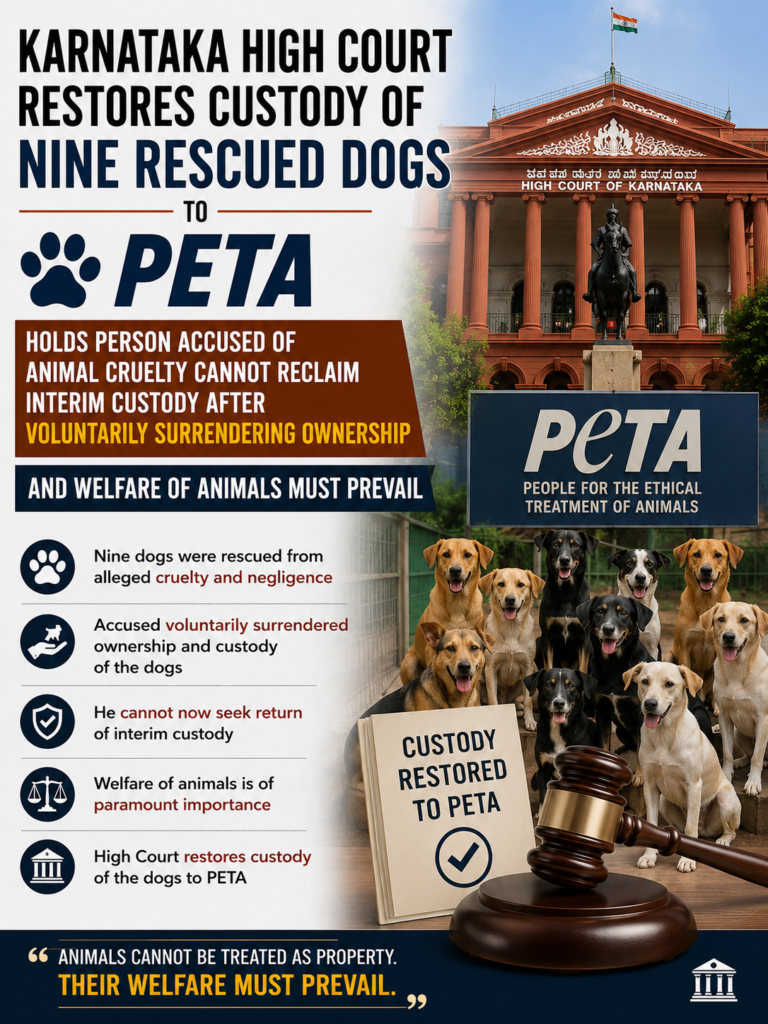
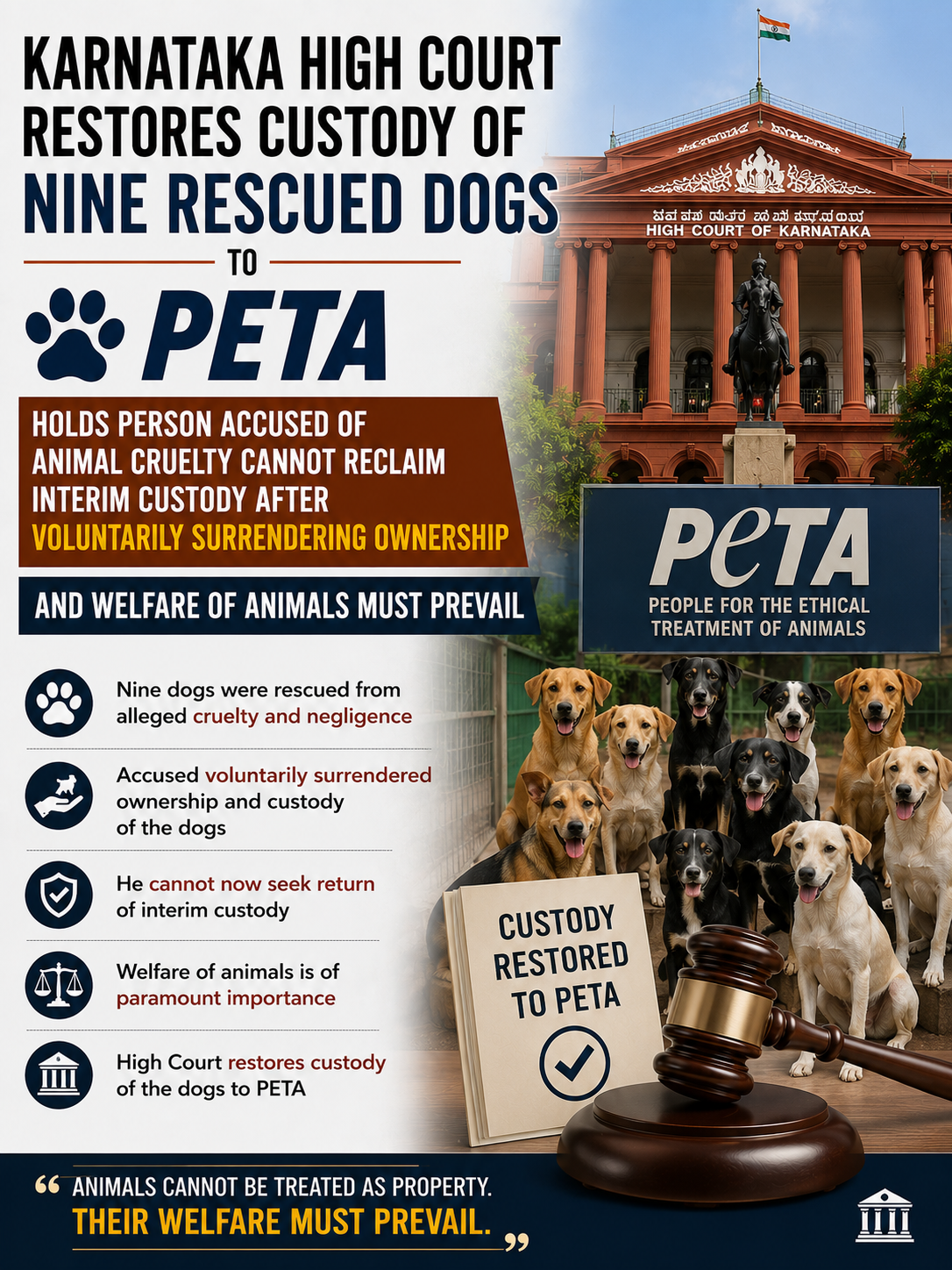
Animals Are Not Mere Property, Karnataka High Court Holds While Allowing PETA to Retain Custody of Nine Rescued Dogs During Animal Cruelty Investigation
Facts
People for the Ethical Treatment of Animals India (“PETA India”) received information that nine dogs—six Golden Retrievers and three Shih Tzus—kept by the second respondent were allegedly being subjected to repeated cruelty, neglect and unlawful breeding practices.
On 15 February 2026, PETA India lodged a complaint before Peenya Police Station. It alleged that the dogs were regularly mistreated, kept in inadequate and unhygienic conditions and subjected to other serious forms of abuse. PETA also alleged that the second respondent was operating an unregistered dog-breeding and sale facility in violation of the Prevention of Cruelty to Animals Act, 1960 and the rules governing dog breeding and pet shops.
Crime No. 89 of 2026 was registered for offences under Sections 325 and 62 of the Bharatiya Nyaya Sanhita, 2023 and Section 11(1) of the Prevention of Cruelty to Animals Act.
During the investigation, the dogs were rescued and placed under PETA’s care for treatment and rehabilitation.
The second respondent thereafter executed separate animal-relinquishment documents for all nine dogs. In those documents, he:
- voluntarily surrendered their ownership and custody to PETA;
- stated that he was unable to properly care for them;
- acknowledged that the animals had been subjected to cruelty and were in poor condition;
- agreed that PETA would thereafter be treated as their owner and guardian; and
- declared that he would have no future claim over their housing, treatment, rehabilitation or adoption.
Despite the relinquishment, the second respondent filed an application under Sections 497 and 503 of the Bharatiya Nagarik Suraksha Sanhita, 2023, seeking interim custody of the dogs.
By an order dated 25 April 2026, the XXXI Additional Chief Judicial Magistrate, Bengaluru, allowed the application and directed that all nine dogs be returned to the second respondent, subject to conditions including execution of a bond, installation of CCTV surveillance and periodic submission of CCTV footage.
PETA approached the Karnataka High Court under Section 482 of the Code of Criminal Procedure, corresponding to Section 528 of the BNSS, challenging the Magistrate’s order and seeking continued custody of the rescued dogs.
Issues
- Whether the Magistrate was justified in granting interim custody of the rescued dogs to the second respondent while serious allegations of animal cruelty were under investigation.
- Whether the second respondent could claim interim custody after voluntarily executing documents relinquishing ownership and all future rights over the dogs.
- Whether the alleged owner’s proprietary claim should prevail over the safety, welfare and rehabilitation of the animals.
- Whether the Magistrate adequately considered the second respondent’s admissions contained in the relinquishment documents.
- Whether conditions such as CCTV monitoring could sufficiently protect the dogs after returning them to the person accused of mistreating them.
- Whether the Magistrate’s reliance upon precedents concerning interim custody of seized animals was appropriate in the peculiar facts of the case.
- Whether animals should be treated merely as property for interim-custody purposes or as sentient living beings entitled to protection from cruelty.
Petitioner’s Arguments
PETA argued that the Magistrate’s order was fundamentally erroneous because it directed the rescued dogs to be returned to the very person accused of subjecting them to cruelty.
It submitted that when animals are rescued from an allegedly abusive environment, their interim custody should ordinarily remain with an animal-welfare organisation capable of providing:
- veterinary treatment;
- rehabilitation;
- safe housing;
- proper nutrition; and
- protection against further cruelty.
PETA emphasised that the second respondent had voluntarily executed relinquishment documents surrendering the ownership and custody of all nine dogs.
Those documents expressly stated that:
- he had failed in his responsibility as their guardian;
- he was incapable of looking after them;
- the dogs were injured and in poor condition;
- PETA would thereafter be responsible for their care and welfare; and
- he would have no future claim over them.
PETA argued that these were not merely temporary custody receipts. They were express and voluntary transfers of ownership and custodial rights.
It was submitted that the Magistrate failed to appreciate the seriousness of the allegations, the pending investigation and the contents of the relinquishment documents.
PETA further argued that returning the animals subject to CCTV monitoring would not adequately protect them. Surveillance after restoring custody could not substitute for removing the animals from an environment in which they were allegedly exposed to sustained mistreatment.
The petitioner therefore sought quashing of the Magistrate’s order and continuation of the dogs’ custody, treatment and rehabilitation under PETA’s supervision.
Respondent’s Arguments
Second Respondent
The second respondent denied the allegations and submitted that they were imaginary and unsupported by a written complaint from the neighbour who had allegedly supplied the information to PETA.
He contended that he lived alone and had raised the nine dogs as companions. According to him, the dogs were healthy and properly cared for while in his possession.
It was argued that he remained their original owner and was entitled to seek interim custody during the pendency of the criminal proceedings.
The second respondent relied upon the Magistrate’s order and submitted that the safeguards imposed by it were adequate. Those conditions included:
- an indemnity bond of ₹5 lakh;
- a prohibition against transferring or alienating the dogs;
- preservation of their identity;
- production of the dogs before the police or Court when required;
- a direction not to subject them to cruelty;
- keeping them in premises covered by CCTV; and
- submission of CCTV footage every 15 days.
He therefore contended that the High Court should not interfere with the discretionary order granting him interim custody.
State of Karnataka
The State supported PETA’s challenge.
It submitted that the dogs should remain with an organisation capable of ensuring their treatment and rehabilitation, particularly while serious allegations against the second respondent remained under investigation.
The State opposed returning the dogs to the second respondent before the investigation reached its conclusion.
Analysis of the Law
Interim custody is not determined by ownership alone
The Court held that interim custody of animals cannot be treated in the same manner as the release of ordinary movable property.
Although provisions concerning custody of seized property may permit a person claiming ownership to seek interim possession, the Court deciding such an application must consider the nature of the property and the risks associated with returning it.
Animals are living and sentient beings. Their welfare, safety and capacity to experience suffering are therefore central considerations.
A claim of ownership cannot automatically override the need to protect an animal from further cruelty.
Effect of the relinquishment documents
The relinquishment documents were of decisive significance.
The second respondent had voluntarily surrendered the ownership and custody of all nine dogs to PETA. He had also declared that PETA would thereafter be treated as their owner and would have complete authority concerning their:
- veterinary care;
- housing;
- rehabilitation;
- adoption; and
- general welfare.
The documents further stated that the second respondent would have no future ownership or claim over them.
The Court held that these declarations could not be ignored while deciding his subsequent request for interim custody.
A person who had expressly relinquished all rights over the dogs could not be treated as an undisputed owner entitled to their return merely because they had originally been recovered from his premises.
Admissions concerning treatment of the dogs
The Court regarded the statements made in the relinquishment documents as particularly serious.
The second respondent had acknowledged that:
- the dogs had been subjected to cruelty;
- some of them were injured and in poor condition;
- he had failed to ensure their safety and protection; and
- he was incapable of properly caring for them.
The Court treated these statements as materially inconsistent with his later claim that the allegations were fabricated and that the dogs were healthy and properly maintained under his care.
While the final determination of criminal liability remained part of the pending investigation and trial, the admissions were directly relevant to the question of safe interim custody.
Welfare must govern animal-custody decisions
The Court held that the principal consideration in determining interim custody must be the animals’ safety and welfare.
The objective of the Prevention of Cruelty to Animals Act is to prevent unnecessary pain and suffering. An interim-custody order should advance that objective rather than expose rescued animals to the risk of returning to the allegedly harmful environment.
The Court rejected a purely proprietary approach under which animals were treated merely as items to be returned to the person from whose possession they were taken.
Conditions imposed by the Magistrate were inadequate
The Magistrate attempted to address the prosecution’s concerns by directing CCTV monitoring and prohibiting future cruelty.
The High Court found this approach legally and practically unsatisfactory.
Conditions requiring a person not to commit cruelty could not justify restoring animals to that person when:
- the investigation into cruelty was still pending;
- the animals had already been rescued;
- the person had voluntarily surrendered them;
- the relinquishment documents contained admissions of mistreatment; and
- PETA was already providing care and rehabilitation.
CCTV footage submitted periodically to the Court would be a post-event monitoring mechanism. It could not guarantee that the animals would remain safe after being returned.
Protection of animals as sentient beings
The Court observed that animals may be incapable of human speech, but they are capable of experiencing pain, fear and suffering.
Modern law no longer regards animals solely as chattels existing for human use. They are living beings entitled to dignity, compassion and protection from cruelty.
The Court connected animal welfare with constitutional morality and stated that protection of animal life is not an act of charity. It is part of the legal and moral obligation of a civilised society towards voiceless living beings.
Scope of Section 528 of the BNSS
The High Court exercised its inherent jurisdiction because the Magistrate’s order resulted in a grave failure to protect the animals and ignored material documents bearing directly upon custody.
Interference was warranted to:
- prevent injustice;
- protect the subject matter of the criminal proceedings;
- ensure that the statutory object of animal-protection legislation was not defeated; and
- safeguard the rescued animals during the investigation.
Precedent Analysis
Manager, Pinjrapole Deudar v. Chakram Moraji Nat
The Magistrate relied upon this Supreme Court decision for the proposition that an owner facing prosecution under the Prevention of Cruelty to Animals Act is not automatically barred from seeking interim custody unless deprived of ownership in accordance with law.
The High Court found that this general proposition could not justify the order passed in the present case.
The second respondent’s case was materially different because he had voluntarily executed written relinquishment documents surrendering all ownership and custodial rights to PETA. The issue was therefore not merely whether an accused owner could ordinarily seek custody before conviction.
The Court also had before it the second respondent’s written statements concerning his inability to care for the dogs and his failure to protect them. Those facts required the welfare of the animals to prevail over the earlier ownership claim.
Vittal Sathyappa Pujeri v. State of Karnataka
The Magistrate also referred to this Karnataka High Court decision, which had considered the Supreme Court’s observations in Manager, Pinjrapole Deudar while dealing with interim custody of animals.
The High Court held, in substance, that such decisions could not be applied mechanically without examining the factual circumstances of the custody claim.
Unlike a routine case involving a continuing ownership claim, the present case involved:
- serious allegations of cruelty;
- an ongoing criminal investigation;
- voluntary surrender of the animals;
- express relinquishment of ownership;
- admissions concerning their condition; and
- their existing placement with an animal-welfare organisation.
The cited authorities therefore did not justify restoring custody to the second respondent.
Court’s Reasoning
The Court found the Magistrate’s approach fundamentally inconsistent with both the record and the object of animal-protection law.
The most important circumstance was that the second respondent had voluntarily surrendered all nine dogs to PETA through formal relinquishment documents.
The Magistrate nevertheless proceeded on the basis that:
- the second respondent remained the owner;
- there was no rival ownership claim; and
- the dogs had merely been seized from his possession.
The High Court found that this reasoning ignored the transfer of custody and ownership recorded in the relinquishment documents.
The Court was particularly concerned that the Magistrate had returned the animals despite:
- allegations of sustained cruelty;
- the pending investigation;
- the second respondent’s own written acknowledgments;
- his declared inability to care for them; and
- the availability of an animal-welfare organisation already providing rehabilitation.
It held that the order suffered not merely from a legal error but from a failure to exercise the degree of judicial sensitivity required in animal-welfare cases.
The Court clarified that the merits of the criminal allegations were still under investigation. It did not finally convict or declare the second respondent criminally liable.
However, the interim-custody question had to be resolved on the available material and by prioritising the safety of the animals.
Since returning the dogs created an avoidable risk of further harm, while continuing PETA’s custody ensured treatment and rehabilitation, there was no justification for disturbing the existing protective arrangement.
Conclusion
The Karnataka High Court allowed PETA India’s criminal petition.
It quashed the order dated 25 April 2026 passed by the XXXI Additional Chief Judicial Magistrate, Bengaluru, granting interim custody of the dogs to the second respondent.
The Court directed that:
- all nine rescued dogs—six Golden Retrievers and three Shih Tzus—would continue to remain in their existing place of care;
- PETA would continue to act as their guardian;
- PETA would ensure their rehabilitation, medical treatment and welfare; and
- the arrangement would remain subject to the ultimate result of the criminal investigation.
The Court held that restoring custody to a person who had voluntarily surrendered the animals and was facing serious allegations of cruelty was legally unsustainable and contrary to the welfare and protection of the animals.
Case: People for the Ethical Treatment of Animals India v. State of Karnataka and Another
Court: High Court of Karnataka at Bengaluru
Case Number: Criminal Petition No. 7003 of 2026
Judge: Justice M. Nagaprasanna
Date: 24 June 2026
Result: Petition allowed; Magistrate’s order granting interim custody of the nine rescued dogs to the second respondent quashed, and PETA directed to continue their guardianship, rehabilitation, medical care and welfare subject to the result of the investigation.