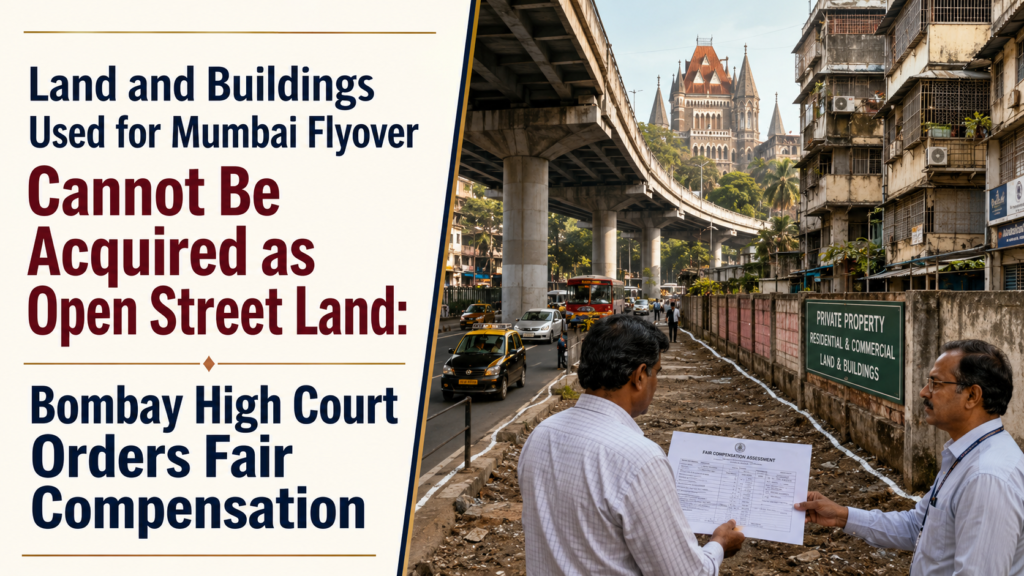
BMC Demolished Goregaon Properties for Flyover but Paid Reduced Compensation; Bombay High Court Orders Fresh Acquisition Under 2013 Land Acquisition Act
Facts
The dispute concerned land, buildings and structures situated at Village Goregaon, Taluka Malad, Mumbai, which were taken over and used for constructing a road, overbridge or flyover.
The petitioners in Writ Petition No. 1173 of 2016, led by Rohan J. Tiwari, claimed leasehold rights in the land and structures. Their predecessors had been recognised as lessees or tenants under consent terms filed before the Bombay High Court in 1971.
The petitioners in Writ Petition No. 414 of 2023, J.D. and Company Private Limited and others, claimed ownership rights over the same land.
On 8 October 2013, the Municipal Corporation of Greater Mumbai informed the lessees that a portion of the property would be affected by the proposed flyover. They were asked to indicate whether they preferred monetary compensation, Transferable Development Rights or relocation of the affected premises.
The petitioners responded that they would permit construction only after receiving compensation.
On 8 February 2016, BMC officials allegedly entered the property and began demolishing the structures. The lessees urgently approached the Bombay High Court, which initially restrained further demolition.
The interim restraint was subsequently vacated because the public infrastructure project could not be halted. The Court directed BMC to determine the compensation and deposit 50% of that amount. It also permitted the petitioners to seek higher compensation in accordance with law.
The affected land and structures were thereafter handed over to BMC, and construction of the flyover was completed.
BMC initially calculated compensation at ₹3,98,28,600 and deposited ₹2 crore, which the lessees withdrew without prejudice to their right to seek higher compensation.
The Deputy Municipal Commissioner subsequently passed a fresh order dated 11 June 2018. Compensation was calculated using ready-reckoner rates, followed by several deductions:
- 40% towards the cost of land;
- 25% towards the State Government’s alleged interest;
- A further reduction because the petitioners were treated as tenants; and
- ₹10 lakh towards the demolished structures.
After applying these deductions and adding solatium, the Deputy Municipal Commissioner determined that ₹2,17,97,650 was payable.
The lessees challenged this calculation. They contended that BMC had wrongly relied upon Sections 298 to 301 of the Mumbai Municipal Corporation Act, 1888.
The owners filed a separate writ petition challenging the same order. They argued that compensation had been determined and apportioned without giving them an opportunity to be heard.
Both groups contended that BMC should have formally acquired the land and buildings under Section 296 read with Section 91 of the MMC Act and the Right to Fair Compensation and Transparency in Land Acquisition, Rehabilitation and Resettlement Act, 2013.
Issues
- Whether BMC could acquire the land and structures under Sections 298 to 301 of the MMC Act merely because they fell within the regular line of a public street.
- Whether Section 299 of the MMC Act applies where independent buildings stand on the land required for a road or flyover.
- Whether the land and buildings should have been formally acquired under Section 296 read with Section 91 of the MMC Act and the 2013 Land Acquisition Act.
- Whether the Deputy Municipal Commissioner’s order calculating compensation under Section 301 of the MMC Act was legally sustainable.
- Whether the property owners’ exclusion from the compensation proceedings violated principles of natural justice.
- Whether the petitioners were entitled to rental compensation for the period after BMC took possession.
- Whether the dispute between the owners and lessees concerning apportionment of compensation had to be decided in the present proceedings.
Petitioner’s Arguments
Arguments of the Lessees
The lessees argued that Section 299 of the MMC Act applies only to:
- Open land situated within the regular line of a public street and not occupied by a building; or
- A platform, verandah, step or similar external structure attached to a building.
Their property was occupied by complete and independent buildings. It was not merely an open plot, platform, verandah, step or external projection.
Therefore, BMC could not acquire the property under Section 299 or calculate compensation under Section 301.
The lessees submitted that BMC was required to invoke Section 296 of the MMC Act, which deals with the acquisition of land and buildings for opening, widening, extending or improving public streets.
Section 296 had to be read with Section 91, which required acquisition under the applicable land acquisition legislation where the property could not be obtained through agreement. Therefore, compensation had to be determined under the 2013 Act.
The petitioners also argued that the structures were authorised and had existed before the 1962 datum line and before the city survey. BMC had never alleged in its affidavits that they were unauthorised.
They further contended that the deductions applied by the Deputy Municipal Commissioner were arbitrary and unjustified.
Arguments of the Owners
The owners supported the lessees’ contention that BMC had applied the wrong statutory provisions.
They additionally argued that the Deputy Municipal Commissioner had determined and apportioned compensation without hearing them, even though BMC knew that they were the landowners.
This violated the principles of natural justice and independently justified setting aside the compensation order.
The owners reserved their right to dispute the eventual apportionment of compensation between themselves and the lessees after the total amount was properly determined.
Respondent’s Arguments
BMC argued that Sections 298 to 301 of the MMC Act constituted a complete statutory mechanism for acquiring land situated within the regular line of a public street and for determining compensation.
Since the regular street line had been prescribed and the affected property fell within it, BMC contended that the Deputy Municipal Commissioner had correctly applied Section 301.
It relied upon ready-reckoner rates and maintained that all relevant factors had been considered while calculating the compensation.
BMC argued that there was no requirement to acquire the property under Section 296 or apply the 2013 Land Acquisition Act.
It relied upon precedent holding that compensation under Section 301 need not be based upon the market value of the acquired property.
It also attempted to argue that the petitioners had not demonstrated that the demolished structures were authorised and that Section 299 could therefore be invoked.
The remaining respondents supported BMC and sought dismissal of both writ petitions.
Analysis of the Law
Scope of Section 299 of the MMC Act
Section 299 applies only when:
- Land lying within the regular line of a public street is not occupied by a building; or
- A platform, verandah, step or similar external structure attached to a building falls within that line.
The expression “other structure” must be read in the context of the preceding words—platform, verandah and step. It refers to a similar, inessential external structure and not to an independent building.
Therefore, merely establishing that land falls within the regular street line is insufficient. Section 299 becomes inapplicable if the land is occupied by an existing independent building.
Scope of Section 298
Section 298 concerns setting buildings back to the regular street line in specified circumstances.
It applies where:
- A building is proposed to be rebuilt, substantially taken down or altered;
- A building falls down;
- A building burns down; or
- A building is removed under statutory provisions relating to unauthorised or dangerous structures.
None of these conditions existed in the present case. The buildings were demolished by BMC specifically to construct the road and flyover.
Application of Section 301
Section 301 provides compensation only for acquisitions made under Sections 298 or 299.
Since neither provision applied, BMC could not calculate compensation under Section 301.
Acquisition Under Section 296
Section 296 authorises BMC to acquire land and buildings required for opening, widening, extending or otherwise improving a public street.
Where BMC cannot acquire the property by agreement, Section 91 requires the acquisition to proceed under the applicable land acquisition statute.
Since the land and complete buildings were used for the flyover, they had to be acquired under Section 296 read with Section 91 and the 2013 Land Acquisition Act.
Natural Justice
The owners were acknowledged as persons interested in the property but were not heard before compensation was determined and apportioned.
A compensation order affecting their rights could not be passed behind their back. Their exclusion constituted a separate violation of natural justice.
Precedent Analysis
Indian City Properties Ltd. v. Municipal Commissioner of Greater Bombay
The Supreme Court distinguished between a “building” and a “structure” for Section 299 of the MMC Act.
It held that platforms, verandahs, steps and similar external structures are inessential parts attached to a building. An independent permanent structure is a building and cannot be treated as an external structure under Section 299.
The Bombay High Court applied this principle and held that the existence of independent buildings on the petitioners’ land excluded Section 299.
Municipal Corporation of Greater Bombay v. Durgadas Shankarrao Rege
This judgment recognised Sections 297 to 301 as a complete scheme for a particular type of property situated within the regular street line.
However, it expressly stated that acquisition under Sections 298 and 299 is confined to land not occupied by a building or occupied only by a compound wall, platform, verandah, step or comparable external structure.
Other land and buildings must be acquired under Section 296.
The High Court held that this precedent supported the petitioners rather than BMC.
Municipal Corporation of Greater Bombay v. Central Bank of India
The Supreme Court held that compensation under Section 301 is not necessarily equivalent to the market value of the land or building. It is based on the loss or damage caused by the acquisition under Sections 298 or 299.
The High Court found this decision inapplicable because the present dispute concerned whether Sections 298 and 299 applied at all. Since they did not apply, the method of calculating compensation under Section 301 was irrelevant.
Jasuben Raghavji Patel v. Municipal Corporation of Greater Mumbai
This case concerned the acquisition of nearby land for the same flyover.
The Bombay High Court had directed BMC to acquire the property under the 2013 Land Acquisition Act and consider payment of rental compensation because possession had already been taken.
The decision supported the relief sought by the present petitioners.
Shankara N. Shetty v. State of Maharashtra
BMC relied upon this decision concerning the regular line of a street. The Court held that it did not assist BMC because the decisive fact was that complete buildings stood upon the land.
Dr. Kirtkumar B. Mehta v. Municipal Corporation for Greater Mumbai
BMC relied upon this decision while belatedly alleging that the structures were unauthorised.
The Court rejected the argument because BMC had never pleaded that the structures were illegal. The record indicated that the buildings existed before the 1962 datum line, and their authorisation had not been disputed.
Court’s Reasoning
The Bombay High Court held that the central question was not merely whether the property fell within the regular street line. The decisive question was whether the land was occupied by buildings.
The record demonstrated that complete buildings and structures stood on the property when BMC took possession and began demolition.
Once the existence of those buildings was established, Section 299 became inapplicable. The property was not open land, nor did it contain only a platform, verandah, step or similar external structure.
Section 298 was also inapplicable because the buildings had not fallen, burned down, been voluntarily removed or been demolished as unauthorised or dangerous structures. BMC demolished them specifically for the road and flyover project.
Consequently, Section 301 could not be used to determine compensation.
The Court found the Deputy Municipal Commissioner’s order internally inconsistent. Although it referred at one point to compensation under land acquisition law, it ultimately calculated compensation under Section 301 using ready-reckoner rates and arbitrary deductions.
The proper course was acquisition under Section 296 read with Section 91 of the MMC Act and the 2013 Land Acquisition Act.
The Court also found that BMC had violated natural justice by determining compensation without hearing the admitted landowners.
BMC’s late attempt to describe the buildings as unauthorised was rejected. It had not raised that contention in its affidavits, and the record showed that the structures existed before the relevant datum line.
The Court left the dispute between the owners and lessees concerning their respective shares open for determination after the total compensation was calculated.
Conclusion
The Bombay High Court allowed both writ petitions.
It held that BMC had wrongly calculated compensation under Section 301 because Section 299 did not apply to land occupied by complete buildings.
The Court:
- Quashed the Deputy Municipal Commissioner’s compensation order dated 11 June 2018;
- Directed BMC and the other authorities to acquire the land and buildings under Section 296 of the MMC Act read with the 2013 Land Acquisition Act;
- Directed completion of the acquisition proceedings and passing of the award within one year;
- Kept the owners’ and lessees’ competing claims regarding apportionment open;
- Held that the petitioners could claim rental compensation under the State Government’s policy because possession had already been taken; and
- Directed that the ₹2 crore already withdrawn by the lessees be adjusted against the final compensation.
Case Details
Case: Rohan J. Tiwari & Others v. Municipal Corporation of Greater Mumbai & Others, with J.D. and Company Pvt. Ltd. & Others v. Municipal Corporation of Greater Mumbai & Others
Court: High Court of Judicature at Bombay, Ordinary Original Side
Case Number: Writ Petition No. 1173 of 2016 with Writ Petition No. 414 of 2023; CNR No. HCBM020026372020
Judge: Justice Manish Pitale and Justice Shreeram V. Shirsat
Reserved On: 18 June 2026
Date: 17 July 2026
Result: Writ petitions allowed. BMC’s compensation order was quashed, and fresh acquisition under the 2013 Land Acquisition Act was directed within one year. Claims for apportionment and rental compensation were kept open.