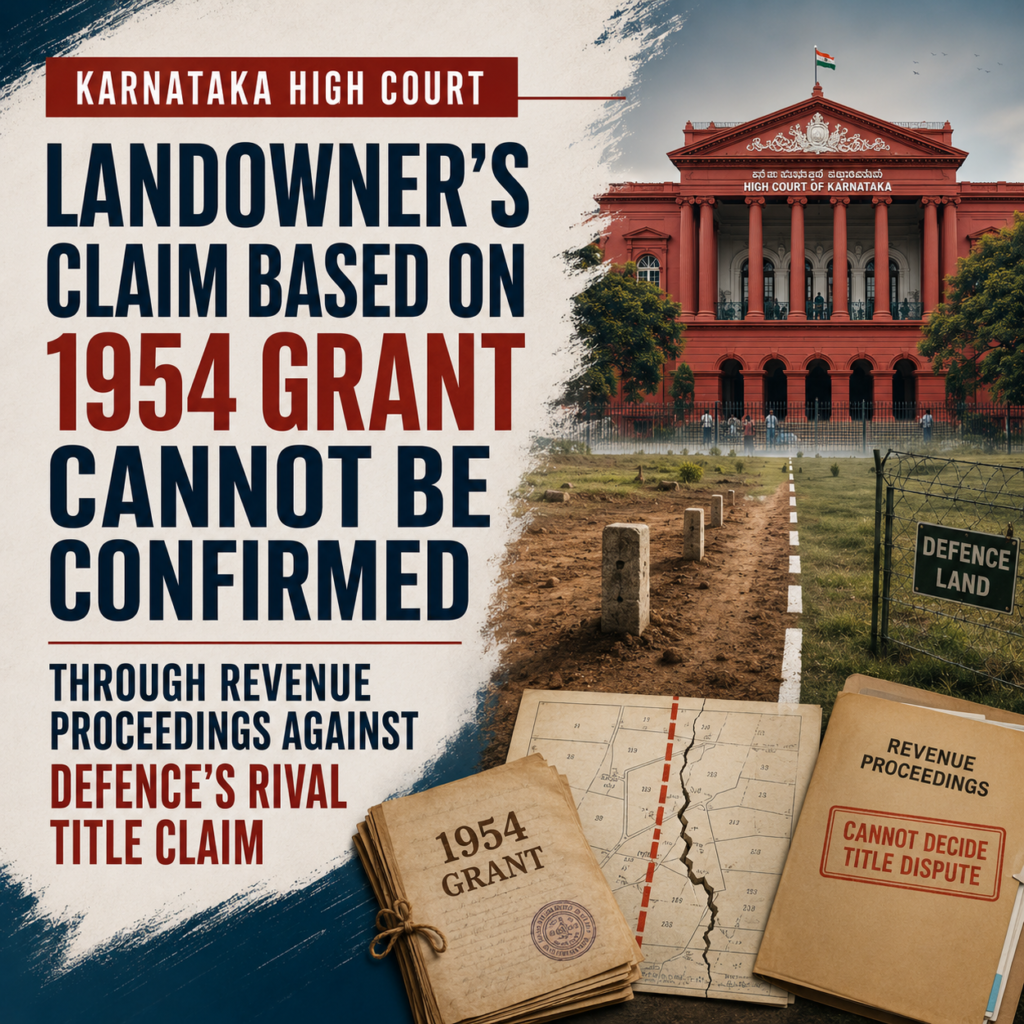
Karnataka High Court Holds Revenue Authorities Cannot Decide Title Dispute Between Private Land Claimant and Defence Department
The Karnataka High Court dismissed a writ appeal arising from a long-standing dispute over two acres of land in Savarline Village, Bengaluru North Taluk.
The appellant claimed title through a 1954 government grant made in favour of his father. The Defence authorities asserted that the land had already been acquired for military purposes in 1907.
A Division Bench comprising Justice D. K. Singh and Justice T. M. Nadaf held that revenue authorities could not decide the genuineness of the old grant or adjudicate competing claims of ownership. Such disputed questions of title must be decided by a competent civil court.
The Court also upheld the quashing of a 2015 Tahsildar’s order after expressing serious doubt about its authenticity and legal foundation.
Facts
A. Venkatesh claimed rights over two acres of land in Survey No. 1 of Savarline Village, Kasaba Hobli, Bengaluru North Taluk.
According to him, the land had been granted to his father, Nagarajappa, by a grant order dated 7 October 1954.
Following the grant, Nagarajappa’s name was entered in the revenue records.
The appellant relied upon:
- the original Saguvali Chit;
- entries in the Darkhast Register;
- the Saguvali Chit Issue Register;
- settlement records;
- mutation entries;
- a family partition deed of 1968;
- a registered will dated 18 July 1984; and
- a later partition deed dated 18 February 2009 under which Site Nos. 1 and 2 allegedly fell to his share.
Since the land was located near Defence property, the appellant approached the Defence Estate Officer for a no-objection certificate.
The Defence Estate Officer initially issued an NOC on 11 December 2009 after physical verification and examination of the Military Land Register, stating that the appellant’s property fell outside the Defence boundary.
The NOC was later withdrawn at the instance of the Parachute Regiment Training Centre.
Thereafter, proceedings were initiated before the Special Deputy Commissioner under Section 136(3) of the Karnataka Land Revenue Act, 1964 concerning the revenue entries.
By an order dated 19 June 2014, the Special Deputy Commissioner observed that the power under Section 136(3) was limited to correction of revenue entries and could not be used to cancel a grant or decide title.
The parties were advised to approach the civil court under the proviso to Section 135 for adjudication of ownership.
However, the Special Deputy Commissioner also directed the Tahsildar to conduct an inquiry under the relevant Land Grant Rules.
Acting on that direction, the Tahsildar passed an order dated 13 July 2015 holding that the 1954 grant in favour of Nagarajappa was genuine and directing continuation of the revenue entries in his name.
The Defence authorities challenged that order before the Assistant Commissioner under Section 136(2).
Separately, the Special Deputy Commissioner later reopened the matter and, by an order dated 23 May 2023, relied upon Defence records and earlier civil proceedings to drop the proceedings against the Defence authorities.
The appellant challenged the reopening order as well as the proceedings before the Assistant Commissioner by filing a writ petition.
The learned Single Judge allowed the writ petition and quashed:
- the reopened proceedings before the Special Deputy Commissioner;
- the order dated 23 May 2023;
- the appeal proceedings before the Assistant Commissioner;
- the Tahsildar’s order dated 13 July 2015; and
- parts of the earlier order dated 19 June 2014 directing a further inquiry.
The Single Judge held that revenue authorities had no jurisdiction to decide ownership disputes and that the rival parties must approach the civil court.
The appellant filed the present writ appeal, principally challenging the quashing of the Tahsildar’s order and certain consequential directions.
Issues
The principal issues before the Division Bench were:
- Whether the Special Deputy Commissioner had jurisdiction under Section 136(3) of the Karnataka Land Revenue Act to reopen concluded proceedings.
- Whether revenue authorities could investigate the genuineness of a 1954 land grant.
- Whether the Tahsildar could confirm title and the validity of the grant through revenue proceedings.
- Whether the Assistant Commissioner could entertain an appeal against the Tahsildar’s order under Section 136(2).
- Whether the learned Single Judge was justified in quashing the Tahsildar’s order despite the appellant’s challenge being primarily directed against later proceedings.
- Whether the competing claims based upon the 1954 grant and the Defence acquisition of 1907 could be adjudicated by revenue officers.
- Whether the title dispute had to be decided exclusively by a competent civil court.
- Whether the manner in which the Tahsildar’s 2015 order was prepared raised doubts about its genuineness.
Petitioner’s Arguments
The appellant argued that the learned Single Judge had correctly quashed the reopening order dated 23 May 2023 but had gone too far by quashing the entire earlier proceedings.
He contended that the operative portion of the Single Judge’s order was inconsistent with the reasoning in the judgment.
According to the appellant, the Tahsildar’s order dated 13 July 2015 had been passed after examining the original grant documents and official revenue records.
The Tahsildar had found that Nagarajappa was lawfully granted two acres in 1954 and that the entries had continued in his name for decades.
The appellant argued that the order was passed pursuant to the Special Deputy Commissioner’s earlier direction and was therefore not liable to be quashed.
It was further submitted that no specific prayer had been made in the writ petition seeking quashing of the Tahsildar’s order.
The appellant contended that the Single Judge exceeded the scope of the petition by setting aside that order.
He also challenged the directions stating that any civil court should not attach undue importance to revenue entries.
According to him, the revenue documents and long-standing entries were relevant pieces of evidence and should not have been neutralised in advance.
The appellant therefore sought restoration of the Tahsildar’s order and modification of the Single Judge’s directions.
Respondent’s Arguments
State Government’s Arguments
The State supported the judgment of the learned Single Judge.
It argued that revenue authorities have no power to decide disputed questions of title.
The appellant’s claim was based on a 1954 grant, whereas the Defence authorities relied upon acquisition notifications and military records dating back to 1907.
Such competing historical claims required examination of evidence, documents and legal rights in a full civil trial.
The State relied upon the Full Bench judgment in Smt. Jayamma v. State of Karnataka to contend that the Tahsildar, Assistant Commissioner and Deputy Commissioner could not adjudicate title.
It further argued that the High Court, while exercising jurisdiction under Article 226, could quash any order found to be without jurisdiction, even if no precise prayer had been drafted for that relief.
Defence Authorities’ Arguments
The Defence Estate Officer and Parachute Regiment Training Centre argued that the entire land had been acquired for Defence purposes in 1907.
They relied upon the Military Land Register and other Defence records.
It was submitted that the revenue records and the alleged 1954 grant could not override an earlier lawful acquisition.
The Defence authorities argued that the Tahsildar had no jurisdiction to validate or confirm the grant.
They supported the finding that the entire controversy must be resolved by the civil court.
They also argued that statements made in earlier civil proceedings had cast serious doubt upon the genuineness of the appellant’s grant documents.
Analysis of the Law
Scope of Section 136 of the Karnataka Land Revenue Act
Section 136 provides a mechanism for correction and revision of revenue entries.
The powers under Sections 136(2) and 136(3) are supervisory and revenue-related in nature.
They do not confer jurisdiction upon revenue officers to:
- declare ownership;
- cancel or validate land grants;
- adjudicate rival title claims;
- decide complex questions of acquisition; or
- determine the genuineness of documents affecting civil rights.
Revenue records are maintained primarily for fiscal and administrative purposes.
They do not create title by themselves.
Where rival parties assert ownership on the basis of competing documents, the dispute must be decided by a civil court.
Revenue Entries and Title
Mutation entries, RTCs, Pahanis and khata records may reflect possession or the person liable to pay land revenue.
However, such entries are not conclusive proof of ownership.
A revenue officer cannot convert an entry-related proceeding into a title adjudication.
The Court held that the Tahsildar’s conclusion confirming the 1954 grant and validating the appellant’s title exceeded the permissible scope of revenue jurisdiction.
Reopening of Concluded Proceedings
The Special Deputy Commissioner had already concluded in 2014 that Section 136(3) could not be used to decide title and had relegated the parties to the civil court.
After that conclusion, reopening the same proceedings years later was impermissible.
The Court agreed with the Single Judge that the Special Deputy Commissioner could not resurrect concluded proceedings and undertake a fresh examination of ownership.
Civil Court’s Exclusive Jurisdiction
The controversy involved two fundamentally inconsistent claims:
- the appellant relied on a government grant of 1954; and
- the Defence authorities relied on an acquisition of 1907.
Determining which claim was valid required examination of:
- original grant records;
- acquisition notifications;
- possession;
- boundary records;
- the Military Land Register;
- official registers;
- previous civil proceedings; and
- oral and documentary evidence.
These questions could not be decided summarily by revenue officers.
The Court therefore held that a civil suit for declaration of title was the appropriate remedy.
Powers Under Article 226
The High Court’s writ jurisdiction is not confined strictly to the wording of the prayer where an order brought before the Court is found to be wholly without jurisdiction.
The learned Single Judge was entitled to quash the Tahsildar’s order because it was part of the same chain of proceedings and directly affected the legality of the dispute.
The absence of a specifically worded prayer did not require the Court to preserve an illegal or jurisdictionally defective order.
Precedent Analysis
Smt. Jayamma & Ors. v. State of Karnataka & Ors.
The Full Bench of the Karnataka High Court held that revenue authorities do not have jurisdiction to decide disputed questions of title.
The Tahsildar, Assistant Commissioner and Deputy Commissioner may maintain or correct revenue entries but cannot adjudicate ownership.
Where the parties assert competing title claims, the dispute must be resolved by the competent civil court.
Any decree passed by the civil court would bind both private parties and revenue authorities.
The Division Bench treated this judgment as directly applicable to the dispute.
The appellant’s alleged grant and the Defence authorities’ acquisition claim could not be tested in proceedings under Section 136.
Earlier Writ Proceedings Relied Upon by the Special Deputy Commissioner
The Special Deputy Commissioner had relied upon an earlier High Court judgment holding that Section 136(3) could not be used indirectly to cancel a grant.
The same principle supported the conclusion that the revenue authorities could neither cancel nor validate the appellant’s grant.
Their jurisdiction was limited to revenue entries.
Principles Governing Revenue Records
The judgment reaffirmed the settled distinction between fiscal entries and civil title.
Revenue entries may be relevant evidence, but they cannot substitute for a declaration of ownership by a civil court.
The civil court must evaluate all evidence independently and cannot treat revenue entries as conclusive.
Court’s Reasoning
The Division Bench agreed with the learned Single Judge that the Special Deputy Commissioner had no authority to reopen the concluded proceedings under Section 136(3).
The Special Deputy Commissioner had already recognised in 2014 that the title dispute had to be resolved before the civil court.
The subsequent direction to the Tahsildar to investigate the grant was itself legally impermissible.
The Court held that even if such a direction had been issued, the Tahsildar could not examine or certify the genuineness of a grant made in 1954.
The Tahsildar’s order went beyond correction of revenue records and effectively declared the appellant’s title.
That power belonged exclusively to the civil court.
The Court deliberately refrained from deciding whether:
- the appellant’s father had genuinely received the grant;
- the Defence authorities had acquired the land in 1907;
- the appellant was in possession; or
- the Military Land Register conclusively established Defence ownership.
Any finding on these matters could prejudice the parties in future civil proceedings.
The Court also examined the unusual manner in which the Tahsildar’s order dated 13 July 2015 had been prepared.
The Bench summoned the former Tahsildar, Shivappa Lamani, who was said to have passed the order.
When directed to read the order, he was unable to read even a line of it because it was written in English.
He was also unable to explain the statutory provisions under which the order had allegedly been passed.
The Court observed that this created serious suspicion as to whether the order had actually been authored or passed by him.
It stated that the order appeared possibly to be the creation of “unseen hands playing behind the scene.”
This circumstance reinforced the Single Judge’s decision to quash the order.
The Court also upheld the directions requiring any future civil suit to be decided independently.
It clarified that no observation made by the revenue authorities, the Single Judge or the Division Bench would bind the civil court.
The civil court was directed to determine ownership solely on the basis of the pleadings, evidence and documents placed before it.
Conclusion
The Karnataka High Court dismissed the writ appeal and affirmed the judgment of the learned Single Judge.
The Court upheld the quashing of:
- the reopened proceedings before the Special Deputy Commissioner;
- the order dated 23 May 2023;
- the proceedings before the Assistant Commissioner;
- the Tahsildar’s order dated 13 July 2015; and
- the consequential directions arising from the earlier revenue proceedings.
The Court held that revenue authorities could not determine whether the land was validly granted to the appellant’s father in 1954 or had already been acquired for Defence purposes in 1907.
The rival parties were left free to approach the competent civil court for declaration of title.
The civil court was directed to decide the dispute independently, without being influenced by:
- observations made by revenue officers;
- findings quashed by the writ court;
- observations in the writ appeal; or
- the existing revenue entries.
All pending interlocutory applications were disposed of.
Case: A. Venkatesh v. State of Karnataka & Ors.
Court: High Court of Karnataka at Bengaluru
Case Number: Writ Appeal No. 392 of 2024
Judges: Justice D. K. Singh and Justice T. M. Nadaf
Date: 23 June 2026
Result: Writ appeal dismissed; quashing of the revenue proceedings and Tahsildar’s order upheld; parties directed to have the competing private and Defence title claims adjudicated independently by a competent civil court.
Landowner’s Claim Based on 1954 Grant Cannot Be Confirmed Through Revenue Proceedings Against Defence’s Rival Title Claim
Karnataka High Court Holds Revenue Authorities Cannot Decide Title Dispute Between Private Land Claimant and Defence Department
The Karnataka High Court dismissed a writ appeal arising from a long-standing dispute over two acres of land in Savarline Village, Bengaluru North Taluk.
The appellant claimed title through a 1954 government grant made in favour of his father. The Defence authorities asserted that the land had already been acquired for military purposes in 1907.
A Division Bench comprising Justice D. K. Singh and Justice T. M. Nadaf held that revenue authorities could not decide the genuineness of the old grant or adjudicate competing claims of ownership. Such disputed questions of title must be decided by a competent civil court.
The Court also upheld the quashing of a 2015 Tahsildar’s order after expressing serious doubt about its authenticity and legal foundation.
Facts
A. Venkatesh claimed rights over two acres of land in Survey No. 1 of Savarline Village, Kasaba Hobli, Bengaluru North Taluk.
According to him, the land had been granted to his father, Nagarajappa, by a grant order dated 7 October 1954.
Following the grant, Nagarajappa’s name was entered in the revenue records.
The appellant relied upon:
- the original Saguvali Chit;
- entries in the Darkhast Register;
- the Saguvali Chit Issue Register;
- settlement records;
- mutation entries;
- a family partition deed of 1968;
- a registered will dated 18 July 1984; and
- a later partition deed dated 18 February 2009 under which Site Nos. 1 and 2 allegedly fell to his share.
Since the land was located near Defence property, the appellant approached the Defence Estate Officer for a no-objection certificate.
The Defence Estate Officer initially issued an NOC on 11 December 2009 after physical verification and examination of the Military Land Register, stating that the appellant’s property fell outside the Defence boundary.
The NOC was later withdrawn at the instance of the Parachute Regiment Training Centre.
Thereafter, proceedings were initiated before the Special Deputy Commissioner under Section 136(3) of the Karnataka Land Revenue Act, 1964 concerning the revenue entries.
By an order dated 19 June 2014, the Special Deputy Commissioner observed that the power under Section 136(3) was limited to correction of revenue entries and could not be used to cancel a grant or decide title.
The parties were advised to approach the civil court under the proviso to Section 135 for adjudication of ownership.
However, the Special Deputy Commissioner also directed the Tahsildar to conduct an inquiry under the relevant Land Grant Rules.
Acting on that direction, the Tahsildar passed an order dated 13 July 2015 holding that the 1954 grant in favour of Nagarajappa was genuine and directing continuation of the revenue entries in his name.
The Defence authorities challenged that order before the Assistant Commissioner under Section 136(2).
Separately, the Special Deputy Commissioner later reopened the matter and, by an order dated 23 May 2023, relied upon Defence records and earlier civil proceedings to drop the proceedings against the Defence authorities.
The appellant challenged the reopening order as well as the proceedings before the Assistant Commissioner by filing a writ petition.
The learned Single Judge allowed the writ petition and quashed:
- the reopened proceedings before the Special Deputy Commissioner;
- the order dated 23 May 2023;
- the appeal proceedings before the Assistant Commissioner;
- the Tahsildar’s order dated 13 July 2015; and
- parts of the earlier order dated 19 June 2014 directing a further inquiry.
The Single Judge held that revenue authorities had no jurisdiction to decide ownership disputes and that the rival parties must approach the civil court.
The appellant filed the present writ appeal, principally challenging the quashing of the Tahsildar’s order and certain consequential directions.
Issues
The principal issues before the Division Bench were:
- Whether the Special Deputy Commissioner had jurisdiction under Section 136(3) of the Karnataka Land Revenue Act to reopen concluded proceedings.
- Whether revenue authorities could investigate the genuineness of a 1954 land grant.
- Whether the Tahsildar could confirm title and the validity of the grant through revenue proceedings.
- Whether the Assistant Commissioner could entertain an appeal against the Tahsildar’s order under Section 136(2).
- Whether the learned Single Judge was justified in quashing the Tahsildar’s order despite the appellant’s challenge being primarily directed against later proceedings.
- Whether the competing claims based upon the 1954 grant and the Defence acquisition of 1907 could be adjudicated by revenue officers.
- Whether the title dispute had to be decided exclusively by a competent civil court.
- Whether the manner in which the Tahsildar’s 2015 order was prepared raised doubts about its genuineness.
Petitioner’s Arguments
The appellant argued that the learned Single Judge had correctly quashed the reopening order dated 23 May 2023 but had gone too far by quashing the entire earlier proceedings.
He contended that the operative portion of the Single Judge’s order was inconsistent with the reasoning in the judgment.
According to the appellant, the Tahsildar’s order dated 13 July 2015 had been passed after examining the original grant documents and official revenue records.
The Tahsildar had found that Nagarajappa was lawfully granted two acres in 1954 and that the entries had continued in his name for decades.
The appellant argued that the order was passed pursuant to the Special Deputy Commissioner’s earlier direction and was therefore not liable to be quashed.
It was further submitted that no specific prayer had been made in the writ petition seeking quashing of the Tahsildar’s order.
The appellant contended that the Single Judge exceeded the scope of the petition by setting aside that order.
He also challenged the directions stating that any civil court should not attach undue importance to revenue entries.
According to him, the revenue documents and long-standing entries were relevant pieces of evidence and should not have been neutralised in advance.
The appellant therefore sought restoration of the Tahsildar’s order and modification of the Single Judge’s directions.
Respondent’s Arguments
State Government’s Arguments
The State supported the judgment of the learned Single Judge.
It argued that revenue authorities have no power to decide disputed questions of title.
The appellant’s claim was based on a 1954 grant, whereas the Defence authorities relied upon acquisition notifications and military records dating back to 1907.
Such competing historical claims required examination of evidence, documents and legal rights in a full civil trial.
The State relied upon the Full Bench judgment in Smt. Jayamma v. State of Karnataka to contend that the Tahsildar, Assistant Commissioner and Deputy Commissioner could not adjudicate title.
It further argued that the High Court, while exercising jurisdiction under Article 226, could quash any order found to be without jurisdiction, even if no precise prayer had been drafted for that relief.
Defence Authorities’ Arguments
The Defence Estate Officer and Parachute Regiment Training Centre argued that the entire land had been acquired for Defence purposes in 1907.
They relied upon the Military Land Register and other Defence records.
It was submitted that the revenue records and the alleged 1954 grant could not override an earlier lawful acquisition.
The Defence authorities argued that the Tahsildar had no jurisdiction to validate or confirm the grant.
They supported the finding that the entire controversy must be resolved by the civil court.
They also argued that statements made in earlier civil proceedings had cast serious doubt upon the genuineness of the appellant’s grant documents.
Analysis of the Law
Scope of Section 136 of the Karnataka Land Revenue Act
Section 136 provides a mechanism for correction and revision of revenue entries.
The powers under Sections 136(2) and 136(3) are supervisory and revenue-related in nature.
They do not confer jurisdiction upon revenue officers to:
- declare ownership;
- cancel or validate land grants;
- adjudicate rival title claims;
- decide complex questions of acquisition; or
- determine the genuineness of documents affecting civil rights.
Revenue records are maintained primarily for fiscal and administrative purposes.
They do not create title by themselves.
Where rival parties assert ownership on the basis of competing documents, the dispute must be decided by a civil court.
Revenue Entries and Title
Mutation entries, RTCs, Pahanis and khata records may reflect possession or the person liable to pay land revenue.
However, such entries are not conclusive proof of ownership.
A revenue officer cannot convert an entry-related proceeding into a title adjudication.
The Court held that the Tahsildar’s conclusion confirming the 1954 grant and validating the appellant’s title exceeded the permissible scope of revenue jurisdiction.
Reopening of Concluded Proceedings
The Special Deputy Commissioner had already concluded in 2014 that Section 136(3) could not be used to decide title and had relegated the parties to the civil court.
After that conclusion, reopening the same proceedings years later was impermissible.
The Court agreed with the Single Judge that the Special Deputy Commissioner could not resurrect concluded proceedings and undertake a fresh examination of ownership.
Civil Court’s Exclusive Jurisdiction
The controversy involved two fundamentally inconsistent claims:
- the appellant relied on a government grant of 1954; and
- the Defence authorities relied on an acquisition of 1907.
Determining which claim was valid required examination of:
- original grant records;
- acquisition notifications;
- possession;
- boundary records;
- the Military Land Register;
- official registers;
- previous civil proceedings; and
- oral and documentary evidence.
These questions could not be decided summarily by revenue officers.
The Court therefore held that a civil suit for declaration of title was the appropriate remedy.
Powers Under Article 226
The High Court’s writ jurisdiction is not confined strictly to the wording of the prayer where an order brought before the Court is found to be wholly without jurisdiction.
The learned Single Judge was entitled to quash the Tahsildar’s order because it was part of the same chain of proceedings and directly affected the legality of the dispute.
The absence of a specifically worded prayer did not require the Court to preserve an illegal or jurisdictionally defective order.
Precedent Analysis
Smt. Jayamma & Ors. v. State of Karnataka & Ors.
The Full Bench of the Karnataka High Court held that revenue authorities do not have jurisdiction to decide disputed questions of title.
The Tahsildar, Assistant Commissioner and Deputy Commissioner may maintain or correct revenue entries but cannot adjudicate ownership.
Where the parties assert competing title claims, the dispute must be resolved by the competent civil court.
Any decree passed by the civil court would bind both private parties and revenue authorities.
The Division Bench treated this judgment as directly applicable to the dispute.
The appellant’s alleged grant and the Defence authorities’ acquisition claim could not be tested in proceedings under Section 136.
Earlier Writ Proceedings Relied Upon by the Special Deputy Commissioner
The Special Deputy Commissioner had relied upon an earlier High Court judgment holding that Section 136(3) could not be used indirectly to cancel a grant.
The same principle supported the conclusion that the revenue authorities could neither cancel nor validate the appellant’s grant.
Their jurisdiction was limited to revenue entries.
Principles Governing Revenue Records
The judgment reaffirmed the settled distinction between fiscal entries and civil title.
Revenue entries may be relevant evidence, but they cannot substitute for a declaration of ownership by a civil court.
The civil court must evaluate all evidence independently and cannot treat revenue entries as conclusive.
Court’s Reasoning
The Division Bench agreed with the learned Single Judge that the Special Deputy Commissioner had no authority to reopen the concluded proceedings under Section 136(3).
The Special Deputy Commissioner had already recognised in 2014 that the title dispute had to be resolved before the civil court.
The subsequent direction to the Tahsildar to investigate the grant was itself legally impermissible.
The Court held that even if such a direction had been issued, the Tahsildar could not examine or certify the genuineness of a grant made in 1954.
The Tahsildar’s order went beyond correction of revenue records and effectively declared the appellant’s title.
That power belonged exclusively to the civil court.
The Court deliberately refrained from deciding whether:
- the appellant’s father had genuinely received the grant;
- the Defence authorities had acquired the land in 1907;
- the appellant was in possession; or
- the Military Land Register conclusively established Defence ownership.
Any finding on these matters could prejudice the parties in future civil proceedings.
The Court also examined the unusual manner in which the Tahsildar’s order dated 13 July 2015 had been prepared.
The Bench summoned the former Tahsildar, Shivappa Lamani, who was said to have passed the order.
When directed to read the order, he was unable to read even a line of it because it was written in English.
He was also unable to explain the statutory provisions under which the order had allegedly been passed.
The Court observed that this created serious suspicion as to whether the order had actually been authored or passed by him.
It stated that the order appeared possibly to be the creation of “unseen hands playing behind the scene.”
This circumstance reinforced the Single Judge’s decision to quash the order.
The Court also upheld the directions requiring any future civil suit to be decided independently.
It clarified that no observation made by the revenue authorities, the Single Judge or the Division Bench would bind the civil court.
The civil court was directed to determine ownership solely on the basis of the pleadings, evidence and documents placed before it.
Conclusion
The Karnataka High Court dismissed the writ appeal and affirmed the judgment of the learned Single Judge.
The Court upheld the quashing of:
- the reopened proceedings before the Special Deputy Commissioner;
- the order dated 23 May 2023;
- the proceedings before the Assistant Commissioner;
- the Tahsildar’s order dated 13 July 2015; and
- the consequential directions arising from the earlier revenue proceedings.
The Court held that revenue authorities could not determine whether the land was validly granted to the appellant’s father in 1954 or had already been acquired for Defence purposes in 1907.
The rival parties were left free to approach the competent civil court for declaration of title.
The civil court was directed to decide the dispute independently, without being influenced by:
- observations made by revenue officers;
- findings quashed by the writ court;
- observations in the writ appeal; or
- the existing revenue entries.
All pending interlocutory applications were disposed of.
Case: A. Venkatesh v. State of Karnataka & Ors.
Court: High Court of Karnataka at Bengaluru
Case Number: Writ Appeal No. 392 of 2024
Judges: Justice D. K. Singh and Justice T. M. Nadaf
Date: 23 June 2026
Result: Writ appeal dismissed; quashing of the revenue proceedings and Tahsildar’s order upheld; parties directed to have the competing private and Defence title claims adjudicated independently by a competent civil court.