


Court’s Decision
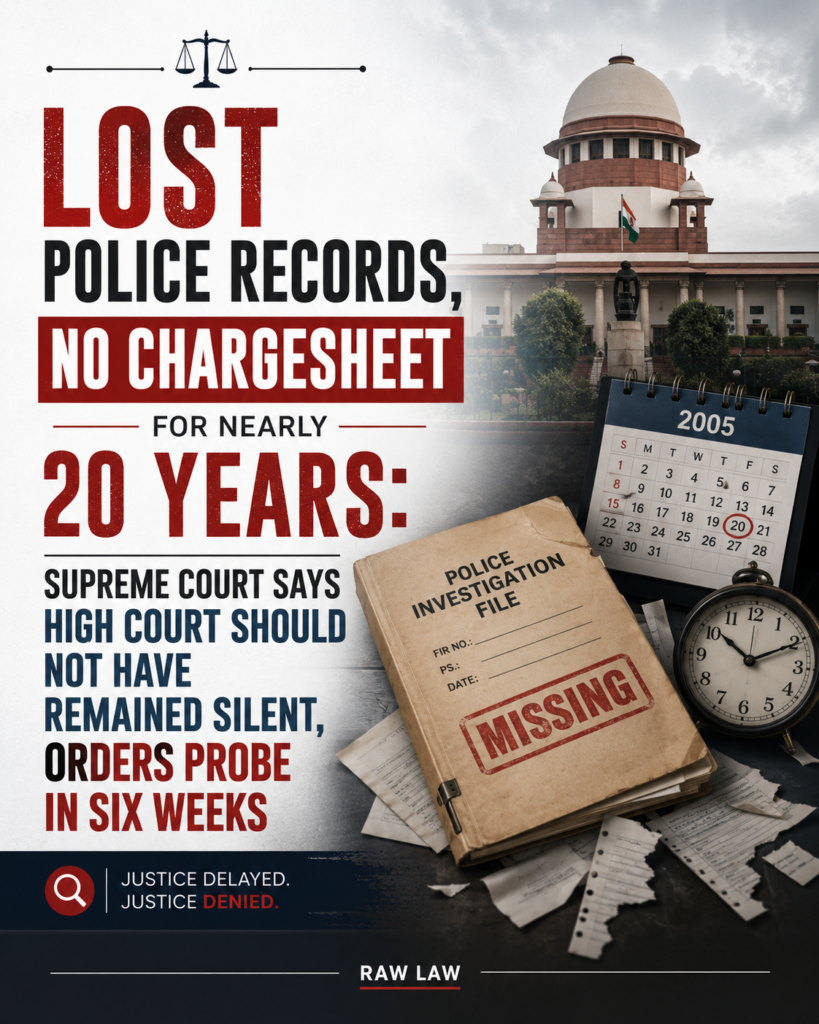
The Supreme Court interfered with the order of the High Court which had refused to issue directions in a long-pending criminal complaint. The Court held that the High Court ought to have taken note of the extraordinary delay in filing the chargesheet and should have exercised its jurisdiction instead of declining relief.
The Supreme Court directed the State and the concerned police station to conclude the investigation within six weeks and file an appropriate report before the Magistrate, containing all available investigative material and, if any material is unavailable, the details of such absence. The State was also directed to file an affidavit explaining the action taken against the officer involved in loss of records, why the Magistrate was not informed about inability to reconstruct records or trace witnesses, and compliance with the direction to complete investigation.
Facts
The dispute arose from a criminal complaint filed before the Magistrate in 2007. The complainant alleged that while he was away on Haj pilgrimage, the accused persons forged his signature and created a forged partition deed and bogus sale deed concerning his self-acquired property. On the basis of these allegedly forged documents, their names were entered in the revenue records.
In 2014, the police submitted a C-Summary report before the Magistrate. The Magistrate rejected it and directed further investigation to be completed within 60 days.
Thereafter, the complainant approached the High Court. In 2017, the High Court directed preparation of the investigation report within six weeks and recorded that some material collected during investigation had gone missing from the custody of the police station. Later, the FSL report indicated that the complainant had not authored the signatures on the disputed documents. Despite this, the matter did not reach a meaningful conclusion.
The Magistrate again directed the investigating officer to clarify whether the investigation was pending or concluded. In 2022, the Magistrate again directed the investigating officer to carry out investigation and file the chargesheet in accordance with law. Since no effective action followed, the complainant was compelled to approach the High Court again. The High Court refused relief, stating that the complainant should pursue appropriate proceedings before the Magistrate.
Issues
The Supreme Court considered whether the High Court was justified in refusing to interfere when the criminal investigation had remained pending for nearly two decades despite repeated orders by the Magistrate and High Court.
The Court also considered whether prolonged non-completion of investigation violates the constitutional requirement of speedy investigation and trial under Article 21 of the Constitution.
Appellants’ Arguments
The appellants’ grievance was that the original complainant had repeatedly approached the courts, yet the police had failed to file a chargesheet or bring the investigation to a logical conclusion.
It was submitted that despite orders of the Magistrate and High Court, and despite the FSL report indicating forged signatures, the investigation remained pending for years. The appellants sought directions for filing of the chargesheet and completion of investigation.
State’s Stand
The State submitted that the material seized during investigation had been sent for FSL examination, and the FSL report indicated that the complainant had not authored the signatures on the forged documents.
However, according to the State, the detailed report along with original case papers was sent to the Magistrate through the police station but was misplaced in transit and never received by the Magistrate. It was further submitted that during re-investigation, original case papers remained untraceable and relevant witnesses could not be conclusively traced. Disciplinary proceedings were stated to have been initiated against the concerned officer.
Analysis Of The Law
The Supreme Court emphasized that the right to speedy trial is intrinsically linked to Article 21 of the Constitution, and timely completion of investigation is part of that right.
The Court relied on the principle that criminal investigations cannot continue endlessly. Even though rigid timelines may not always be practical because investigation involves multiple moving parts, the State cannot allow criminal complaints to remain pending indefinitely without explanation.
The Court also observed that where there is a large gap between FIR/complaint and the chargesheet, courts are bound to seek an explanation from the investigating agency and satisfy themselves about the propriety of that explanation.
Precedent Analysis
The Supreme Court referred to Robert Lalchungnunga Chongthu v. State of Bihar, where it was held that prompt investigation is an important facet of Article 21 and that criminal investigations must be completed within a reasonable time.
The cited precedent also clarified that where investigation has continued for an unduly long period without adequate justification, both the accused and the complainant may approach the High Court under Section 528 BNSS / Section 482 CrPC seeking an update on the investigation or appropriate relief.
Court’s Reasoning
The Supreme Court found that almost two decades had passed since the complaint was filed, yet the investigation had not reached any meaningful conclusion.
The Court observed that the complainant had effectively run from pillar to post for filing of the chargesheet, but without success. In such circumstances, the High Court ought not to have declined interference merely because the Magistrate had earlier passed directions.
The Court further held that constitutional courts cannot remain mute spectators when prolonged investigations are brought to their notice. The Court stated that where records are lost during an active investigation, such incidents must be taken with utmost seriousness because they strike at the core of the criminal justice system and render bona fide complaints inactionable.
Conclusion
The Supreme Court directed the State and police to complete the investigation within six weeks and file an appropriate report before the Magistrate. The State was also directed to file an affidavit explaining the action taken against the officer involved in the loss of records, why the Magistrate was not informed about inability to reconstruct records or trace witnesses, and whether the investigation-completion direction had been complied with.
The matter was directed to be listed as part-heard on 14 July 2026.
Key Takeaway
This judgment is important for complainants whose cases remain stuck for years because of police inaction, lost records, or failure to file a chargesheet.
The Supreme Court has made it clear that investigation cannot remain pending endlessly. If police delay the investigation without justification, the High Court can be approached for an update, monitoring, or appropriate directions.
At the same time, the judgment also protects the criminal justice system itself by saying that loss of investigation records is not a small administrative lapse — it can destroy a genuine complaint and therefore must be taken seriously.
Also Read: Arbitration Limitation Clock Starts After Section 33 Order, Not Original Award: Supreme Court