


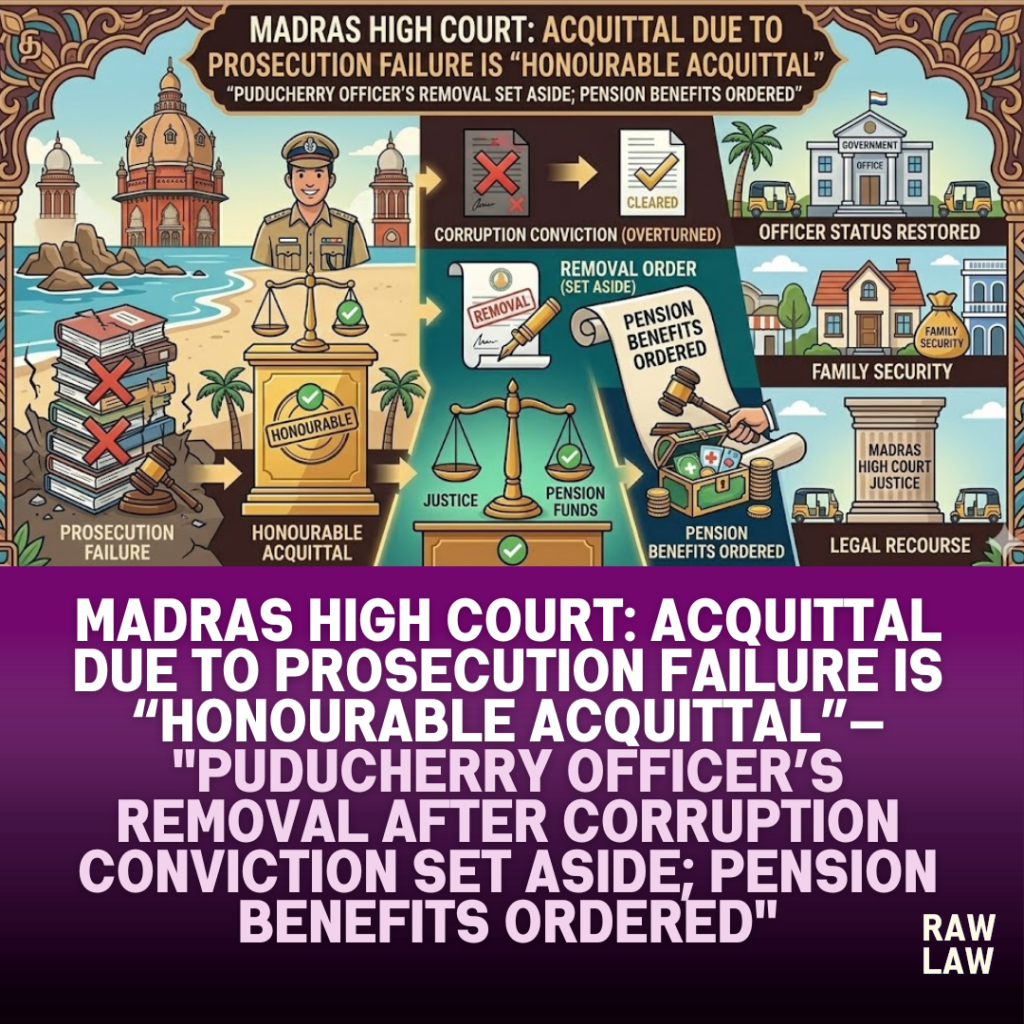
1. Court’s decision
A Division Bench of the Madras High Court allowed a writ petition filed by a former transport department official of the Government of Puducherry seeking restoration of retirement benefits after acquittal in a corruption case.
The Court set aside the order of the Central Administrative Tribunal which had rejected the petitioner’s claim on the ground that his acquittal was not “honourable.”
The Bench ruled that the acquittal was based on the prosecution’s failure to establish demand and acceptance of bribe and therefore could not be dismissed as merely a benefit-of-doubt acquittal. The Court directed the authorities to revoke the removal order and release all terminal benefits payable to the petitioner upon retirement.
2. Facts
The petitioner joined the Transport Department of the Government of Puducherry in 1984 as an Assistant Motor Vehicle Inspector.
Over the years he rose through the ranks and was promoted as Assistant Engineer in 2001, eventually officiating as Regional Transport Officer at Karaikal.
While he was serving in that position, the Central Bureau of Investigation registered a case alleging that he demanded and accepted a bribe.
The petitioner was subsequently prosecuted under provisions of the Prevention of Corruption Act, 1988 and was convicted by the trial court in 2012.
Based on this conviction, the government invoked Rule 19(1) of the Central Civil Services (Classification, Control and Appeal) Rules, 1965 and removed him from service on the date of his superannuation in September 2013.
3. Issues
The High Court examined two primary legal questions.
First, whether the petitioner’s acquittal in the criminal appeal entitled him to seek revocation of the removal order imposed based on the earlier conviction.
Second, whether the acquittal could be categorised as a “non-honourable acquittal,” thereby justifying the government’s refusal to restore service benefits.
4. Petitioner’s arguments
The petitioner argued that once the High Court had set aside the conviction and acquitted him of all charges, the foundation of the disciplinary punishment ceased to exist.
He contended that the authorities had wrongly refused to reconsider the removal order on the ground that the acquittal was not “honourable.”
According to the petitioner, the only lawful course available to the authorities after the acquittal was either to reinstate him or to revoke the removal order and release all retirement benefits.
The petitioner therefore sought quashing of the tribunal’s order and directions for payment of pension and other terminal benefits with retrospective effect.
5. Respondent’s arguments
The government opposed the writ petition and supported the tribunal’s order.
It argued that the petitioner had been acquitted only on the ground of benefit of doubt and that such an acquittal could not be treated as an “honourable acquittal.”
According to the respondents, when an acquittal is based on benefit of doubt rather than a clear finding of innocence, disciplinary authorities are not obliged to revoke the punishment imposed following conviction.
On this basis, the government argued that the removal order remained valid despite the acquittal in the criminal case.
6. Analysis of the law
The Court analysed Rule 19 of the Central Civil Services (Classification, Control and Appeal) Rules, 1965, which permits disciplinary authorities to impose penalties on a government servant based on a criminal conviction without conducting a departmental inquiry.
However, the Court observed that such action is fundamentally linked to the existence of a valid conviction.
Once the conviction is set aside on appeal, the very basis of the disciplinary punishment requires reconsideration.
The Court therefore emphasised that authorities must examine the nature and reasoning of the acquittal before deciding whether to maintain or revoke the disciplinary penalty.
7. Precedent analysis
The Court emphasised that the nature of an acquittal must be determined by carefully reading the judgment as a whole.
An acquittal may occur because the prosecution fails to prove the charge beyond reasonable doubt, because evidence is unreliable, or because competing interpretations of evidence create doubt about the accused’s guilt.
The Court held that when the prosecution fails to prove the essential ingredients of an offence, the resulting acquittal cannot be dismissed as merely technical or conditional.
8. Court’s reasoning
The High Court carefully analysed the earlier criminal appellate judgment that had acquitted the petitioner.
The appellate court had clearly held that the prosecution failed to prove the demand and acceptance of bribe—two essential ingredients of corruption offences.
The Court also noted that key witnesses lacked credibility and that the prosecution’s narrative contained significant contradictions.
Further, the petitioner had offered a plausible explanation for possession of the allegedly tainted money, stating that it represented a penalty amount for a seized vehicle rather than a bribe.
Given these findings, the Court concluded that the prosecution case had collapsed entirely and that the acquittal could not be characterised as a mere benefit-of-doubt acquittal.
9. Conclusion
The High Court held that the tribunal had erred in treating the acquittal as a non-honourable acquittal and refusing relief to the petitioner.
Accordingly, the Court allowed the writ petition, set aside the tribunal’s order, and directed the government to revoke the removal order and grant all retirement and terminal benefits due to the petitioner upon his superannuation.
10. Implications
The ruling clarifies the legal consequences of criminal acquittals for government servants facing disciplinary action based on conviction.
It reiterates that once a conviction forming the basis of disciplinary punishment is set aside, authorities must reconsider the penalty unless independent departmental proceedings justify its continuation.
The judgment also emphasises that courts must avoid mechanical classification of acquittals as “honourable” or “non-honourable” without examining the reasoning of the judgment itself.
Case Law References
- Rule 19, Central Civil Services (Classification, Control and Appeal) Rules, 1965
This rule permits disciplinary authorities to impose penalties based on criminal conviction without conducting a departmental inquiry. - Prevention of Corruption Act, 1988
The petitioner had originally been prosecuted under Sections 7 and 13(2) read with Section 13(1)(d) relating to bribery by public servants.
FAQs
1. Can a government employee claim service benefits after acquittal in a criminal case?
Yes. If disciplinary punishment was imposed solely based on a criminal conviction and that conviction is later set aside, authorities must reconsider the penalty and may restore service benefits.
2. What is meant by “honourable acquittal” in service law?
An honourable acquittal generally refers to a situation where the court finds that the prosecution completely failed to prove the charges, rather than merely granting benefit of doubt.
3. Can a government servant be removed from service based on a criminal conviction?
Yes. Under Rule 19 of the Central Civil Services (CCA) Rules, disciplinary authorities may impose penalties without departmental inquiry if a government servant is convicted of a criminal offence.