


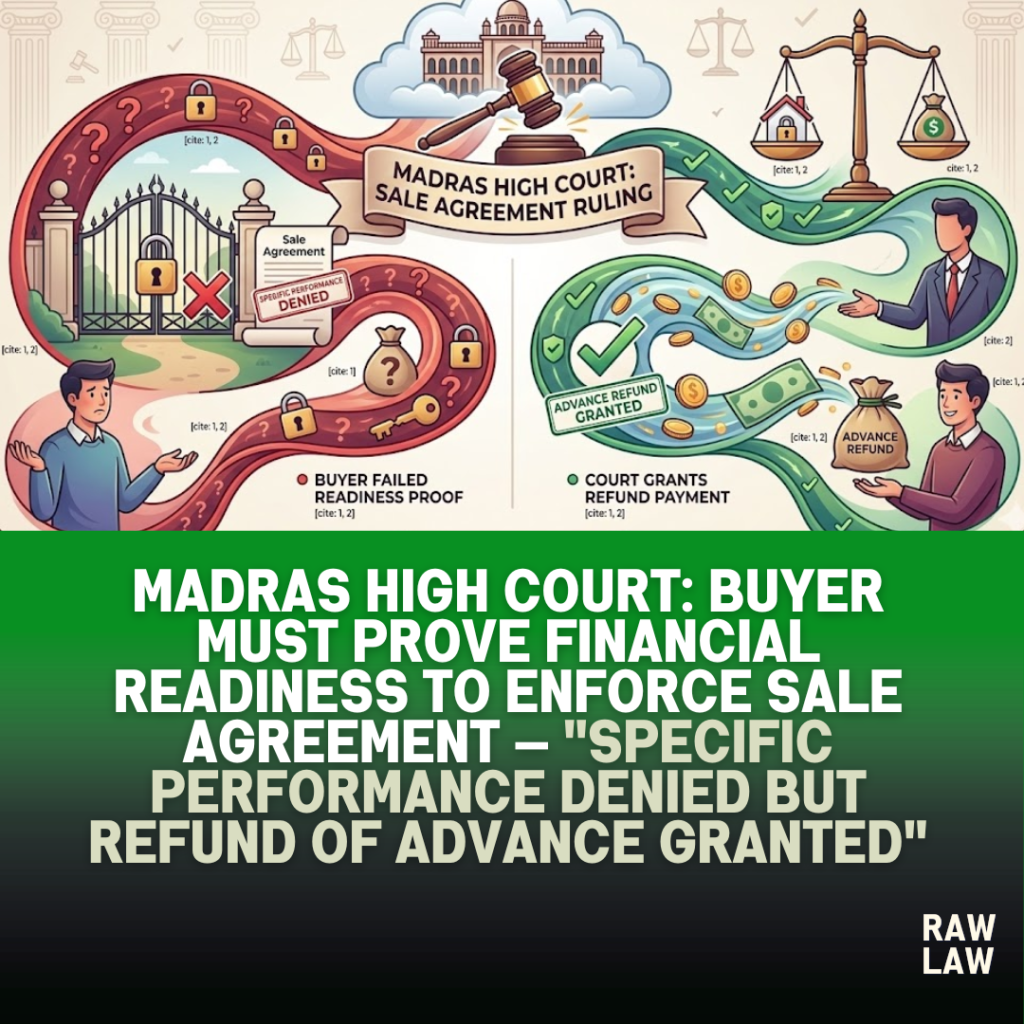
1. Court’s decision
The Madras High Court partly allowed an appeal challenging the dismissal of a suit for specific performance of a sale agreement relating to immovable property.
The Court held that the evidence on record clearly established the existence of a genuine sale agreement and receipt of advance money by the defendant. However, the Court found that the plaintiff failed to prove his readiness and willingness to pay the balance consideration, which is a mandatory requirement for granting specific performance.
Accordingly, while refusing to compel execution of the sale deed, the Court granted the alternative remedy of refund of the advance amount along with interest.
2. Facts
The dispute arose from a sale agreement executed between the plaintiff and the first defendant regarding a residential property. The first defendant had obtained ownership of the property through a settlement deed executed by his mother.
The plaintiff claimed that the defendant agreed to sell the property for a total sale consideration of ₹14,00,000. According to the plaintiff, an advance amount of ₹3,00,000 was paid on the date of the agreement, and the parties agreed that the sale deed would be executed within three months.
The plaintiff alleged that despite repeated requests and a legal notice, the defendant failed to produce the original title documents or complete the sale transaction. The plaintiff therefore filed a suit seeking specific performance of the agreement and an injunction against alienation of the property.
3. Issues
The High Court examined several legal questions arising in the appeal.
The first issue was whether the document relied upon by the plaintiff was a genuine sale agreement intended for transfer of property or merely a document executed as security for a loan transaction.
The second issue concerned whether the plaintiff had satisfied the statutory requirement of demonstrating readiness and willingness to perform his part of the contract throughout the relevant period.
The third issue was whether the trial court’s decree denying specific performance but granting refund of money required modification.
4. Petitioner’s arguments
The plaintiff argued that the trial court had erred in holding that the sale agreement was merely a security for a loan transaction. It was contended that the defendant had clearly admitted the execution of the sale agreement in earlier correspondence and notices.
The plaintiff further argued that he had consistently expressed readiness and willingness to pay the balance sale consideration of ₹11,00,000 and complete the transaction. According to the plaintiff, the defendant deliberately delayed the execution of the sale deed by refusing to produce the original title documents.
It was also submitted that the plaintiff had sufficient financial means to pay the balance amount and that the trial court had wrongly concluded otherwise.
5. Respondent’s arguments
The defendants argued that the agreement relied upon by the plaintiff was not a genuine sale agreement but merely a document executed as security for repayment of loans. According to them, the defendant had borrowed ₹2,50,000 from the plaintiff and ₹50,000 from the plaintiff’s father, and the agreement was executed only as collateral security for this loan.
The defendants also argued that the plaintiff failed to produce any documentary evidence demonstrating financial capacity to pay the remaining sale consideration.
On this basis, the defendants contended that the plaintiff had not satisfied the statutory requirement of readiness and willingness under the Specific Relief Act and therefore could not obtain the relief of specific performance.
6. Analysis of the law
The Court examined the legal principles governing suits for specific performance under the Specific Relief Act, 1963. One of the most fundamental requirements under Section 16(c) of the Act is that the plaintiff must prove continuous readiness and willingness to perform his part of the contract.
This requirement is mandatory and applies regardless of whether the defendant specifically raises the issue. The plaintiff must demonstrate financial capacity and genuine intention to perform the contract throughout the relevant period.
Failure to establish this requirement is sufficient ground for denying the equitable remedy of specific performance.
7. Precedent analysis
The Court relied upon judicial precedents emphasizing that specific performance is a discretionary and equitable remedy. Courts grant such relief only when the plaintiff demonstrates strict compliance with statutory requirements.
The Court also referred to a Supreme Court decision clarifying that even an unregistered sale agreement can be relied upon as evidence of a contract in a suit for specific performance under the proviso to Section 49 of the Registration Act.
However, even when the agreement is valid, the plaintiff must independently prove readiness and willingness to complete the transaction.
8. Court’s reasoning
The High Court carefully examined the evidence placed on record and concluded that the sale agreement was indeed executed for the purpose of selling the property. This conclusion was supported by admissions contained in a notice issued by the defendant during the litigation.
However, the Court found that the plaintiff had not produced any evidence, such as bank statements or financial records, demonstrating that he had the necessary funds to pay the balance sale consideration of ₹11,00,000.
Since readiness and willingness must be proved by tangible evidence, the Court held that the plaintiff had failed to satisfy the statutory requirement for obtaining specific performance.
9. Conclusion
The High Court upheld the trial court’s refusal to grant specific performance but modified the decree concerning the refund of the advance amount.
The Court held that the plaintiff was entitled to recover the advance sum of ₹3,00,000 with interest at 12% per annum from the date of filing the suit until realization. The appeal was therefore partly allowed only to the extent of modifying the interest component of the trial court’s decree.
10. Implications
The judgment reiterates a crucial principle governing suits for specific performance: the plaintiff must prove continuous readiness and willingness to perform the contract.
Even when a valid sale agreement exists, courts may refuse specific performance if the plaintiff fails to demonstrate financial capacity or genuine intention to complete the transaction.
The ruling also highlights the equitable nature of the remedy of specific performance and reinforces the judiciary’s cautious approach in granting such relief.
Case Law References
- Umabai v. Nilkanth Dhondiba Chavan (2005)
The Supreme Court held that readiness and willingness under the Specific Relief Act must be proved through evidence and cannot be presumed. - R. Hemalatha v. Kasture (2023)
The Supreme Court clarified that an unregistered agreement to sell can be admitted as evidence in a suit for specific performance under the proviso to Section 49 of the Registration Act. - Pappammal v. P. Ramasamy (2012)
The Court emphasized that specific performance is an equitable remedy and must be granted only when the plaintiff strictly complies with legal requirements.
FAQs
1. Can a buyer enforce an unregistered sale agreement in court?
Yes. Under the proviso to Section 49 of the Registration Act, an unregistered sale agreement can be used as evidence in a suit for specific performance.
2. What must a plaintiff prove to obtain specific performance of a contract?
The plaintiff must prove that the agreement is valid and that they were continuously ready and willing to perform their obligations, including payment of the balance consideration.
3. What happens if the court denies specific performance of a property agreement?
If specific performance is denied, the court may grant alternative relief such as refund of the advance amount along with interest.