


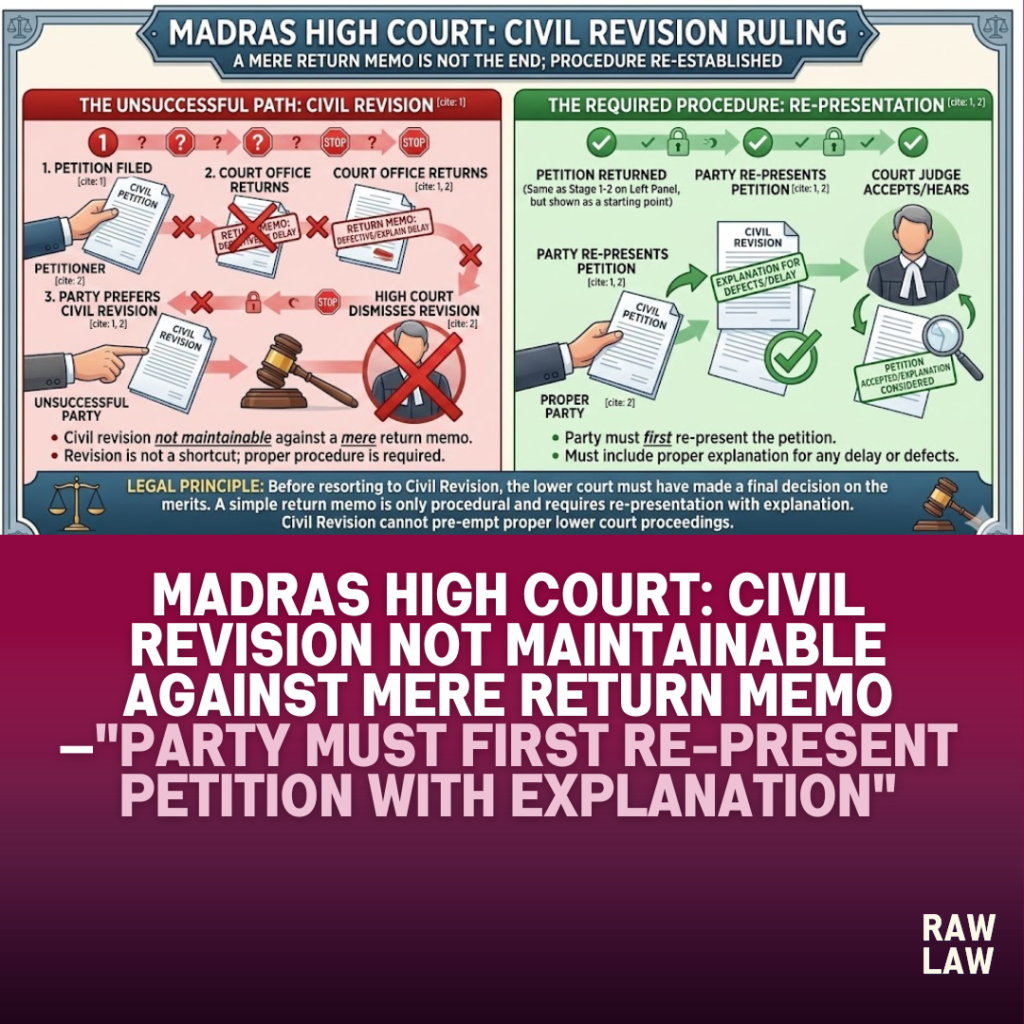
1. Court’s decision
The Madras High Court dismissed a civil revision petition filed under Section 115 of the Code of Civil Procedure challenging a return memo issued by the trial court. The High Court held that a return memo issued at the stage of scrutiny does not determine the rights of the parties and therefore cannot be challenged through revision proceedings.
The Court clarified that when a petition is returned merely for clarification regarding maintainability, the proper course for the party is to re-present the petition with an explanation. Consequently, the revision petition was dismissed for lack of merit.
2. Facts
The dispute arose in execution proceedings pending before the X Assistant City Civil Court in Chennai. During the course of those proceedings, the petitioner filed an application under Order XXI Rule 58 of the Code of Civil Procedure seeking to raise attachment over a scheduled property.
The petitioner also requested the court to communicate to the relevant registering authority that the attachment order dated 18 October 2022 had been lifted so that necessary entries could be corrected in official records.
However, the application was returned at the scrutiny stage by the trial court through a return memo dated 11 February 2026. The petitioner challenged this return memo before the High Court by filing a civil revision petition under Section 115 of the Code of Civil Procedure.
3. Issues
The High Court examined whether a civil revision petition can be maintained against a return memo issued by a trial court during the scrutiny stage of a petition.
The Court also considered whether returning an application for clarification regarding maintainability amounts to a judicial determination capable of being challenged in revision.
Another issue before the Court was whether the petitioner could claim to be an aggrieved party when the trial court had merely granted time to re-present the petition along with an explanation.
4. Petitioner’s arguments
The petitioner argued that the trial court had wrongly returned the application at the scrutiny stage on the ground of maintainability. According to the petitioner, questions regarding maintainability should be decided only after numbering the petition, taking it on file, and hearing the parties.
It was submitted that by returning the petition without numbering it, the trial court had failed to exercise jurisdiction vested in it by law. The petitioner contended that the trial court should have numbered the application and decided the issue of maintainability through a reasoned order after hearing both sides.
On this basis, the petitioner sought intervention by the High Court to set aside the return memo and direct the trial court to entertain the application.
5. Respondent’s arguments
Although the order primarily records the petitioner’s submissions, the Court independently examined the nature of the return memo issued by the trial court.
The High Court noted that the return memo did not reject the application or decide the issue of maintainability. Instead, the trial court had simply called upon the petitioner to explain the maintainability of the application and granted two weeks’ time for re-presentation.
Thus, the trial court had not passed any final order affecting the petitioner’s rights.
6. Analysis of the law
The Court examined the scope of revisional jurisdiction under Section 115 of the Code of Civil Procedure. Revision lies only against orders that determine rights or involve jurisdictional errors in adjudication by subordinate courts.
A return memo issued at the scrutiny stage is administrative in nature and does not amount to a judicial determination. Such memos merely require clarification or correction of defects before a petition is formally taken on record.
Since no adjudication on merits had taken place, the petitioner could not invoke the revisional jurisdiction of the High Court.
7. Precedent analysis
The Court’s reasoning aligns with established procedural principles governing court registries and scrutiny processes. Judicial precedents have consistently recognized that return memos are part of procedural scrutiny intended to ensure that pleadings comply with legal requirements before being admitted on file.
Courts have held that such preliminary steps do not constitute appealable or revisable orders because they do not determine the rights of the parties. Only orders involving adjudication or jurisdictional determination can be challenged through revision.
8. Court’s reasoning
Upon examining the impugned return memo, the High Court found that the trial judge had not rejected the petitioner’s application. Instead, the memo only required the petitioner to provide an explanation regarding maintainability and permitted re-presentation within two weeks.
The Court observed that since the trial court had not made any determination on the merits or maintainability of the petition, the petitioner could not be considered an aggrieved party at that stage.
Therefore, the revision petition was premature and not maintainable.
9. Conclusion
The High Court dismissed the civil revision petition, holding that it lacked merit because the petitioner had challenged a mere return memo that did not determine any legal issue.
The Court directed the petitioner to re-present the papers before the trial court along with the required explanation within one week from the receipt of the High Court’s order. It further clarified that if the trial court subsequently passes an order affecting the petitioner’s rights, the petitioner would be free to challenge that order through appropriate legal remedies.
10. Implications
The ruling reiterates an important procedural principle in civil litigation: return memos issued during scrutiny are not judicial orders and cannot be challenged through revision or appeal.
The decision encourages litigants to follow procedural requirements and correct defects before invoking higher court jurisdiction. It also prevents unnecessary litigation over preliminary procedural steps.
For practitioners, the judgment clarifies that challenges should only be brought after a court has actually decided the issue in question, not at the stage where the registry or court merely seeks clarification or rectification.
Case Law References
- Procedural Principle under Section 115 of the Code of Civil Procedure
Revisional jurisdiction can be invoked only against orders involving jurisdictional errors or adjudication affecting rights. - Return Memo Jurisprudence
Courts have consistently held that return memos issued during scrutiny are administrative steps and do not amount to appealable or revisable judicial orders.
FAQs
1. Can a return memo issued by a court be challenged in revision?
Generally, no. A return memo is not a judicial order but a procedural step requiring correction or clarification. It does not determine the rights of parties and therefore cannot usually be challenged in revision.
2. What should a litigant do if a petition is returned by a court?
The litigant should re-present the petition after rectifying the defects or providing the explanation requested by the court.
3. When can a revision petition be filed under Section 115 of the Code of Civil Procedure?
A revision petition can be filed when a subordinate court has exercised jurisdiction illegally or with material irregularity and has passed an order affecting the rights of the parties.