


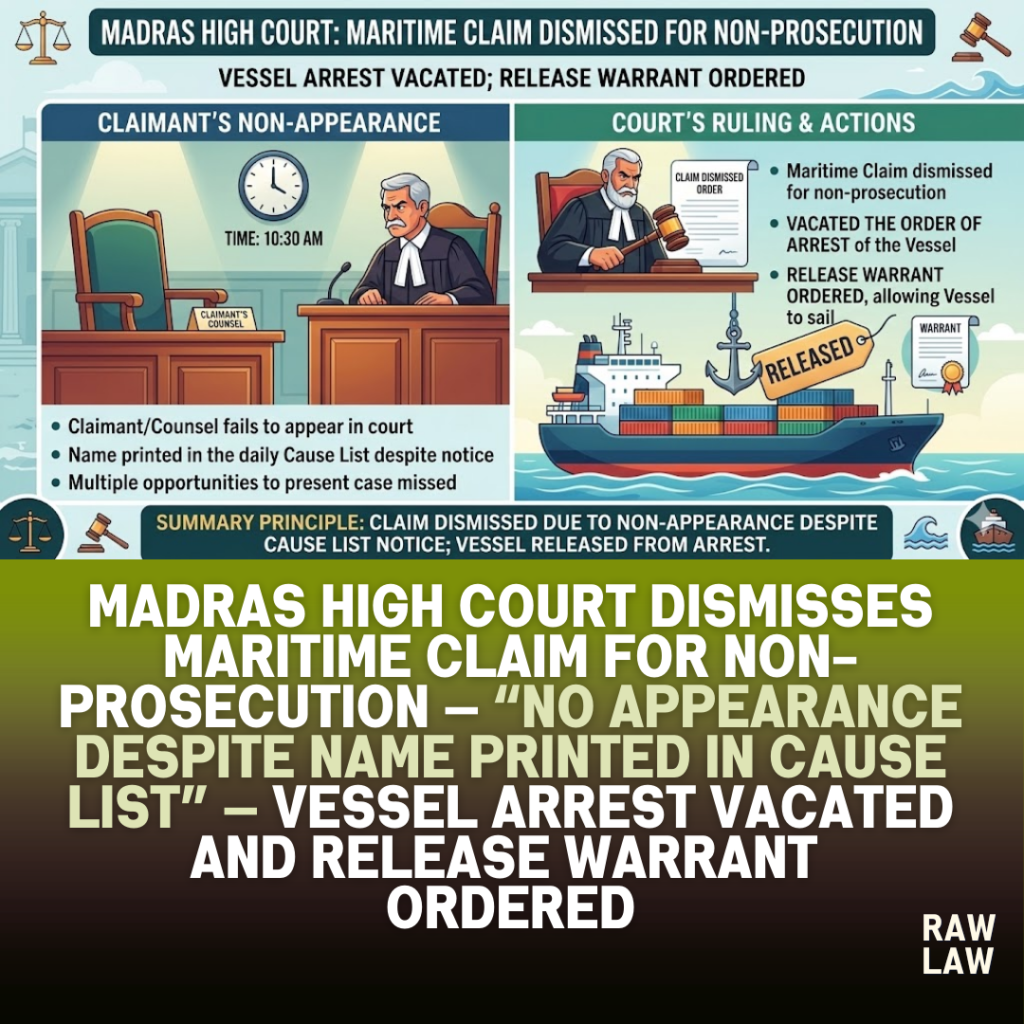
Court’s decision
The Madras High Court dismissed a commercial admiralty suit for non-prosecution after the plaintiff failed to appear either in person or through counsel despite specific directions. Consequently, the Court vacated the earlier order of arrest passed against a foreign-flagged vessel and directed issuance of a release warrant.
In a subsequent “for being mentioned” proceeding, the Court corrected paragraph 2 of the dismissal order to expressly record that the arrest order stood vacated and the Registry must issue a release warrant.
Facts
The suit was filed by M/s Paragon Trading under the Commercial Division jurisdiction seeking recovery of USD 120,360 (approximately ₹1.05 crore) along with interest, allegedly arising from maritime claims against three motor tug vessels flying the flag of the Republic of Palau.
The primary relief sought included arrest and sale of Motor Tug AVADH (IMO No. 9564358), then lying at V.O. Chidambaranar Port, Tuticorin, within Indian territorial waters. Similar claims were made against Motor Tug ADWAY (lying at Port of Male, Maldives) and Motor Tug ACCOMPLICE (lying at Tuticorin).
An earlier order dated 02 July 2025 in the connected application had resulted in arrest of one of the vessels.
Issues
The core issues before the Court were procedural rather than substantive:
- Whether the suit could proceed when counsel for the plaintiff reported “no instructions.”
- Whether dismissal for non-prosecution was warranted when the plaintiff failed to appear after specific Court directions.
- Whether the arrest order should continue once the suit stood dismissed.
Plaintiff’s position
When the matter was taken up on 12 February 2026, learned counsel for the plaintiff submitted that he had no instructions and filed a memo to that effect. The Court directed deletion of counsel’s name from the cause list and directed the Registry to print the plaintiff’s name in the cause list for the next hearing on 19 February 2026.
Despite this explicit direction and opportunity, there was no appearance on behalf of the plaintiff on the next date of hearing.
Defendants’ position
The defendants consisted of the owners and parties interested in the three vessels, represented through their Masters. Although the order does not elaborate submissions on merits, the matter was later listed under the caption “for being mentioned” at the instance of learned counsel for the respondents, leading to correction of the operative portion of the earlier order.
Analysis of the law
Under Order IX of the Code of Civil Procedure, 1908, read with the Commercial Courts Act, a suit may be dismissed for non-prosecution where the plaintiff fails to appear when the matter is called for hearing.
Admiralty proceedings involving arrest of vessels operate in rem, directly affecting maritime property. However, such drastic interim measures cannot survive independently of the substantive suit. Once the suit is dismissed, ancillary interim orders, including arrest, ordinarily fall.
The Court exercised its inherent powers to clarify the operative portion of the dismissal order to avoid ambiguity regarding the status of the vessel arrest.
Precedent analysis
Although the brief order does not cite specific precedents, the principle is well settled that interim orders cannot outlive the main proceedings. The arrest of a vessel is an extraordinary admiralty remedy designed to secure maritime claims. However, when the plaintiff abandons prosecution, continuation of arrest would amount to unjustified deprivation of property.
The correction order ensures alignment with established admiralty jurisprudence that vessel arrest is contingent upon subsistence of the suit.
Court’s reasoning
On 12 February 2026, the Court recorded that counsel for the plaintiff had no instructions and directed procedural steps to enable the plaintiff to appear directly. The matter was adjourned to 19 February 2026.
On the adjourned date, there was no appearance either in person or through counsel. The Court therefore dismissed the suit for non-prosecution.
Subsequently, on 27 February 2026, the matter was mentioned by the respondents. The Court directed replacement of paragraph 2 of the earlier order to clearly state that the dismissal resulted in vacating the arrest order dated 02 July 2025 and that the Registry must issue a release warrant.
This clarification ensured that port authorities could lawfully release the vessel from arrest.
Conclusion
The Madras High Court dismissed the commercial admiralty suit for non-prosecution and vacated the order of arrest against the vessel. The Registry was directed to issue a release warrant.
The order highlights the procedural rigor required in maritime claims and reinforces that arrest orders cannot continue in the absence of a pending suit.
Implications
This ruling carries significant implications for maritime litigants:
- Admiralty arrest orders are conditional and cannot survive dismissal of the main suit.
- Plaintiffs must diligently prosecute maritime claims; failure to appear can result in immediate vacation of arrest.
- Courts may issue corrected orders to avoid ambiguity affecting vessel release.
- Shipowners benefit from procedural safeguards against prolonged arrest without active litigation.
The judgment underscores the balance between securing maritime claims and protecting commercial shipping operations from unnecessary restraint.
Case Law References
While the order does not cite precedents, it applies settled principles under:
- Order IX CPC (dismissal for non-prosecution)
- Admiralty jurisdiction principles governing arrest in rem
- Inherent powers of High Courts to correct and clarify operative portions of orders
FAQs
1. Can a vessel remain under arrest if the suit is dismissed?
No. Arrest orders are ancillary to the main suit. Once the suit is dismissed, the arrest order is ordinarily vacated.
2. What happens if a plaintiff’s counsel reports ‘no instructions’?
The Court may grant time for the plaintiff to appear personally. Failure to appear thereafter can lead to dismissal for non-prosecution.
3. Can a court correct its own order after dismissal?
Yes. Courts can replace or correct portions of an order to clarify consequences, such as vacating an arrest and issuing a release warrant.