


1. Court’s decision
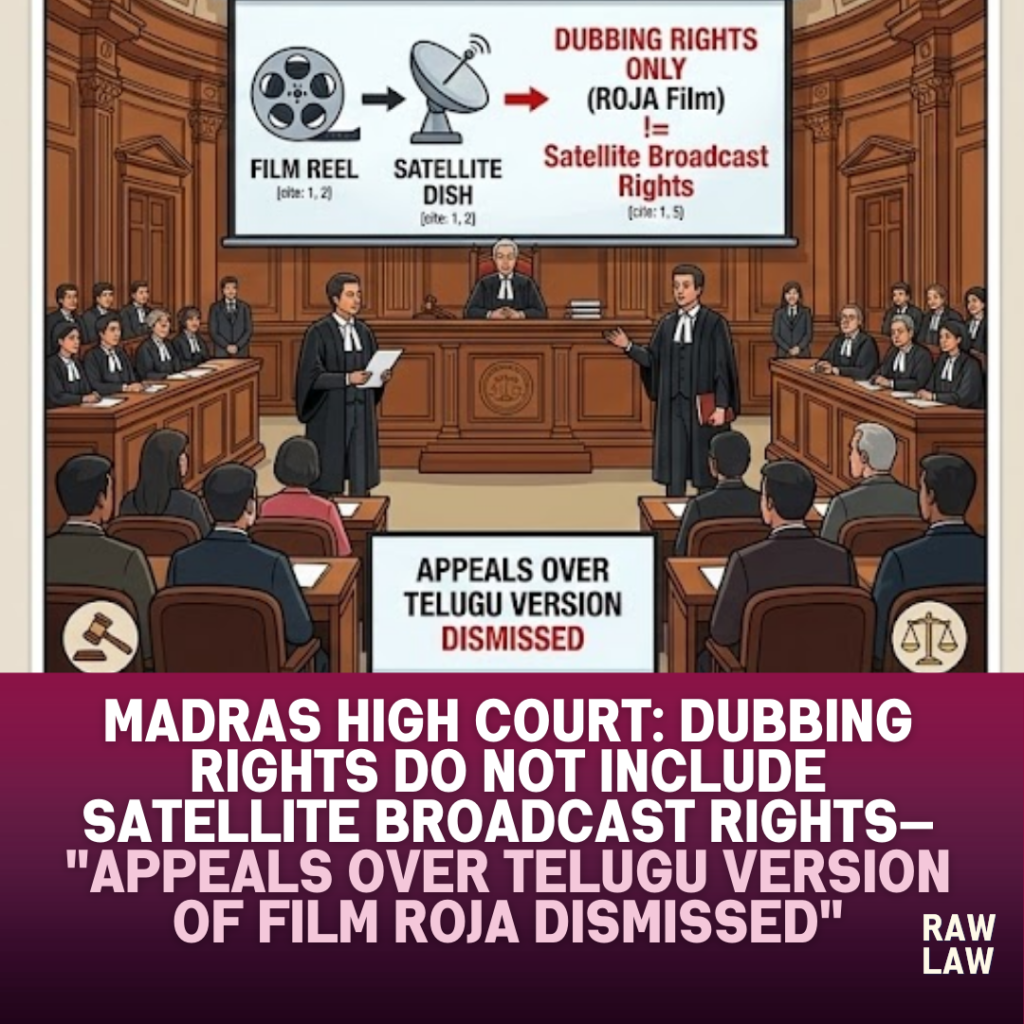
A Division Bench of the Madras High Court dismissed two original side appeals filed by a recording company claiming exclusive copyright over the Telugu dubbed version of the film Roja.
The appellant sought to restrain television broadcasters from telecasting the Telugu dubbed version through satellite networks and also claimed damages of ₹1 crore for alleged infringement.
After examining the contractual agreements and statutory copyright framework, the Court held that the appellant had acquired only the limited right to dub and exhibit the film theatrically in specific territories. Since satellite rights had been separately assigned by the producer, the defendants’ broadcast of the film did not infringe the appellant’s copyright.
2. Facts
The dispute arose from an agreement executed on 16 June 1992 between the appellant recording company and the producer of the Tamil film Roja. Under the agreement, the appellant was granted exclusive rights to dub or remake the film in Telugu and exploit the dubbed version in specific territories including Andhra Pradesh and Orissa for a period of twenty-five years.
The appellant paid a substantial consideration of ₹34,50,000 and subsequently dubbed the film into Telugu. It later discovered that television broadcasters planned to telecast the Telugu dubbed version through satellite television.
Claiming that it held exclusive rights over the Telugu version, the appellant filed one suit seeking permanent injunction against telecast and another suit seeking damages of ₹1 crore for alleged copyright infringement.
3. Issues
The High Court considered three principal legal issues.
First, whether the appellant, having acquired theatrical dubbing rights for the Telugu version of the film, could restrain broadcasters from exploiting satellite broadcasting rights.
Second, whether telecasting the Telugu dubbed film through satellite television constituted infringement of the appellant’s copyright.
Third, whether the appellant was entitled to permanent injunction and damages based on the alleged infringement of copyright in the dubbed version.
4. Petitioner’s arguments
The appellant argued that by dubbing the film into Telugu at substantial expense, it had effectively become the producer and copyright holder of the Telugu version of the film.
It relied on provisions of the Copyright Act, 1957 to contend that the person responsible for creating the cinematograph work for valuable consideration becomes the first owner of copyright.
According to the appellant, the agreement granting dubbing rights also entitled it to exploit the Telugu version across all platforms, including satellite broadcasting.
The appellant therefore contended that telecasting the film through satellite television without its consent amounted to copyright infringement.
5. Respondent’s arguments
The producer and broadcasting entities argued that the agreement granted the appellant only the right to dub the film and exploit the Telugu version theatrically in specified territories.
They contended that satellite broadcasting rights constituted a separate and independent category of copyright which remained with the producer.
According to the respondents, the producer had validly assigned satellite rights to another entity through a separate agreement, thereby authorising the telecast of the film.
Since the appellant had never been granted satellite rights, the respondents argued that no infringement had occurred.
6. Analysis of the law
The Court analysed the structure of copyright ownership under the Copyright Act, 1957.
Under Section 17 of the Act, the producer of a cinematograph film is treated as the first owner of copyright, as the film is produced at the producer’s instance and expense.
The law also allows the owner of copyright to assign the rights wholly or partially to different entities. Such assignments may include theatrical rights, television rights, satellite rights, dubbing rights or distribution rights, each of which can be transferred independently through contractual agreements.
The Court emphasised that parties are bound by the precise scope of rights granted in the agreement.
7. Precedent analysis
The Court relied on established copyright principles that distinguish between different modes of exploiting cinematograph works.
Judicial precedents recognise that theatrical exhibition rights and satellite broadcasting rights are separate commercial rights capable of independent assignment.
Therefore, an entity holding theatrical or dubbing rights cannot automatically claim satellite broadcasting rights unless such rights are expressly granted under the contract.
Applying this principle, the Court examined the contractual agreement governing the Telugu dubbing rights.
8. Court’s reasoning
The Court found that the agreement between the appellant and the producer clearly restricted the appellant’s rights to dubbing and theatrical exhibition of the Telugu version in specific territories.
The agreement did not grant satellite broadcasting rights.
The Court further noted that the producer had separately assigned satellite television rights to another entity. Since satellite rights and theatrical rights are distinct forms of copyright exploitation, the assignment of satellite rights did not violate the appellant’s contractual rights.
Accordingly, the Court concluded that telecasting the Telugu dubbed version through satellite television did not infringe the appellant’s copyright.
9. Conclusion
The High Court held that the appellant could not claim rights beyond what had been contractually assigned.
Since the appellant had only acquired theatrical dubbing rights and not satellite broadcasting rights, it could not restrain the defendants from telecasting the film through satellite networks.
Consequently, the claims for permanent injunction and damages were rejected and the appeals were dismissed with costs.
10. Implications
The ruling highlights the importance of clearly defining and understanding the scope of copyright assignments in the film industry.
It reinforces that different exploitation rights in cinematograph works—such as theatrical, satellite, digital or dubbing rights—are commercially distinct and can be independently assigned.
The judgment serves as a reminder to producers, broadcasters and distributors that contractual terms strictly determine the scope of copyright ownership and enforcement rights in media and entertainment disputes.
Case Law References
- Principle of first ownership under the Copyright Act, 1957
Under Section 17 of the Act, the producer of a cinematograph film is considered the first owner of copyright and has the authority to assign rights to third parties. - Judicial principle on distinct copyright exploitation rights
Courts recognise that theatrical exhibition rights and satellite broadcasting rights are separate commercial rights that can be independently assigned through contractual agreements.
FAQs
1. Do dubbing rights automatically include satellite broadcasting rights?
No. Dubbing rights only permit translation or adaptation of a film into another language. Satellite broadcasting rights must be separately assigned through an agreement.
2. Who is the first owner of copyright in a film under Indian law?
Under the Copyright Act, the producer of a cinematograph film is treated as the first owner of copyright because the film is produced at the producer’s instance and expense.
3. Can different rights of a film be assigned to different parties?
Yes. Producers may separately assign theatrical, satellite, digital, dubbing and distribution rights to different entities through contractual agreements.