


Court’s decision
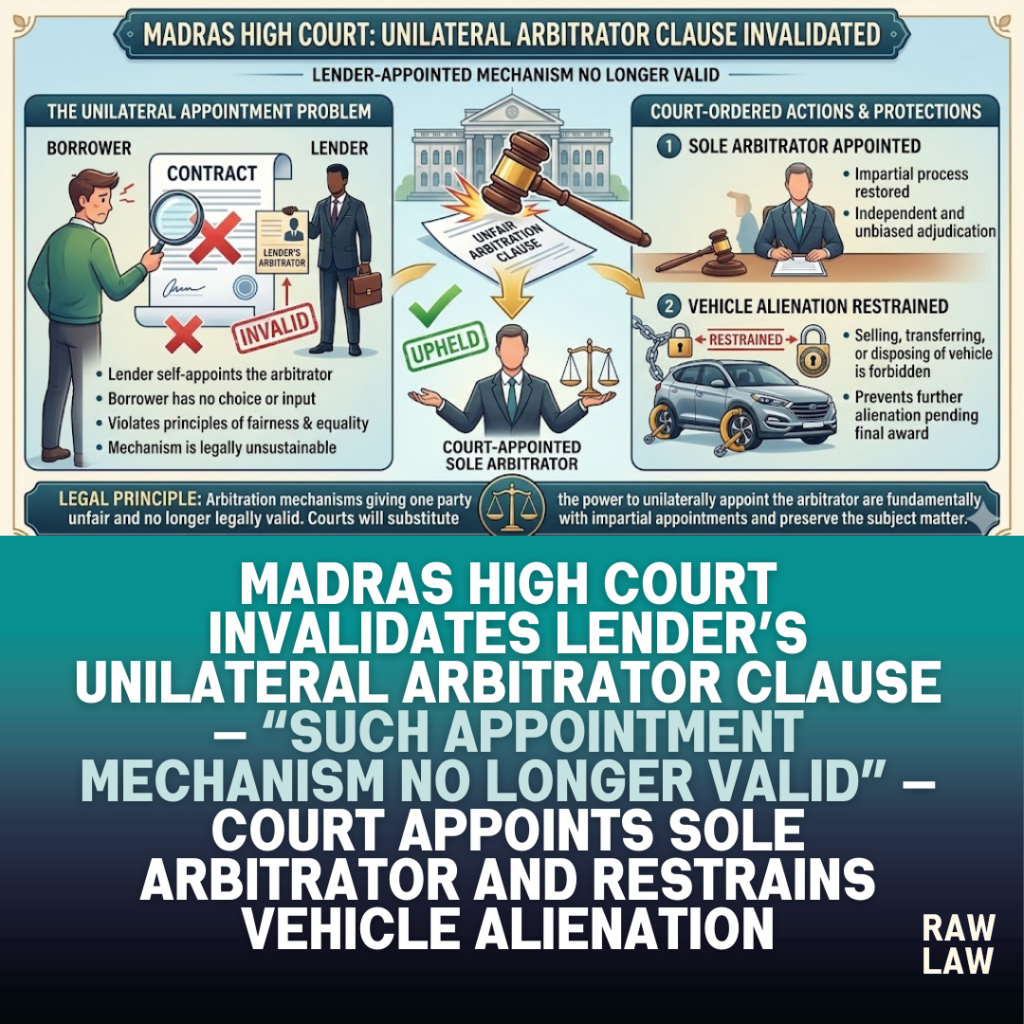
The Madras High Court held that an arbitration clause empowering the lender to unilaterally appoint a sole arbitrator is no longer valid in law. Exercising powers under Section 11(6) read with Sections 14(1)(b) and 15(2) of the Arbitration and Conciliation Act, 1996, the Court appointed an independent sole arbitrator to adjudicate disputes arising out of a vehicle loan agreement.
The Court also granted interim protection by restraining the borrowers from alienating or encumbering the financed vehicle for three months, while granting liberty to approach the arbitral tribunal for further interim relief.
Facts
The dispute arose from a loan agreement and an unattested deed of hypothecation dated 28 March 2023 executed between Mercedes Benz Financial Services India Pvt Ltd and the respondents for the purchase of a Mercedes Benz C 300 D motor car.
The lender initiated arbitration proceedings under the agreement and also filed an application seeking interim measures, including seizure and delivery of the vehicle bearing registration number KA-03-NQ-1624.
Earlier, an arbitrator had been appointed by the High Court. However, that arbitrator withdrew from the proceedings due to allegations raised by the respondents. Consequently, the lender approached the Court again seeking substitution of the arbitrator.
Meanwhile, the respondents had given an undertaking not to alienate or encumber the vehicle, which remained in their custody.
Issues
The principal questions before the Court were:
- Whether the arbitration clause permitting unilateral appointment of a sole arbitrator by the lender remained valid in law.
- Whether a substitute arbitrator ought to be appointed by the Court under Sections 11, 14 and 15 of the Arbitration and Conciliation Act, 1996.
- Whether interim protection was required to safeguard the secured asset pending arbitration.
Petitioner’s arguments
The lender submitted that disputes had arisen under the loan agreement, necessitating arbitration. It relied on Clause 76 of the agreement, which provided that disputes shall be referred to a sole arbitrator appointed by the lender, with the seat of arbitration at Chennai.
It was argued that since the previously appointed arbitrator had withdrawn, the Court must exercise its jurisdiction under Section 11(6) read with Sections 14(1)(b) and 15(2) to appoint a substitute arbitrator.
The petitioner also sought interim measures, including appointment of an Advocate Commissioner to seize and deliver the hypothecated vehicle, along with police assistance if required.
Respondents’ arguments
The respondents opposed unilateral appointment of the arbitrator and had earlier levelled allegations leading to the withdrawal of the previously appointed arbitrator.
They had, however, furnished an undertaking not to alienate or encumber the vehicle pending resolution of disputes. Through counsel, they consented to appointment of an independent arbitrator by the Court.
Analysis of the law
The Court examined the arbitration clause contained in Clause 76 of the loan agreement. The clause empowered the lender to appoint a sole arbitrator and stipulated that the place of arbitration would be exclusively at Chennai or such other location as intimated by the lender.
The Court observed that although the agreement conferred unilateral power of appointment on the lender, such clauses are no longer valid in view of the law laid down by the Supreme Court. The statutory scheme under the Arbitration and Conciliation Act, 1996, particularly post-amendment, ensures independence and impartiality in arbitral appointments.
When a named arbitrator withdraws or becomes unable to act, Sections 14 and 15 of the Act empower the Court to terminate the mandate and appoint a substitute arbitrator.
Given the invalidity of unilateral appointment mechanisms and the earlier withdrawal, the Court held that judicial appointment was necessary.
Precedent analysis
Though the order is brief, it rests on settled Supreme Court jurisprudence holding that a party interested in the outcome of the dispute cannot unilaterally appoint a sole arbitrator.
The principle of neutrality in arbitral appointments has been consistently affirmed to uphold fairness and independence in arbitration. The High Court’s observation that such a clause “is no longer valid in view of the law laid down by the Supreme Court” reflects adherence to this binding precedent.
Court’s reasoning
With the consent of both parties, the Court appointed Mr. S.R. Sundar, Advocate, as the sole arbitrator. The arbitrator was requested to enter upon reference and adjudicate the dispute. Fees and expenses were to be fixed in consultation with the parties.
On the interim relief sought, the Court noted that the respondents had already undertaken not to alienate or encumber the vehicle. To safeguard the subject matter of arbitration, the Court restrained the respondents from alienating, encumbering or disposing of the vehicle for a period of three months.
The Court granted liberty to approach the arbitral tribunal for extension of interim measures or for additional relief under Section 17 of the Act.
The arbitration petition and the interim application were disposed of on these terms.
Conclusion
The Madras High Court reaffirmed that unilateral arbitrator appointment clauses in loan agreements are unenforceable. The Court exercised its powers to appoint an independent sole arbitrator and ensured interim protection of the hypothecated vehicle pending arbitration.
The decision reinforces the principle that arbitral neutrality cannot be compromised by contractual clauses conferring exclusive appointment power on one party.
Implications
This ruling carries important implications for financial institutions and non-banking finance companies:
- Unilateral arbitrator appointment clauses are vulnerable to judicial invalidation.
- Courts will step in under Sections 11, 14 and 15 to ensure impartial arbitral constitution.
- Interim protection of secured assets may be granted even when seizure is not immediately ordered.
- Parties are encouraged to seek interim relief before the arbitral tribunal once constituted.
The judgment underscores the judiciary’s continued commitment to fairness and neutrality in commercial arbitration.
Case law references
While not elaborated in the order, the ruling reflects the binding principle laid down by the Supreme Court that unilateral appointment of a sole arbitrator by an interested party is invalid under the Arbitration and Conciliation Act, 1996.
FAQs
1. Can a lender unilaterally appoint a sole arbitrator under a loan agreement?
No. Courts have consistently held that unilateral appointment clauses are invalid if they compromise neutrality and independence.
2. What happens if an appointed arbitrator withdraws?
Under Sections 14 and 15 of the Arbitration Act, the Court can terminate the mandate and appoint a substitute arbitrator.
3. Can courts grant interim protection before arbitration begins?
Yes. Under Section 9 of the Arbitration Act, courts can grant interim measures such as restraining alienation of secured assets.