


1. Court’s decision
The Madras High Court delivered a common judgment disposing of two civil miscellaneous appeals arising out of a motor accident claim.
The Court partly allowed the injured claimant’s appeal seeking enhancement of compensation while dismissing the appeal filed by the transport corporation challenging liability and quantum.
The Court enhanced the compensation from ₹14,80,000 to ₹15,28,000 after increasing the amounts awarded under the heads of pain and suffering and loss of amenities. It also directed the transport corporation to deposit the enhanced amount with interest within four weeks.
2. Facts
The case arose from a road accident that occurred on 14 January 2017 on the Maduravoyal–Tambaram bypass road near Mudichur in Chennai.
According to the claimant, he was riding his motorcycle when a bus belonging to the Tamil Nadu State Transport Corporation, travelling ahead of him, suddenly applied brakes. As a result, the motorcycle collided with the rear of the bus, causing the claimant to sustain multiple serious injuries.
The claimant suffered fractures to the left zygoma and left maxilla, injuries to the left wrist and knee, and other complications. He underwent hospital treatment in multiple spells and claimed compensation of ₹15,00,000 before the Motor Accident Claims Tribunal.
3. Issues
The High Court considered several legal questions arising from the appeals.
First, whether the tribunal had correctly fixed contributory negligence between the bus driver and the claimant.
Second, whether the tribunal had correctly assessed the claimant’s functional disability and its impact on earning capacity.
Third, whether the compensation awarded under various heads was adequate and consistent with established principles governing motor accident compensation.
4. Petitioner’s arguments
The claimant argued that the tribunal had erred in fixing 20% contributory negligence on him despite finding that the accident occurred due to the bus driver’s negligence.
It was further contended that the medical board had assessed permanent disability at 41%, but the tribunal arbitrarily reduced the functional disability to 30%.
The claimant also argued that the tribunal incorrectly calculated his monthly income by considering only basic salary and house rent allowance rather than his gross income.
Additionally, it was submitted that the amounts awarded under the heads of pain and suffering and loss of amenities were extremely low given the severity of injuries and surgeries undergone by the claimant.
5. Respondent’s arguments
The transport corporation challenged the tribunal’s award and argued that the accident occurred solely due to the negligence of the claimant.
According to the corporation, the claimant rode his motorcycle in a rash and negligent manner and collided with the rear portion of the bus, which was either stationary or moving slowly.
The corporation further contended that the tribunal wrongly applied the multiplier method while calculating compensation for loss of earning capacity and that there was no sufficient evidence showing that the claimant suffered permanent disability affecting his employment.
On these grounds, the corporation sought to set aside the award.
6. Analysis of the law
The Court analysed the principles governing compensation in personal injury cases under the Motor Vehicles Act, 1988.
It emphasised that compensation must be “just compensation,” which requires careful evaluation of the nature of injuries, disability, and its impact on earning capacity.
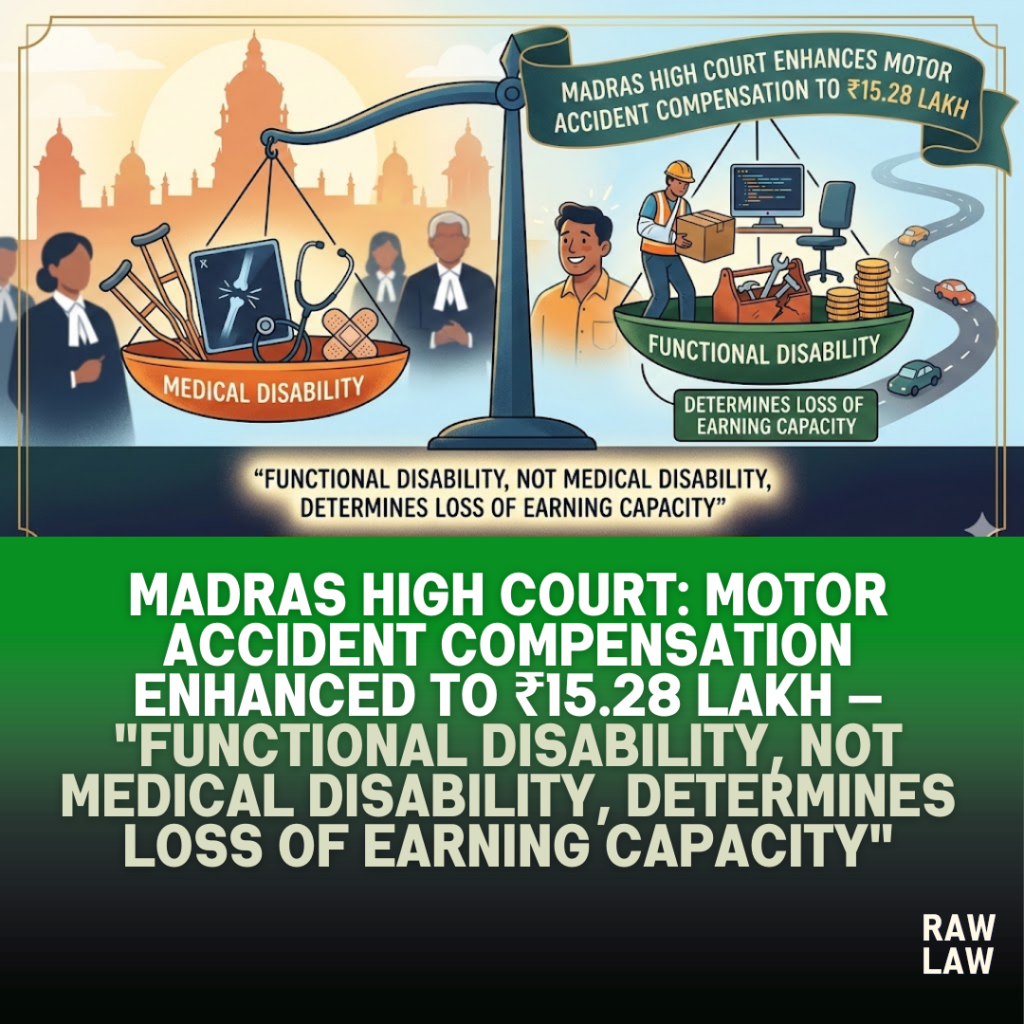
The Court noted that medical disability assessed by doctors does not automatically translate into loss of earning capacity. Instead, tribunals must determine functional disability and evaluate how the injury affects the claimant’s profession and ability to earn.
7. Precedent analysis
The Court relied heavily on the landmark judgment of the Supreme Court of India in Raj Kumar v. Ajay Kumar.
In that decision, the Supreme Court clarified that the percentage of permanent physical disability cannot automatically be equated with the percentage of loss of earning capacity.
The tribunal must instead determine the functional disability by examining how the injury affects the claimant’s profession, earning ability, and daily activities.
Applying these principles, the High Court held that the tribunal correctly fixed the claimant’s functional disability at 30% despite the medical board assessing physical disability at 41%.
8. Court’s reasoning
The Court found no reason to interfere with the tribunal’s finding on negligence. The FIR was registered against the bus driver, and the transport corporation failed to prove that the claimant alone caused the accident.
However, the Court agreed with the tribunal that the claimant should also have exercised caution and therefore upheld the finding of 20% contributory negligence.
Regarding compensation, the Court held that the tribunal had correctly assessed income and functional disability. However, it found the compensation for pain and suffering and loss of amenities to be inadequate considering the nature of fractures and surgeries.
Accordingly, the Court enhanced these heads while confirming the remaining components of the award.
9. Conclusion
The High Court concluded that the tribunal’s findings on negligence and functional disability were legally sound and supported by evidence.
However, the Court enhanced the compensation under certain heads to ensure that the claimant received just compensation for the injuries suffered.
The total compensation was increased to ₹19,10,000 before applying contributory negligence, resulting in a payable amount of ₹15,28,000 after deducting 20% negligence attributed to the claimant.
10. Implications
The judgment reiterates a crucial principle in motor accident compensation law: medical disability and loss of earning capacity are not identical.
Courts must carefully evaluate the functional impact of injuries on a claimant’s profession rather than mechanically applying the percentage of physical disability.
The ruling also reinforces the principle that contributory negligence may be applied even where the primary negligence lies with another party, ensuring equitable allocation of liability.
Case Law References
- Raj Kumar v. Ajay Kumar (2011) 1 SCC 343: The Supreme Court laid down detailed principles for assessing compensation in injury cases. It held that functional disability affecting earning capacity must be distinguished from medical disability and assessed based on the claimant’s occupation and circumstances.
FAQs
1. How is disability assessed in motor accident compensation cases?
Courts distinguish between medical disability and functional disability. While doctors determine the percentage of physical disability, courts assess how that disability affects the victim’s ability to earn.
2. Can a claimant receive compensation even if partly responsible for the accident?
Yes. Courts apply the principle of contributory negligence. Compensation is reduced proportionately based on the claimant’s share of negligence.
3. What factors determine compensation for injury in motor accident cases?
Courts consider the nature of injuries, permanent disability, loss of earning capacity, medical expenses, pain and suffering, and loss of amenities.