


1. Court’s decision
The Madras High Court partly allowed a civil miscellaneous appeal filed by the family members of a deceased accident victim seeking enhancement of compensation awarded by the Motor Accident Claims Tribunal.
While increasing the compensation payable to the claimants, the Court rejected the appeal filed by the insurance company that challenged the finding of negligence as well as the quantum of compensation.
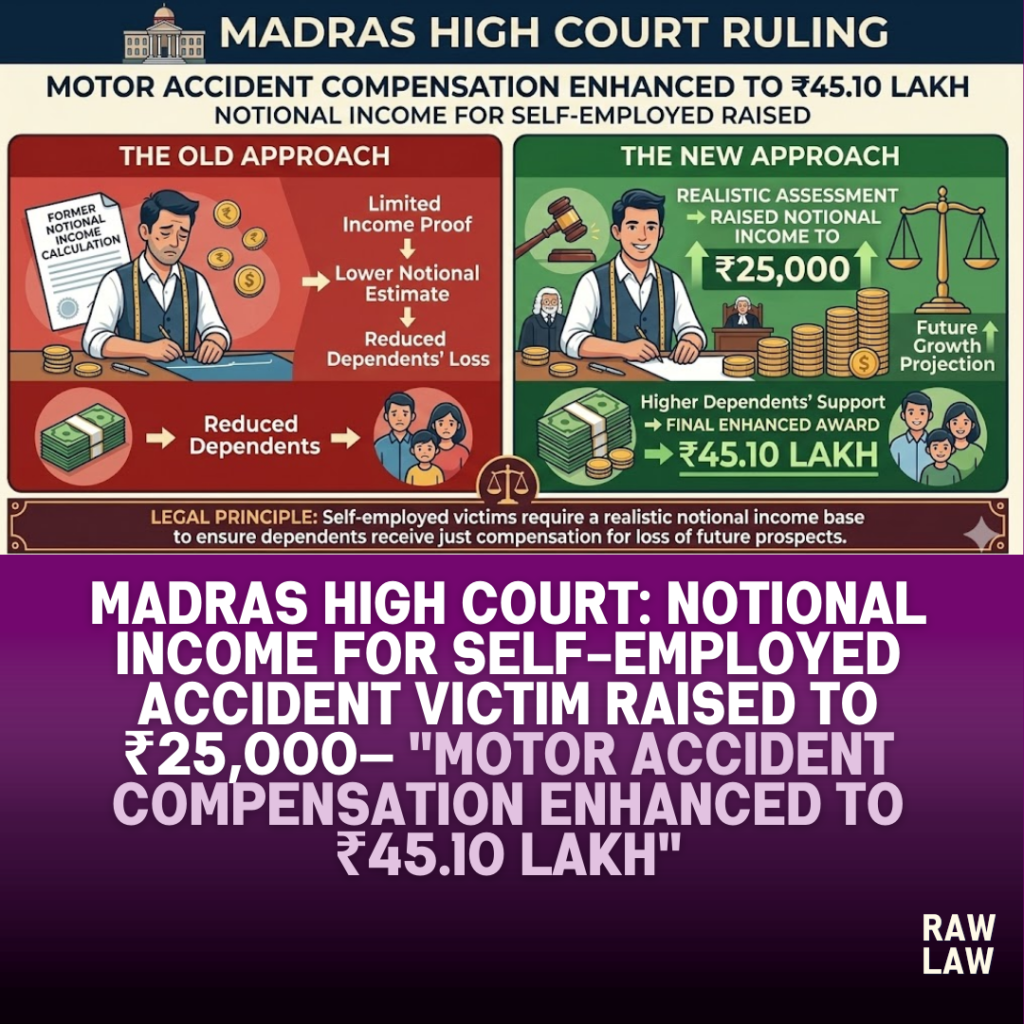
After reassessing the deceased’s income and applying the relevant legal principles governing motor accident compensation, the Court enhanced the total compensation to ₹45,10,000 and directed the insurer to deposit the amount with interest.
2. Facts
The case arose from a fatal road accident that occurred on 30 April 2018 on OMR Salai near AKDR Tower in Chennai.
According to the claimants, the deceased was standing near an auto rickshaw when a car driven in a rash and negligent manner entered the service lane from the main road and collided with the auto. The impact caused severe injuries to the deceased, who later succumbed to those injuries in hospital.
The claim petition was filed by the deceased’s wife, children and mother seeking compensation of ₹1,25,00,000 under the Motor Vehicles Act against the owner of the car and its insurer.
3. Issues
The High Court examined several questions arising from the appeals filed by both sides.
The first issue was whether the Tribunal had correctly held that the accident occurred due to the rash and negligent driving of the offending car.
The second issue concerned whether the compensation awarded by the Tribunal was adequate, particularly in relation to the monthly income of the deceased.
The Court also examined whether the notional income adopted by the Tribunal required revision in light of the evidence and circumstances of the case.
4. Petitioner’s arguments
The claimants argued that the Tribunal had fixed the monthly income of the deceased at ₹20,000, which was unrealistically low.
According to the claimants, the deceased owned and operated two auto rickshaws and earned more than ₹50,000 per month through self-employment and rental income.
They therefore sought enhancement of compensation by requesting the Court to adopt a higher notional income and recalculate the loss of dependency accordingly.
5. Respondent’s arguments
The insurance company challenged both the finding of negligence and the amount of compensation awarded by the Tribunal.
It argued that the auto rickshaw was parked in the service lane and that the accident occurred due to the manner in which the vehicle was stationed. The insurer contended that the Tribunal had wrongly attributed negligence solely to the driver of the car.
The insurer also argued that since the claimants had failed to prove the income of the deceased through documentary evidence, the Tribunal should have adopted a lower notional income in accordance with established precedents.
6. Analysis of the law
The Court analysed the principles governing compensation in motor accident cases under the Motor Vehicles Act, 1988.
Courts are required to determine compensation based on the concept of “just compensation”, which involves assessing the loss suffered by dependants due to the death of the victim.
In cases where income cannot be conclusively proved, courts may fix a reasonable notional income based on the nature of employment, age of the deceased and prevailing economic conditions.
The Court also applied the established multiplier method and principles relating to future prospects in accordance with Supreme Court precedents.
7. Precedent analysis
The Court relied upon the decision of the Supreme Court of India in National Insurance Co. Ltd. v. Pranay Sethi for determining future prospects.
Under that judgment, courts are required to add a specified percentage to the income of the deceased to account for future prospects.
The Court also applied the multiplier principle laid down in Sarla Verma v. Delhi Transport Corporation for calculating loss of dependency.
8. Court’s reasoning
The Court noted that the FIR and charge sheet had been filed against the driver of the offending car. The insurance company had not produced any evidence contradicting the prosecution records or proving contributory negligence.
Accordingly, the Court confirmed the Tribunal’s finding that the accident occurred due to the rash and negligent driving of the car driver.
With respect to income, the Court held that the Tribunal had underestimated the earnings of the deceased. Considering his occupation as an auto owner and driver and the economic conditions prevailing in 2018, the Court fixed the notional monthly income at ₹25,000 instead of ₹20,000.
After adding 25% towards future prospects, deducting one-fifth for personal expenses due to the presence of seven dependants, and applying multiplier 14, the Court recalculated the loss of dependency at ₹42,00,000.
9. Conclusion
The High Court partly allowed the appeal filed by the claimants and enhanced the total compensation from ₹36,70,000 to ₹45,10,000.
The appeal filed by the insurance company was dismissed. The insurer was directed to deposit the enhanced compensation with interest at 7.5% per annum from the date of filing of the claim petition until realization.
The Court also directed that the shares of minor claimants be deposited in fixed deposits until they attain majority.
10. Implications
The judgment reiterates that courts must ensure fair and realistic assessment of income when calculating compensation in motor accident cases involving self-employed victims.
By revising the notional income and applying the multiplier method in accordance with Supreme Court guidelines, the Court reaffirmed the principle that compensation must reflect the economic realities faced by the dependants of the deceased.
The ruling also underscores that insurers cannot challenge findings of negligence without producing convincing contrary evidence.
Case Law References
- National Insurance Co. Ltd. v. Pranay Sethi (2017)
The Supreme Court laid down principles for determining future prospects in motor accident compensation cases. - Sarla Verma v. Delhi Transport Corporation (2009)
The Court established the multiplier method used to calculate loss of dependency in motor accident claims.
FAQs
1. How do courts calculate compensation in motor accident death cases?
Courts calculate compensation using the multiplier method, which involves determining the victim’s income, adding future prospects, deducting personal expenses and applying an age-based multiplier.
2. What happens if the victim’s income cannot be proved?
Courts may fix a reasonable notional income based on the victim’s occupation, age and economic conditions at the time of the accident.
3. Can an insurance company challenge negligence findings in motor accident cases?
Yes, but the insurer must provide convincing evidence to rebut the findings of the tribunal. Without such evidence, courts usually uphold the tribunal’s determination.