


Court’s decision
The Madras High Court quashed the prosecution initiated against the Petitioner for offences under Sections 69 and 351(2) of the Bharatiya Nyaya Sanhita, holding that the allegations, even if taken at face value, disclosed nothing more than the breakdown of a long-term consensual relationship between two educated adults. The Court noted that criminal law, especially provisions relating to sexual offences based on alleged false promise to marry, must be invoked with great caution and only where consent is vitiated by deceit that exists at the inception of the relationship.
In examining the prosecution’s reliance on Section 69 BNS—which criminalises sexual relations obtained through deceit or false promise of marriage—the Court referred to authoritative precedents including Deepak Gulati v. State of Haryana, Mahesh Damu Khare v. State of Maharashtra, Amol Bhagwan Nehul v. State of Maharashtra, and Biswajyoti Chatterjee v. State of West Bengal. These cases collectively emphasise that every breach of promise or failed relationship cannot be elevated to a criminal offence unless there is clear material to show a fraudulent intent at the inception of the relationship.
The Court agreed with this judicial trajectory, holding that the continuation of an intimate relationship over several years without protest negates the existence of deceit from the beginning. The Court also rejected the Section 351(2) BNS charge, applying the Supreme Court’s reasoning in Prashant v. State (NCT of Delhi) that criminal intimidation cannot arise from disputes flowing out of consensual relationships.
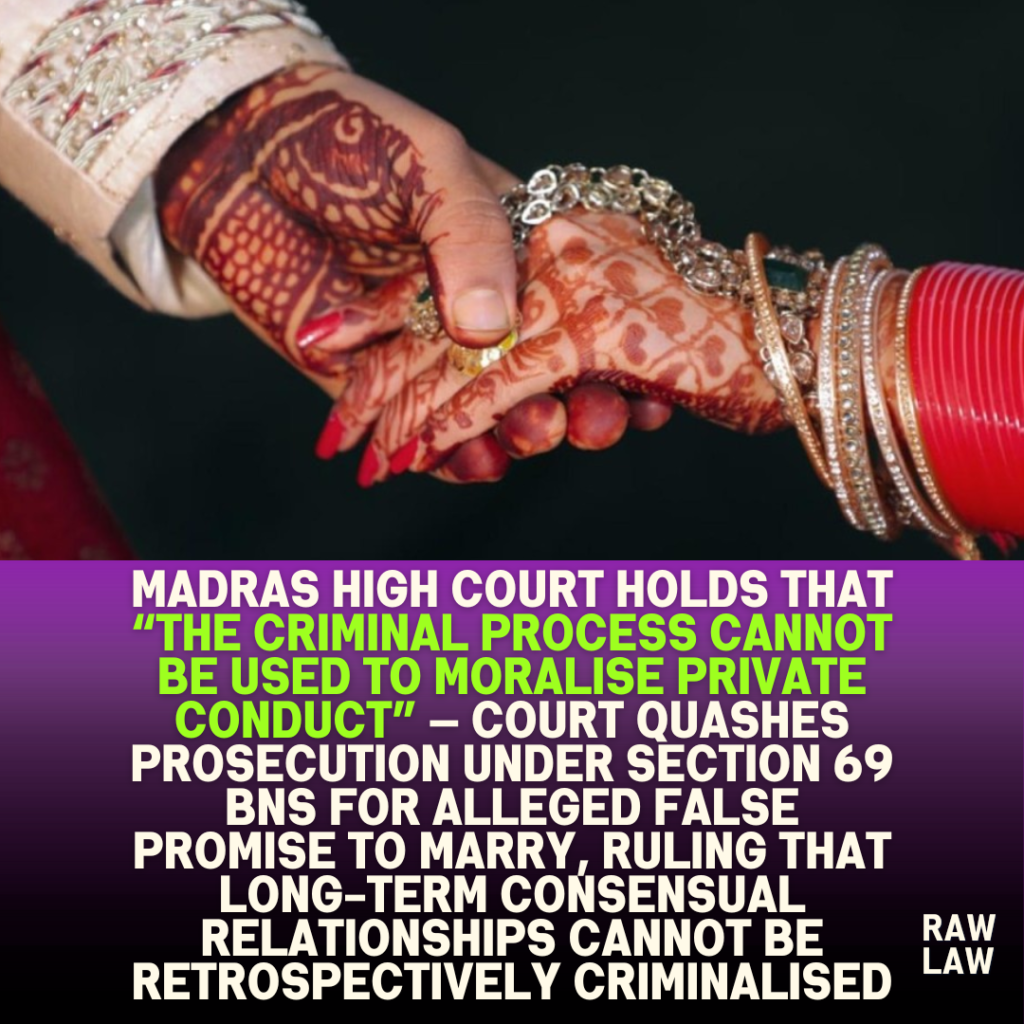
Reiterating that criminal law cannot serve as a tool for moral policing or resolving emotional discord, the Court emphasized that “the criminal process cannot be used to moralise private conduct or convert personal disappointment into litigation.” Consequently, the proceedings before the Magistrate were quashed in entirety, and the connected applications were closed.
Facts
The case arose from a long-standing intimate relationship between the Petitioner and the complainant, both of whom were pursuing higher education at the relevant time. The complainant later became a practicing Advocate. Their interaction began during their college years and developed into a relationship involving repeated instances of physical intimacy. According to the prosecution, the complainant initially acceded to the relationship because of the Petitioner’s alleged promise to marry. She contended that the Petitioner reiterated this promise over time but eventually refused to proceed with marriage, citing caste differences. She further alleged that the Petitioner invited her to a secluded location at one stage and engaged in sexual intercourse against her will, though the continued relationship thereafter was admittedly consensual.
The complainant lodged a criminal complaint only after several years of consensual intimacy, asserting that the Petitioner had no real intention to marry her from the beginning. The Petitioner disputed these allegations and maintained that the relationship was voluntary and mutual. He contended that the complaint was lodged only after the relationship broke down and that no element of deceit or coercion existed when the relationship commenced or continued. These conflicting versions formed the basis of the proceedings challenged before the High Court.
Issues
- Whether the allegations made by the complainant satisfied the essential ingredients of the offence under Section 69 BNS, which criminalises sexual intercourse obtained by deceitful means or false promise of marriage without intention to fulfil the same.
- Whether the charge under Section 351(2) BNS for criminal intimidation could be sustained when the parties had an admitted consensual intimate relationship over several years.
- Whether continuation of the prosecution would amount to an abuse of the criminal process when the dispute appears to arise purely from the breakdown of a personal relationship rather than any actionable criminal conduct.
Petitioner’s arguments
The Petitioner asserted that the relationship was entirely voluntary and spanned several years, demonstrating unequivocally that both parties entered into it with full understanding and without any form of deceit. He emphasized that the complainant was a legally trained professional who clearly understood the consequences of her actions and that her claim of being deceived was an afterthought introduced only upon the deterioration of the relationship. The Petitioner argued that criminal liability under Section 69 BNS cannot be imposed unless the complainant demonstrates that a false promise was made at the inception with mala fide intent. He maintained that the complaint was motivated by personal animosity, and that the absence of timely protest over the years dispelled any notion that the relationship was induced by deception.
Respondent’s arguments
The Respondent State and complainant contended that the Petitioner wrongfully induced the complainant into a physical relationship by making a promise to marry that he never intended to fulfil. They argued that this alleged deception vitiated her consent under Section 69 BNS. The Respondents further asserted that the complainant’s decision to continue the relationship stemmed from her belief in the Petitioner’s assurances, and that his later refusal to marry—particularly when justified by caste differences—reflected the falsity of the promise from the beginning. They also maintained that the Petitioner’s conduct amounted to criminal intimidation under Section 351(2) BNS when he allegedly threatened her after she confronted him about marriage.
Analysis of the law
Section 69 BNS criminalises sexual intercourse obtained through deceitful means or false promise of marriage where the accused harboured no intention of fulfilling the promise at the inception. The jurisprudence consistently draws a distinction between a promise that could not ultimately be fulfilled and a promise that was false from the very beginning. Courts have repeatedly held that subsequent failure to marry, without more, does not automatically render the initial consent invalid.
The High Court interpreted Section 69 BNS through the lens of prior Supreme Court decisions, which emphasize examining the timing, conduct, and continuity of the relationship. Consent must be evaluated in context, including the autonomy and awareness of both parties. Consent provided by an adult with full agency, over an extended period and without contemporaneous objection, significantly weakens any claim of initial deception.
Regarding Section 351(2) BNS, the offence of criminal intimidation requires a clear threat intended to cause alarm and compel a person to act in a manner they are not legally bound to. When emotional or interpersonal disputes arise within consensual relationships, the courts have generally resisted categorizing such interactions as criminal intimidation unless there is explicit, intentional coercion.
Precedent analysis
The Court relied heavily on Deepak Gulati, which clarified that only promises made with mala fide intent at the inception of the relationship can vitiate consent. The Supreme Court’s view that prolonged consensual intimacy dilutes any claim of misconception of fact was central to the judgment.
The Court also referred to Mahesh Damu Khare, which held that long-term consensual relationships negate the possibility that a person continued to consent based solely on a misrepresentation regarding marriage. Amol Bhagwan Nehul reinforced the Court’s stance that criminal law must not be invoked to address personal disappointments arising from failed relationships. Finally, Biswajyoti Chatterjee was invoked to caution against the misuse of criminal proceedings in disputes rooted in consensual partnerships.
Court’s reasoning
The Court concluded that the complainant willingly engaged in a multi-year relationship, fully aware of her actions and the nature of the intimacy. Nothing in the record indicated that the Petitioner harboured deceitful intent when the relationship commenced. The complainant also continued the relationship over years without protest, which undercuts any claim of vitiated consent. The Court stressed that consent by an adult, particularly a law-trained professional, carries strong evidentiary weight against allegations of deception.
Regarding Section 351(2) BNS, the Court held that disagreements or emotional disputes arising from a failed relationship do not constitute criminal intimidation. The Court noted that it is inappropriate to employ the criminal justice system to resolve personal disputes between consenting adults.
The Court observed broader social implications, acknowledging the increasing number of prosecutions arising from failed relationships and cautioning against criminalising consensual intimacy. It reiterated that criminal law deals with legality, not morality, and must not become a tool for moral censure or emotional retaliation.
Conclusion
The Court held that the continuation of the prosecution would amount to an abuse of the process of law, as the allegations failed to satisfy the legal thresholds under both Sections 69 and 351(2) BNS. Emphasizing the autonomy of consenting adults and the need to prevent misuse of criminal law, the Court quashed the proceedings and closed the connected matters.
Implications
This judgment reinforces the judiciary’s consistent stance that Section 69 BNS must not become a vehicle for criminalising consensual relationships that later deteriorate. It strengthens the principle that consent, once freely given by an adult of sound understanding, cannot be retrospectively invalidated merely because the relationship ended unfavourably. The decision provides clarity for courts, lawyers, and complainants on the evidentiary burden required to sustain allegations based on false promise of marriage. It further discourages the use of criminal law for resolving private relationship disputes, emphasising that the criminal process is a tool for addressing genuine wrongdoing, not emotional fallout.