


1. Court’s decision
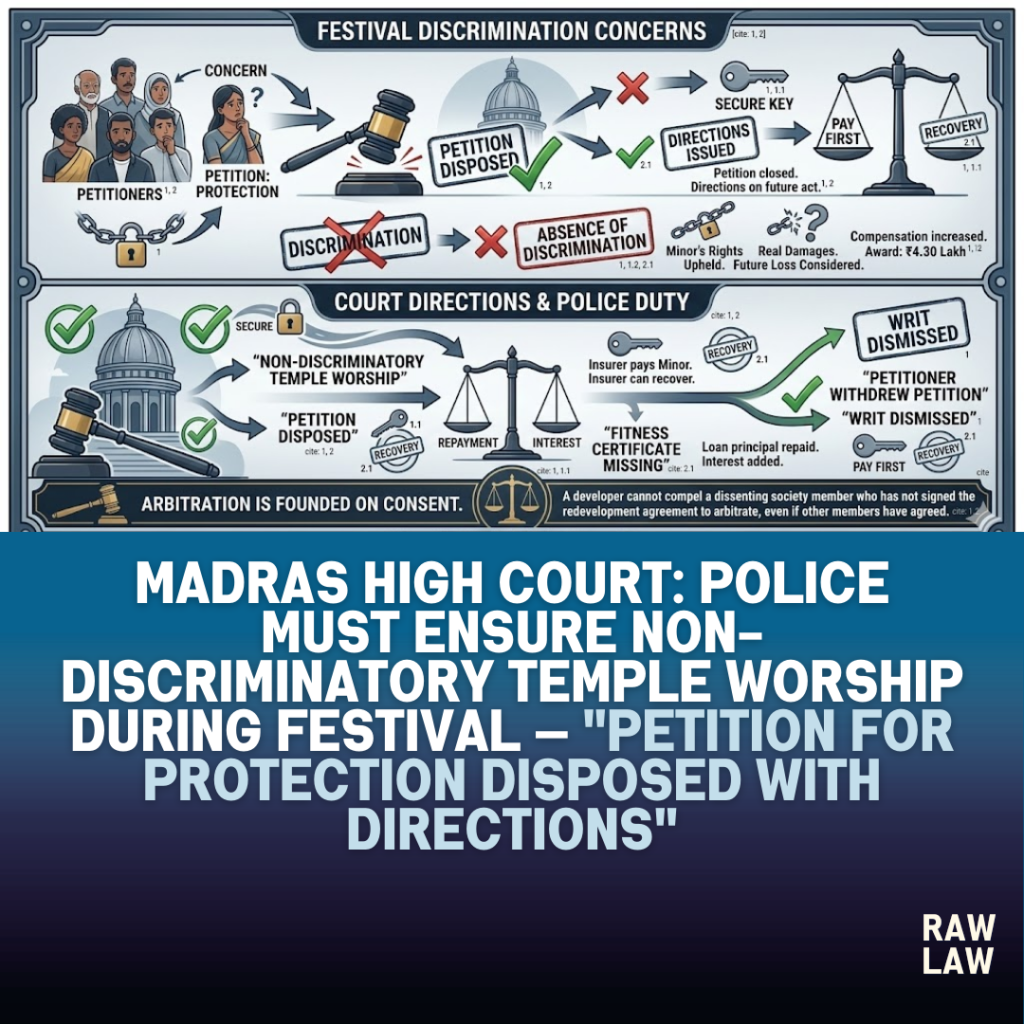
The Madras High Court disposed of a writ petition seeking police protection for villagers intending to participate in a temple festival in Dharmapuri district.
The Court directed the local police to ensure that individuals belonging to the petitioner’s group are not discriminated against while worshipping in the temple. At the same time, the Court noted that the temple festival had already been scheduled and commenced according to a public notice, and therefore it should continue without disruption.
The Court instructed the police authorities to take necessary action if any disturbance or obstruction arises during the festival.
2. Facts
The petitioner approached the Court representing villagers from Thimmampatty Colony in M.G.R. Nagar, Palacode Taluk of Dharmapuri District.
According to the petitioner, villagers belonging to a particular group sought permission to worship at Arulmigu Sri Pulla Muniyappan Temple and to participate in the temple consecration and festival scheduled between 6 March 2026 and 8 March 2026.
A representation dated 25 February 2026 had been submitted to the police authorities requesting permission and protection to participate in the religious ceremony.
However, apprehending possible obstruction or conflict with another group involved in organising the festival, the petitioner sought a direction from the High Court for police protection and for ensuring peaceful participation in the temple event.
3. Issues
The Court examined the following legal questions arising from the petition.
The first issue was whether the petitioner and members of his group were entitled to participate in worship at the temple festival without discrimination.
The second issue concerned whether the Court should direct the police authorities to provide protection or regulate participation in the festival.
The Court also considered whether any judicial intervention was necessary to prevent potential law and order issues during the religious event.
4. Petitioner’s arguments
The petitioner contended that villagers belonging to his group wished to participate in the temple consecration ceremony and worship at the temple during the scheduled festival.
It was argued that a formal representation had been submitted to the police requesting permission and protection, but adequate assurance had not been provided.
The petitioner therefore sought a writ directing the police authorities to permit them to worship and to ensure that they could participate in the temple festival without interference from other groups.
5. Respondent’s arguments
The State, represented by the Additional Public Prosecutor, informed the Court that another group of villagers had already organised the temple festival and were conducting it through their own contributions.
The State submitted that the festival had already commenced and that it should not be disturbed by unnecessary interference.
However, the prosecution clarified that the petitioner’s group could not be discriminated against in matters of worship. It also assured the Court that if any law and order problem arose, the police would take appropriate action to maintain peace and ensure smooth conduct of the festival.
6. Analysis of the law
The Court examined the constitutional framework governing religious freedom and the duty of state authorities to maintain public order.
Under the Constitution, individuals have the right to practice and participate in religious activities subject to public order and law and order considerations.
The Court also noted that the role of the police in such disputes is primarily to maintain peace and prevent conflict rather than to interfere in the internal management of religious events unless necessary to prevent disturbances.
7. Precedent analysis
Indian courts have repeatedly held that law enforcement authorities must ensure that religious practices are carried out peacefully without discrimination among participants.
Judicial precedents emphasise that courts generally avoid micromanaging religious events and instead issue directions to authorities to ensure equality and public order.
Following this principle, the Court adopted a limited approach by directing police supervision while allowing the festival to proceed according to the existing arrangements.
8. Court’s reasoning
The Court took note of the statement made by the prosecution that the festival was already in progress and organised by villagers through their own contributions.
The Court observed that the petitioner’s grievance primarily related to the possibility of discrimination in worship rather than cancellation or alteration of the festival itself.
Therefore, instead of issuing detailed directions regulating the festival, the Court instructed the police to ensure that there is no discrimination in allowing worship at the temple.
The Court further directed the police to intervene if any disturbance or obstruction arises during the festival.
9. Conclusion
The High Court disposed of the writ petition with directions to the local police authorities to ensure equal access to worship and maintain law and order during the temple festival.
The Court clarified that the festival already scheduled and in progress should continue without disruption, and any disturbance must be handled by the police in accordance with law.
No further relief was granted, and the connected miscellaneous petition was also closed.
10. Implications
The judgment underscores the judiciary’s approach in resolving local disputes involving religious events by balancing religious freedom with maintenance of public order.
Instead of directly intervening in the organisation of temple festivals, courts typically issue supervisory directions to police authorities to ensure peaceful conduct of religious ceremonies.
The ruling also reiterates that participation in religious worship cannot be denied on discriminatory grounds and that law enforcement authorities must ensure equal access to places of worship.
Case Law References
- Constitutional protection of religious freedom
Courts consistently hold that individuals have the right to participate in religious worship subject to public order, morality and health. - Judicial approach in festival disputes
Courts generally direct police authorities to maintain law and order rather than interfere with the conduct of religious festivals unless necessary.
FAQs
1. Can courts order police protection for temple festivals?
Yes. Courts can direct police authorities to provide protection or maintain law and order when there is a risk of conflict during religious events.
2. Can a group be prevented from worshipping at a temple festival?
No. Courts have consistently held that worshippers cannot be discriminated against unless restrictions are required for maintaining public order.
3. What role do police play in religious festival disputes?
Police authorities must ensure that festivals are conducted peacefully and that no group faces discrimination or obstruction while participating in religious worship.