


Court’s decision
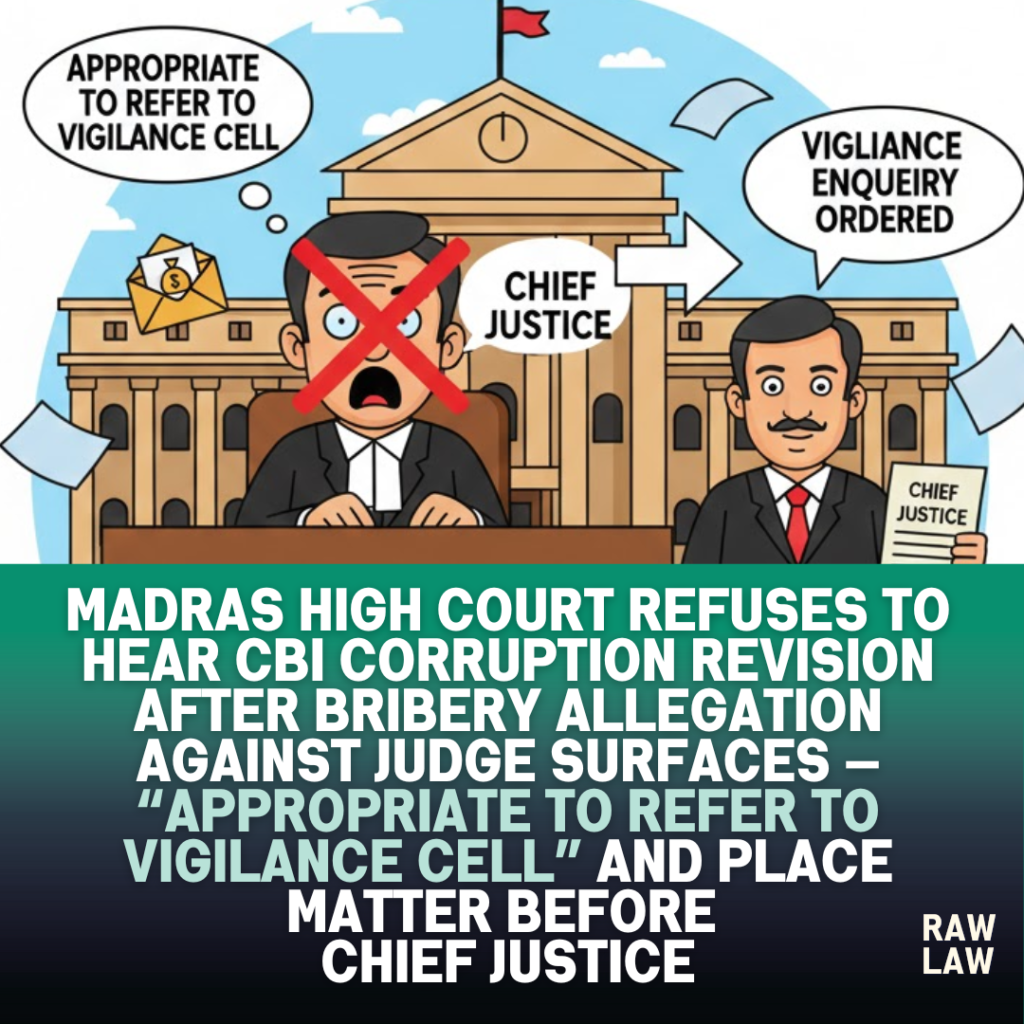
The Madras High Court declined to proceed with the criminal revision and quashing petitions in a pending CBI corruption case after receiving a communication alleging that a senior advocate had collected ₹50 lakhs claiming it was meant for the presiding judge. Observing that the representation contained specific and serious allegations affecting the dignity of the Court, the judge held that the matter must be referred to the Vigilance Cell of the High Court. The case was directed to be placed before the Hon’ble Chief Justice for assignment to an appropriate Bench and for further directions regarding inquiry.
Facts
The matter before the Court consisted of a criminal revision petition under Sections 397 and 401 of the Criminal Procedure Code and a connected petition seeking quashing of the charge sheet in a CBI corruption case pending before the XII Additional Special Judge for CBI Cases, Chennai. The petitions were listed for further hearing and for submission of citations relied upon by counsel for the petitioners.
At that stage, the Registry received a communication from the Ministry of Law and Justice, Department of Legal Affairs, forwarding a representation from the All India Lawyers’ Association for Justice (AILAJ). The communication and annexure were scanned and extracted in the order for reference.
The annexed representation alleged that a senior advocate had collected ₹50,00,000 from a client stating that the amount was to be given to the presiding judge in connection with the pending criminal revision and connected petition. It further alleged that despite receipt of the amount, no order had been passed in the case and requested the judge to pass suitable orders or take action.
The Court shared the communication with the Special Public Prosecutor for CBI cases and with the learned Senior Counsel appearing for the petitioner. The Senior Counsel submitted that the allegations were totally false and expressed readiness to cooperate with any enquiry.
The Special Public Prosecutor contended that such representations should not be entertained and that they adversely affect the dignity of the Court, urging that stern steps be taken to identify the person behind the representation and initiate appropriate action.
Issues
The primary issue before the Court was not the merits of the CBI corruption case but whether it was appropriate for the same judge to continue hearing the criminal revision and quashing petition in light of specific bribery allegations contained in the representation.
A connected issue was whether the representation warranted a formal vigilance inquiry and whether the matter should be placed before the Chief Justice for appropriate administrative action.
The case thus raised concerns relating to judicial propriety, institutional integrity, allegations of judicial corruption, and the need to preserve public confidence in the justice delivery system.
Petitioner’s arguments
The petitioner’s Senior Counsel submitted that the allegations in the representation were completely false and baseless. It was stated that the defence was prepared to cooperate with any enquiry that may be initiated to ascertain the truth. The submission emphasized that the allegations were unsubstantiated and appeared motivated. However, the counsel did not press for continuation of hearing in the face of the communication, instead indicating openness to any course of action the Court deemed appropriate to safeguard institutional credibility.
Respondent’s arguments
The Special Public Prosecutor for CBI cases argued that representations of this nature should not be entertained as they cast aspersions on the judiciary and undermine the dignity of the Court. It was contended that strict action should be taken to identify the origin of such allegations and proceed against those responsible. The prosecution emphasized that the integrity of judicial proceedings must be protected and that frivolous or malicious complaints should not derail ongoing criminal proceedings.
Analysis of the law
The order reflects core principles of judicial propriety and institutional discipline. When specific allegations are made suggesting bribery in relation to a pending judicial proceeding, the presiding judge must ensure that no shadow of doubt lingers over the adjudicatory process.
The Criminal Procedure Code empowers the High Court to exercise revisional jurisdiction and inherent powers in appropriate cases. However, the exercise of such powers must also satisfy the broader constitutional mandate of ensuring fairness, transparency, and public confidence in the justice system.
Judicial ethics demand that a judge recuse or refrain from hearing a matter if circumstances create a reasonable apprehension regarding impartiality. Even in the absence of proven wrongdoing, the appearance of bias or impropriety can undermine public trust.
By referring the matter to the Vigilance Cell and placing it before the Chief Justice, the Court adhered to established administrative mechanisms within the High Court framework for handling complaints concerning judicial conduct or allegations affecting judicial integrity.
Precedent analysis
Although the order does not elaborate on specific precedents, the principles governing recusal and judicial discipline are well settled in Indian jurisprudence. Courts have consistently held that justice must not only be done but must also appear to be done.
In cases involving allegations affecting a judge’s impartiality, courts have emphasized that even a reasonable apprehension of bias can justify recusal. The institutional head, namely the Chief Justice, holds administrative authority to assign matters to appropriate Benches and to direct inquiries through vigilance mechanisms where necessary.
The present order aligns with these principles by prioritizing institutional integrity over continuation of proceedings by the same Bench.
Court’s reasoning
The Court noted that the representation contained specific allegations alleging collection of ₹50 lakhs purportedly to influence the outcome of the pending case. Given the gravity of the allegations and their direct connection to the matter being heard, the Court found it inappropriate to proceed with the hearing.
The judge observed that the issue should be referred to the Vigilance Cell of the High Court for inquiry. In view of the circumstances, the Court expressed its disinclination to continue hearing the case.
Accordingly, the matter was directed to be placed before the Hon’ble Chief Justice for posting before an appropriate Bench and for issuance of suitable directions to the Vigilance Cell to conduct an enquiry and take appropriate action.
This approach ensured that the allegations would be examined through institutional channels without compromising the fairness of the pending criminal proceedings.
Conclusion
The Madras High Court’s order underscores the judiciary’s commitment to transparency and accountability. Faced with allegations of bribery linked to a pending CBI corruption case, the Court chose institutional safeguards over procedural continuation.
Rather than dismissing the representation outright or proceeding with the hearing, the Court opted to refer the matter to the Vigilance Cell and sought administrative directions from the Chief Justice. This step protected both the integrity of the judicial process and the rights of the parties.
The criminal revision and quashing petitions will now be heard by an appropriate Bench, ensuring that the adjudication remains untainted by allegations.
Implications
This ruling carries significant implications for judicial integrity and corruption-related litigation. It reinforces that allegations of judicial impropriety, even if unproven, must be addressed transparently through established vigilance mechanisms.
For litigants in CBI corruption cases and other sensitive matters, the order demonstrates that the High Court prioritizes institutional credibility over expediency. It also signals that complaints affecting judicial dignity will be scrutinized through proper channels.
The decision may influence future cases where allegations arise during pendency of proceedings, establishing that referral to vigilance authorities and reassignment of the case is an appropriate response.
Ultimately, the order strengthens public confidence in the justice system by showing that the judiciary is willing to subject itself to scrutiny when serious allegations surface.
Case law references
The order primarily deals with administrative and ethical principles rather than detailed precedent analysis. However, it reflects established jurisprudence that:
- Justice must not only be done but must appear to be done.
- Reasonable apprehension of bias can warrant recusal.
- The Chief Justice holds administrative authority to assign matters to appropriate Benches.
- Vigilance mechanisms within High Courts are competent to examine allegations affecting judicial conduct.
The Court applied these principles by declining to proceed and directing institutional inquiry, rather than adjudicating the merits amidst allegations.
FAQs
1. Can a High Court judge refuse to hear a case if bribery allegations surface?
Yes. If specific allegations arise that could affect judicial impartiality or public confidence, a judge may decline to hear the case and refer the matter to appropriate authorities to ensure fairness and transparency.
2. What happens when a complaint alleges judicial corruption in a pending case?
Such allegations are typically referred to the High Court’s Vigilance Cell or appropriate administrative authority. The Chief Justice may reassign the case to another Bench to protect the integrity of proceedings.
3. Does this order mean the criminal case is dismissed?
No. The High Court did not decide the merits of the criminal revision or quashing petition. The matter will be placed before the Chief Justice for assignment to another Bench and for further action regarding the inquiry.