


1. Court’s decision
A Division Bench of the Madras High Court dismissed a writ petition filed by a senior government officer challenging the dismissal of his service dispute by the Central Administrative Tribunal.
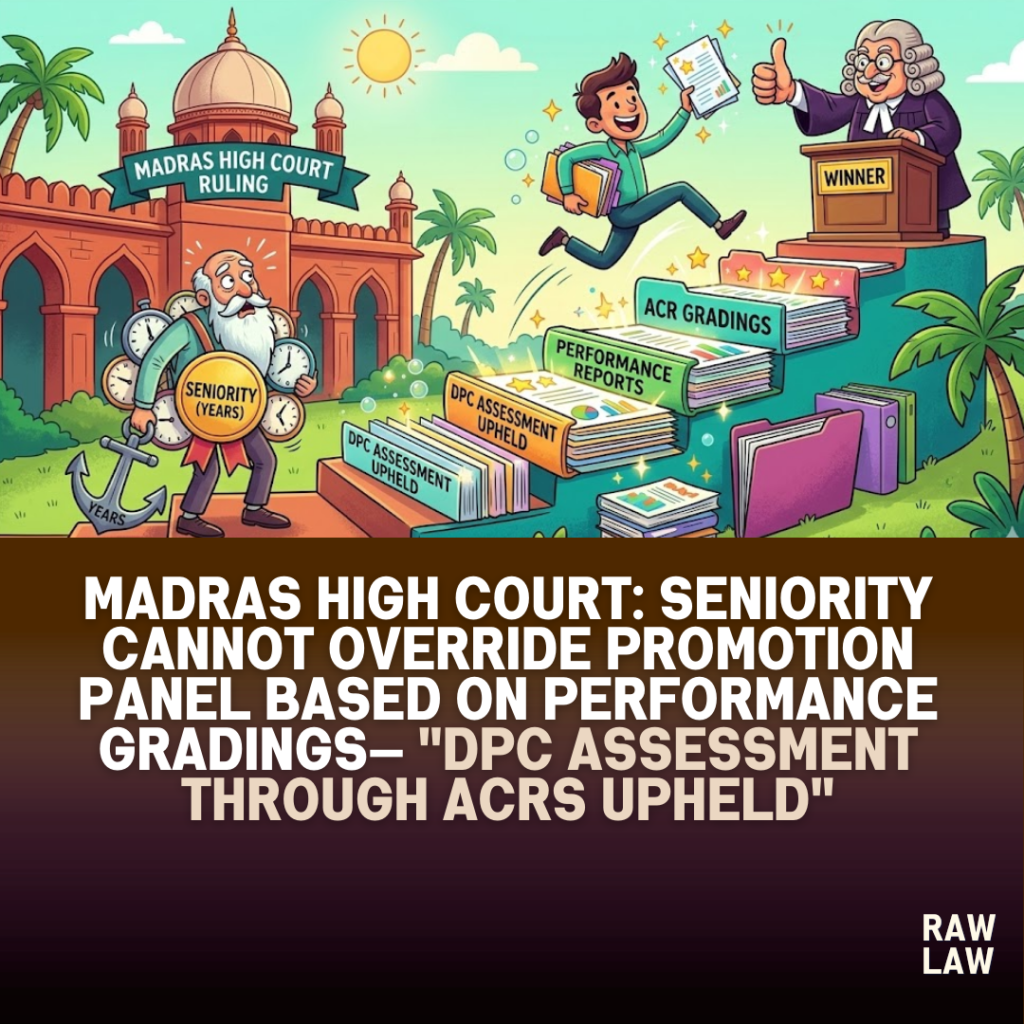
The Court held that the Tribunal had correctly concluded that the petitioner could not claim seniority in the post of Director over other officers who had been promoted earlier through a duly constituted Department Promotion Committee.
The Bench found that the promotions had been made after evaluating the Annual Confidential Reports of eligible candidates and that the process was neither arbitrary nor illegal. Accordingly, the Court refused to interfere with the Tribunal’s decision.
2. Facts
The petitioner was serving as Regional Director of Apprenticeship Training in Chennai when he approached the Tribunal. He had earlier been promoted as Director in the year 2002.
The dispute arose after the petitioner examined the seniority list of Directors and discovered that he had been placed below certain officers who were junior to him in the earlier post of Joint Director.
The petitioner contended that since he was senior to those officers in the feeder cadre, he should also be placed above them in the seniority list of Directors. After his representation seeking revision of seniority was rejected by the authorities, he filed an application before the Tribunal seeking correction of the seniority list.
3. Issues
The High Court examined several legal questions in the dispute.
The primary issue was whether an officer who was senior in the feeder post could claim seniority in the promoted post when other officers had been promoted earlier based on merit evaluation.
Another issue concerned whether the Department Promotion Committee had acted arbitrarily while preparing promotion panels for the years 2000–01 and 2001–02.
The Court also considered whether the Tribunal’s dismissal of the petitioner’s application suffered from any legal infirmity warranting interference under Article 226 of the Constitution.
4. Petitioner’s arguments
The petitioner argued that it was an undisputed fact that he was senior to the private respondents in the post of Joint Director.
He contended that when promotions to the post of Director were considered, the authorities should have preserved the seniority relationship that existed in the feeder cadre. According to him, placing his juniors above him in the seniority list of Directors was unjustified and violated service rules governing promotions.
The petitioner therefore sought quashing of the Tribunal’s orders and restoration of his seniority above the officers who had been promoted earlier.
5. Respondent’s arguments
The government authorities argued that the promotions had been made strictly on the basis of merit as assessed through Annual Confidential Reports.
The Department Promotion Committee examined ACRs for the relevant period while preparing the promotion panel. For the vacancies pertaining to the year 2000–01, the officers who were later arrayed as respondents had received the grading “very good,” whereas the petitioner had received the grading “good.”
Because of this difference in performance evaluation, the respondents were promoted earlier. The petitioner was subsequently promoted in the following year’s panel after receiving a “very good” grading in later ACRs.
6. Analysis of the law
The Court analysed the legal principles governing promotions in public service. Promotions to higher posts are often based on merit-cum-seniority or selection methods that require assessment of performance through confidential reports.
Where promotions are made through a Department Promotion Committee that evaluates service records and ACR gradings, the selection process is primarily merit-based.
In such circumstances, officers promoted earlier through the selection process acquire seniority in the promoted cadre based on the date of promotion, not the seniority they held in the feeder cadre.
7. Precedent analysis
Courts have consistently held that when promotions are made through a merit-based selection process, the seniority in the higher cadre depends on the order of promotion rather than the inter se seniority in the lower post.
Judicial precedents emphasize that once the Department Promotion Committee applies objective criteria such as ACR grading and performance records, the resulting promotion order cannot be disturbed unless there is clear evidence of arbitrariness or procedural violation.
The High Court applied these principles to examine the validity of the promotion panels in the present case.
8. Court’s reasoning
The Court observed that the Department Promotion Committee had considered filling six vacancies in the post of Director for the years 2000–01 and 2001–02.
While preparing the promotion panel for the year 2000–01, the DPC examined the ACRs of eligible candidates and found that the private respondents had received the grading “very good,” whereas the petitioner had received only the grading “good.”
Accordingly, those officers were promoted for the vacancies of that year. When the panel for the following year was prepared, the petitioner had obtained “very good” grading and was therefore promoted for the vacancies of 2001–02.
The Court held that the promotions had been made based on a legitimate evaluation of performance and were not arbitrary. Therefore, the petitioner could not claim seniority over officers who had been promoted earlier.
9. Conclusion
The High Court concluded that the Tribunal had correctly analysed the facts and the applicable service law principles.
Since the promotions had been made on the basis of ACR gradings evaluated by the Department Promotion Committee, there was no illegality in placing the petitioner below the officers who had been promoted earlier.
The Court therefore dismissed the writ petition and upheld the orders passed by the Central Administrative Tribunal.
10. Implications
The judgment reiterates an important principle of service jurisprudence: seniority in a feeder cadre does not automatically translate into seniority in the promoted cadre when promotions are based on merit or performance assessment.
By affirming the role of Department Promotion Committees in evaluating service records and ACR gradings, the Court reinforced the importance of objective performance-based criteria in government promotions.
The ruling also underscores the limited scope of judicial review over administrative decisions relating to promotions when the process is carried out in accordance with established procedures.
Case Law References
- Service law principle on merit-based promotions
Courts consistently hold that promotions determined by selection or merit through a Department Promotion Committee are valid unless shown to be arbitrary or contrary to rules. - Administrative review under Article 226
High Courts exercise limited judicial review over administrative decisions and typically refrain from interfering with promotion decisions taken through lawful procedures.
FAQs
1. Can a government employee claim seniority in a promoted post based on earlier seniority?
Not necessarily. When promotions are based on merit through a Department Promotion Committee, seniority in the higher post depends on the date of promotion rather than seniority in the feeder cadre.
2. What role do Annual Confidential Reports play in promotions?
ACRs are used to evaluate the performance and suitability of officers for promotion. Higher gradings can influence selection and the order of promotion.
3. Can courts interfere with promotion decisions made by a Department Promotion Committee?
Courts generally do not interfere unless the promotion process is shown to be arbitrary, illegal, or in violation of statutory rules.