


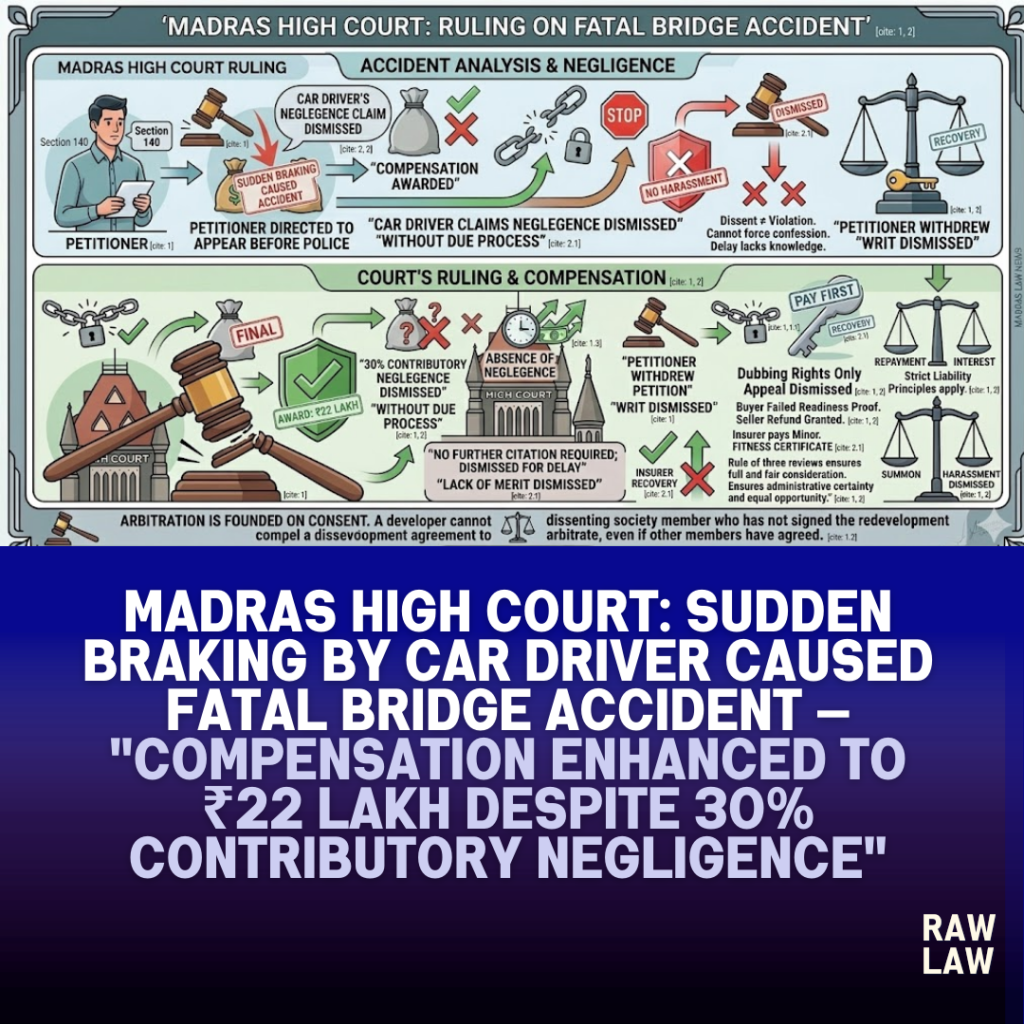
1. Court’s decision
The Madras High Court delivered a common judgment in a civil miscellaneous appeal and a cross-objection arising from a fatal motor accident claim.
The Court dismissed the appeal filed by the insurance company challenging the tribunal’s findings on negligence and compensation. At the same time, the Court partly allowed the cross-objection filed by the deceased victim’s parents seeking enhancement of compensation.
After recalculating the loss of dependency and revising the notional income of the deceased, the Court enhanced the compensation from ₹16,71,600 to ₹22,00,800 and directed the insurer to deposit the enhanced amount with interest within eight weeks.
2. Facts
The case arose from a road accident that occurred on 4 July 2019 on the Anna Arch Flyover in Chennai.
The deceased was riding a motorcycle when a car travelling in the same direction allegedly overtook the motorcycle and suddenly applied brakes. As a result, the motorcyclist lost control of the vehicle and collided with the protective wall of the bridge.
Due to the impact, the victim fell from the flyover and sustained severe injuries. He was immediately taken to the Rajiv Gandhi Government Hospital where he later succumbed to the injuries on 7 July 2019.
The deceased’s parents filed a claim petition seeking compensation of ₹40,00,000 for the loss of their son.
3. Issues
The High Court examined several legal issues arising from the appeal and cross-objection.
First, whether the tribunal had correctly apportioned contributory negligence between the car driver and the deceased motorcyclist.
Second, whether the tribunal had properly assessed the monthly income of the deceased while calculating loss of dependency.
Third, whether the compensation awarded by the tribunal was adequate and consistent with settled principles governing fatal motor accident claims.
4. Petitioner’s arguments
The insurance company argued that the accident occurred solely due to the rash and negligent driving of the deceased motorcyclist.
According to the insurer, the deceased failed to maintain a safe distance from the vehicle travelling ahead, which was mandatory under traffic regulations. The insurer contended that the motorcyclist collided with the rear portion of the car and subsequently lost control of the vehicle, resulting in the fall from the bridge.
It was also argued that the tribunal wrongly relied on the FIR and eyewitness testimony to attribute 70% negligence to the car driver. The insurer further contended that the income assessed by the tribunal was excessive and not supported by documentary proof.
5. Respondent’s arguments
The claimants, who were the parents of the deceased, argued that the accident occurred entirely due to the rash and negligent driving of the car driver who suddenly overtook the motorcycle and applied brakes without warning.
They submitted that the tribunal had wrongly attributed 30% contributory negligence to the deceased despite lack of evidence suggesting reckless riding.
The claimants further contended that the tribunal had fixed the monthly income of the deceased at ₹15,000 despite evidence showing that he was employed as a store assistant earning approximately ₹25,000 per month.
On these grounds, the claimants sought enhancement of compensation.
6. Analysis of the law
The Court analysed the principles governing motor accident compensation under the Motor Vehicles Act, 1988.
It reiterated that claims filed under Section 166 of the statute require proof of negligence on the part of the offending vehicle’s driver. However, such proof is determined on the basis of the standard of preponderance of probabilities rather than strict proof beyond reasonable doubt.
The Court also noted that tribunals dealing with motor accident claims are empowered to adopt a pragmatic approach while determining liability and calculating just compensation.
7. Precedent analysis
While calculating compensation, the Court relied on principles laid down by the Supreme Court of India in two landmark cases.
In National Insurance Co. Ltd. v. Pranay Sethi, the Supreme Court laid down the formula for determining future prospects and conventional heads of compensation in fatal accident cases.
The Court also relied on Sarla Verma v. Delhi Transport Corporation, which standardised the multiplier method for calculating loss of dependency based on the age of the deceased.
These precedents guided the Court in recalculating the compensation payable to the claimants.
8. Court’s reasoning
The Court found that the tribunal had relied on the testimony of an eyewitness and portions of the FIR to determine negligence.
According to the Court, the car driver’s act of suddenly braking after overtaking the motorcycle contributed significantly to the accident. However, the Court also observed that the deceased motorcyclist could have avoided the accident by maintaining a safer distance from the vehicle ahead.
Therefore, the Court held that the tribunal had correctly apportioned negligence at 70% on the car driver and 30% on the deceased.
With regard to compensation, the Court revised the notional monthly income of the deceased from ₹15,000 to ₹20,000 and recalculated the loss of dependency by applying a 40% addition for future prospects and a multiplier of 18.
9. Conclusion
The High Court concluded that the tribunal’s findings on negligence were legally sound and supported by evidence.
However, the Court found that the tribunal had undervalued the deceased’s income while computing compensation.
Accordingly, the Court enhanced the loss of dependency from ₹22,68,000 to ₹30,24,000 and increased the total compensation to ₹31,44,000. After deducting 30% contributory negligence, the payable compensation was fixed at ₹22,00,800.
10. Implications
The ruling reinforces that courts must adopt a balanced approach while determining contributory negligence in motor accident cases, particularly where both drivers could have avoided the accident through reasonable care.
The judgment also highlights that tribunals must carefully assess the income of deceased victims to ensure that dependants receive just and realistic compensation.
Additionally, the case reaffirms the continued application of the multiplier method and future prospects formula laid down by the Supreme Court for calculating loss of dependency.
Case Law References
- National Insurance Co. Ltd. v. Pranay Sethi (2017)
The Supreme Court established uniform guidelines for calculating compensation in motor accident death cases, including future prospects and conventional heads. - Sarla Verma v. Delhi Transport Corporation (2009)
This judgment standardised the multiplier method used to calculate loss of dependency in fatal accident compensation cases.
FAQs
1. What is contributory negligence in motor accident cases?
Contributory negligence occurs when both parties involved in an accident share responsibility for the incident. Courts reduce compensation proportionately based on the victim’s share of negligence.
2. How is compensation calculated in fatal motor accident cases?
Courts calculate compensation using the multiplier method, considering the deceased’s income, future prospects, age, number of dependants, and deductions for personal expenses.
3. Can courts revise the income of the deceased if proof is insufficient?
Yes. Courts may determine a reasonable notional income based on circumstances such as the victim’s profession, age, and prevailing wages when documentary proof is limited.