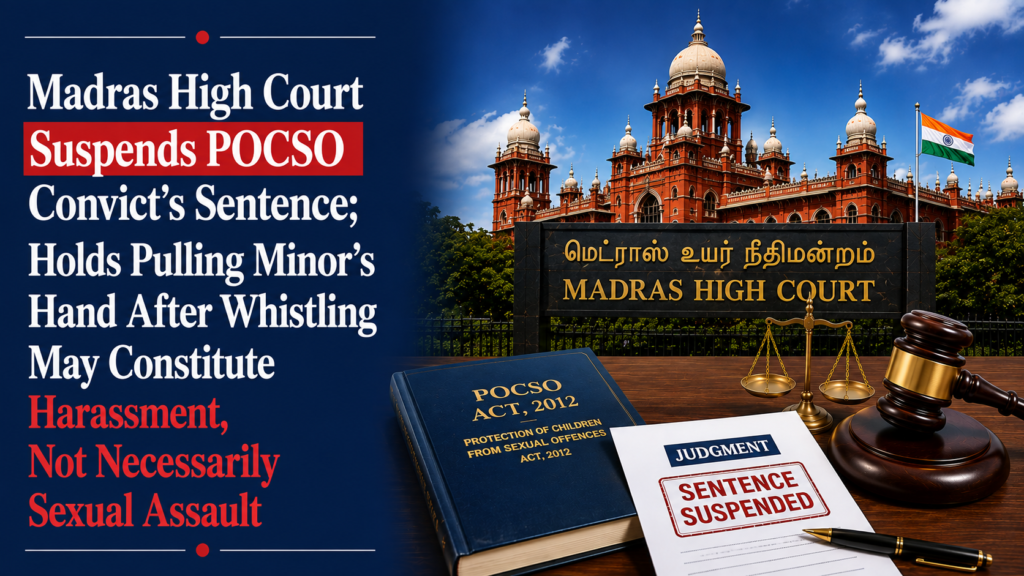
Madras High Court Holds Every Physical Contact with a Minor Does Not Automatically Amount to Sexual Assault Under POCSO
Facts
The petitioner, Mandai @ Manogaran, was convicted by the Special POCSO Court, Chennai, for an offence under Section 8 of the Protection of Children from Sexual Offences (POCSO) Act and sentenced to three years’ rigorous imprisonment with a fine of ₹1,000. Pending disposal of his criminal appeal, he sought suspension of sentence under Section 430(1) of the Bharatiya Nagarik Suraksha Sanhita (BNSS) and release on bail.
According to the prosecution, on 1 March 2020, when the minor victim was returning after collecting food from her aunt’s house, the petitioner, who lived in the same residential compound, whistled at her from his balcony. When she ignored him, he allegedly came downstairs, pulled her hand and smiled at her. The victim informed her mother, following which a complaint was lodged and criminal proceedings were initiated.
Issues
- Whether the petitioner had made out a case for suspension of sentence pending appeal.
- Whether the material on record disclosed an arguable issue regarding the existence of sexual intent required under Section 8 of the POCSO Act.
- Whether the conviction required reconsideration in appeal.
Petitioner’s Arguments
The petitioner contended that the prosecution case arose out of an earlier quarrel between him and the victim’s father and that a false case had been foisted by exploiting the minority of the victim.
It was argued that even according to the victim’s own testimony, the petitioner merely pulled her hand and did nothing more. Counsel submitted that such conduct, at its highest, could amount to harassment under Section 11 of the POCSO Act, but did not constitute sexual assault punishable under Section 8, as there was no material establishing sexual intent.
It was further submitted that because the petitioner’s counsel before the trial court failed to file an application for suspension of sentence immediately after conviction, the petitioner continued to remain in prison despite having received only a three-year sentence, which is ordinarily suspended pending appeal.
Respondent’s Arguments
The State opposed the petition and submitted that the victim had consistently narrated the incident in:
- the FIR,
- her statement under Section 164 CrPC,
- and her deposition before the trial court.
It was argued that these materials sufficiently established the petitioner’s conduct and justified the conviction under the POCSO Act.
However, the State fairly acknowledged that, in the ordinary course, where the sentence imposed is three years, trial courts generally suspend the sentence pending appeal, though no such application had been filed in the present case.
Analysis of the Law
The High Court examined the evidence available at the stage of considering suspension of sentence.
The Court focused on the statutory requirement that the alleged act must disclose sexual intent for attracting liability under Section 8 of the POCSO Act. The Court observed that the evidence presently available suggested only that the petitioner:
- whistled at the victim,
- came downstairs,
- pulled her hand when she ignored him,
- after which the victim freed herself and informed her mother.
The Court observed that such conduct could not automatically be characterised as an act committed with sexual intent, and therefore the correctness of the conviction required closer scrutiny during the final hearing of the appeal.
Precedent Analysis
The order does not rely upon any judicial precedents. Instead, it turns on the Court’s prima facie assessment of the evidence and the statutory ingredients of Section 8 of the POCSO Act, particularly whether the prosecution evidence sufficiently establishes sexual intent at this stage.
Court’s Reasoning
Justice M. Nirmal Kumar noted that the victim was the sole eyewitness to the occurrence and that her evidence indicated only that the petitioner whistled at her and subsequently pulled her hand when she failed to respond.
The Court observed that, prima facie, such conduct could not straightaway be termed an act committed with sexual intent, and at the highest could amount to harassment rather than sexual assault. Consequently, the Court held that the conviction raised arguable questions requiring detailed examination in the pending criminal appeal.
Considering that:
- the appeal was unlikely to be heard immediately,
- the sentence imposed was only three years, and
- the petitioner had already undergone a substantial period of incarceration,
the Court found it appropriate to suspend execution of the sentence pending disposal of the appeal.
Conclusion
The Madras High Court suspended the petitioner’s sentence pending disposal of the criminal appeal.
The petitioner was directed to be released on bail upon executing a bond of ₹5,000 with two sureties, and was further directed to appear before the trial court once every three months until disposal of the appeal. The Court clarified that the appeal involved arguable issues regarding whether the alleged conduct amounted to sexual assault under Section 8 of the POCSO Act.
Case Details
Case: Mandai @ Manogaran v. State represented by the Inspector of Police
Court: High Court of Judicature at Madras
Case Number: CRL MP No. 11962 of 2026 in CRL A No. 830 of 2026
Judge: Hon’ble Mr. Justice M. Nirmal Kumar
Date: 10 July 2026
Result: Sentence Suspended and Bail Granted. The High Court held that the appeal raised arguable questions regarding whether the alleged act disclosed sexual intent under Section 8 of the POCSO Act, suspended the sentence and released the petitioner on bail pending appeal.