


Court’s decision
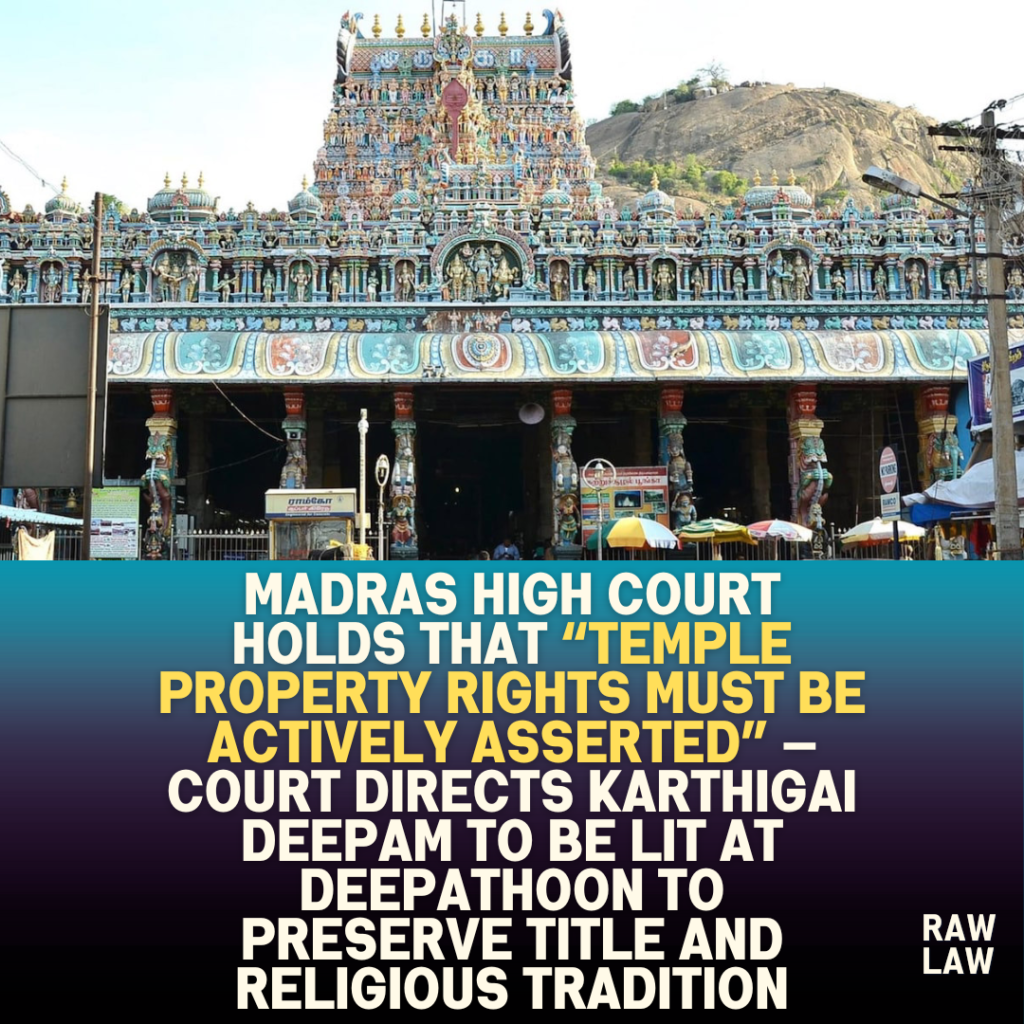
The Madurai Bench of the Madras High Court allowed a batch of writ petitions and directed the temple administration to light the Karthigai Deepam at the Deepathoon, an ancient stone lamp pillar located on the lower peak of Thirupparankundram Hill, in addition to the customary lighting near the Uchi Pillaiyar Temple. The Court quashed the impugned communication issued by the temple executive authority refusing permission for such lighting.
The Court held that the temple administration was under a legal duty to assert and protect temple property as declared by binding civil court decrees, including those affirmed by the Privy Council. It ruled that failure to assert such rights could eventually jeopardise temple ownership and that lighting the Deepam at Deepathoon was both lawful and necessary.
Facts
Multiple writ petitions were filed seeking directions to permit or mandate lighting of the Karthigai Deepam at the Deepathoon situated on Thirupparankundram Hill. The petitioners, devotees of the temple, contended that the Deepathoon was historically meant for lighting the festival lamp and that the practice had been unjustifiably discontinued.
The temple administration opposed the request, stating that the established custom for several decades was to light the Deepam near the Uchi Pillaiyar Temple located midway up the hill. Objections were also raised by authorities and religious institutions located on the hilltop, citing past disputes and apprehension of law and order issues.
Issues
The central issue before the Court was whether the temple administration could be directed to light the Karthigai Deepam at the Deepathoon located on the lower peak of Thirupparankundram Hill.
Ancillary issues included whether devotees had locus standi to seek such directions, whether the issue was barred by res judicata due to earlier litigation, whether the matter involved enforcement of custom or assertion of property rights, and whether such lighting would infringe the rights of other religious institutions situated on the hill.
Petitioner’s Arguments
The Petitioners contended that they were “persons having interest” in the temple under the Hindu Religious and Charitable Endowments Act and were entitled to seek judicial protection of temple property and practices. They argued that Deepathoon was a stone lamp pillar specifically erected for lighting festival lamps and that its very existence established the intended use.
It was further submitted that authoritative civil court decrees had conclusively declared temple ownership over the unoccupied portions of the hill, including the lower peak where Deepathoon is located. The Petitioners argued that lighting the Deepam was necessary not merely as a ritual, but as an assertion of title to prevent erosion of temple property rights.
Respondent’s Arguments
The Respondents opposed the petitions on the ground that the prevailing custom for over a century was to light the Karthigai Deepam near the Uchi Pillaiyar Temple and not at the Deepathoon. It was argued that deviation from this practice could disturb communal harmony and create law and order concerns.
The Respondents further contended that the writ petitions were barred by res judicata, as earlier attempts to light the Deepam at the hilltop had been rejected by the High Court and affirmed in appeal. It was also argued that any dispute regarding custom ought to be adjudicated by statutory authorities under the HR&CE Act rather than through writ proceedings.
Analysis of the law
The Court analysed the scope of writ jurisdiction in matters concerning temple administration, property protection, and rights of worshippers. It examined the definition of “person having interest” under the HR&CE Act and held that devotees are entitled to approach the Court when temple authorities fail to protect temple property.
The Court distinguished between disputes relating to custom and those relating to assertion of title. It held that the present case was not about altering custom but about enforcing and asserting temple ownership as declared by binding civil decrees. The Court emphasised that constitutional courts have a duty to ensure that temple properties are preserved and not lost due to inaction.
Precedent Analysis
The Court relied extensively on historical civil court judgments, including decrees passed in the early twentieth century that conclusively determined ownership of Thirupparankundram Hill. These decrees, affirmed by the Privy Council, held that except for specifically demarcated areas, the unoccupied portions of the hill vested with the temple.
The Court also relied on Supreme Court jurisprudence recognising the right of worshippers to approach courts when trustees fail to safeguard temple interests, and on High Court precedents affirming that festivals and religious practices constitute enforceable civil rights of worshippers.
Court’s Reasoning
The Court found that Deepathoon was located on the lower peak of the hill, at a safe distance from other religious structures, and well outside areas demarcated as belonging to other institutions. It held that lighting the Deepam at this location would not infringe any competing rights.
The Court reasoned that temple property rights must be periodically asserted to prevent encroachment or adverse claims. It held that abandonment of traditional practices connected with property assertion could weaken temple title over time. The Court concluded that the temple administration had failed in its duty and that judicial intervention was warranted.
Conclusion
The Madras High Court directed the temple administration to light the Karthigai Deepam at the Deepathoon and quashed the decision refusing such permission. The Court held that lighting the Deepam was a lawful exercise of temple rights, consistent with tradition, property ownership, and prior judicial decrees.
The judgment restores a practice linked to both religious observance and legal assertion of temple property, reaffirming the responsibility of temple authorities to act as vigilant custodians of endowed properties.
Implications
This judgment has significant implications for temple administration and protection of religious endowments. It clarifies that temple authorities cannot remain passive when property rights require active assertion and that devotees have standing to seek judicial intervention in such cases.
The ruling also underscores that long-standing civil decrees relating to religious property must be respected and enforced, and that practices connected with property assertion cannot be abandoned under the guise of administrative convenience or apprehension.