


HEADNOTE
Parwez Khan v. Shabnam Ara & Anr.
Court: High Court of Delhi
Bench: Swarana Kanta Sharma
Date of Judgment: 10 December 2025
Citation: CRL.REV.P.(MAT.) 114/2024
Laws / Sections Involved: Section 125 Code of Criminal Procedure, 1973; Revisional jurisdiction of High Court
Keywords: Interim maintenance, Section 125 CrPC, wife and child maintenance, earning capacity of wife, moral vs statutory obligations, family resource cake
Summary:
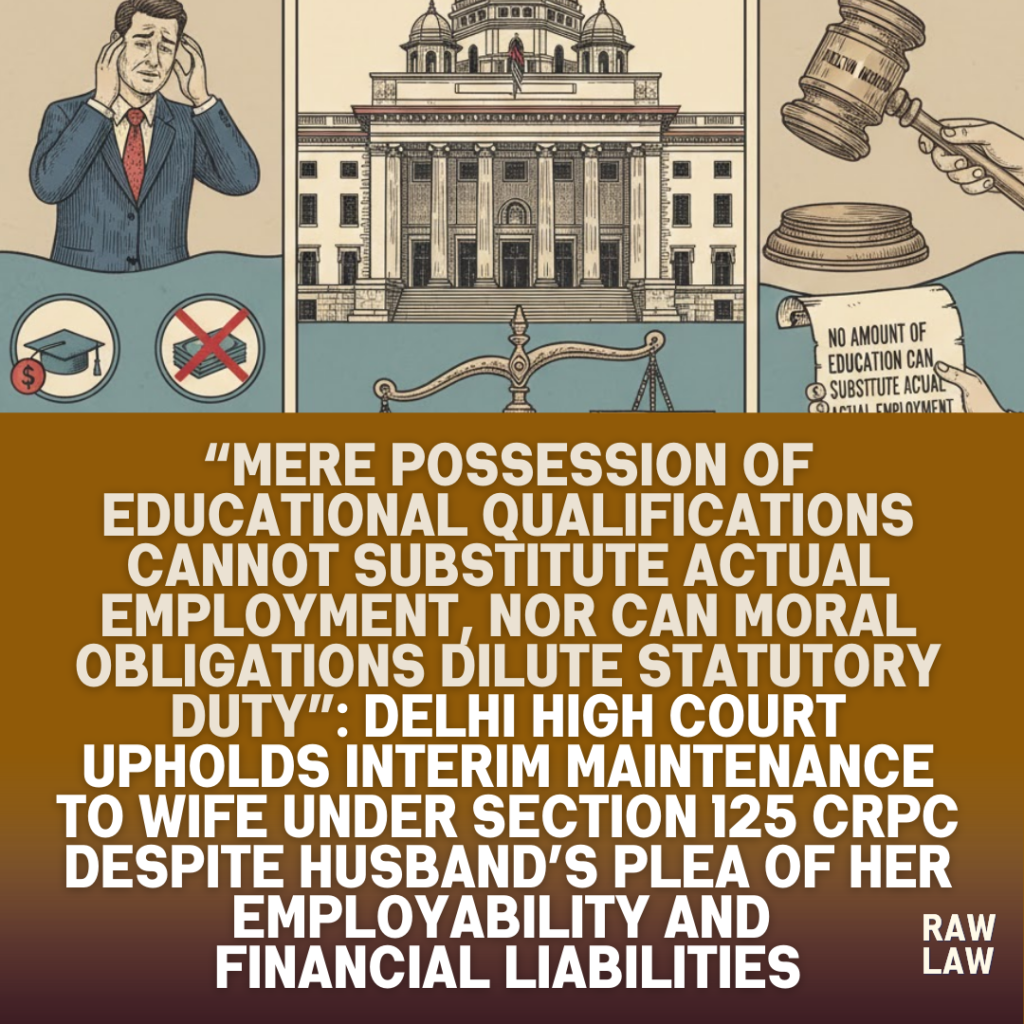
The Delhi High Court partly modified an interim maintenance order passed by the Family Court under Section 125 CrPC, reducing the amount payable to the minor child while affirming maintenance awarded to the wife. The Court held that mere educational qualifications of a wife cannot be a ground to deny maintenance in the absence of actual income, particularly where she is caring for a young child and suffers from health issues. While reiterating that a husband’s statutory duty to maintain his wife and child cannot be diluted by moral obligations towards parents or siblings, the Court applied the “family resource cake” principle to assess proportional distribution of income. Finding the Family Court’s approach legally sound, the High Court interfered only to marginally reduce the child’s maintenance considering her tender age, underscoring the limited scope of revisional interference in interim maintenance matters.
Court’s decision
The Delhi High Court disposed of the criminal revision petition by partly modifying the interim maintenance order dated 16 July 2024 passed by the Family Court, Saket. While affirming the grant of ₹15,000 per month as interim maintenance to the wife, the Court reduced the amount payable to the minor child from ₹15,000 to ₹10,000 per month. The Court held that the reasoning adopted by the Family Court was legally sound and did not warrant substantial interference in revision. It reiterated that revisional jurisdiction in interim maintenance matters is narrow and confined to correcting patent illegality, perversity, or manifest unreasonableness. Except for the limited modification concerning the child’s maintenance, all other directions of the Family Court, including payment of arrears and mode of payment, were left undisturbed.
Facts
The marriage between the petitioner-husband and respondent-wife was solemnised on 22 June 2018 in accordance with Muslim rites and ceremonies. The marriage was consummated, and a daughter was born from the wedlock, who was about three and a half years old at the time of the impugned order. Due to matrimonial discord, the wife initiated proceedings under Section 125 CrPC seeking maintenance for herself and the minor child, alleging neglect and failure on the part of the husband to maintain them. She asserted that she was a housewife with no independent source of income and was also suffering from health ailments, while being solely responsible for the care of the minor child. The Family Court, after considering income affidavits and material on record, directed the husband to pay ₹15,000 per month each to the wife and the child as interim maintenance.
Issues
The principal issue before the High Court was whether the Family Court had committed any legal error or perversity in granting interim maintenance to the wife and the minor child under Section 125 CrPC. The Court was also required to examine whether the quantum of interim maintenance fixed by the Family Court was excessive or arbitrary, particularly in light of the husband’s contentions that the wife was well-educated and capable of earning, and that he had several financial obligations towards his aged parents and divorced sister. Another issue concerned the permissible scope of interference by the High Court in revisional jurisdiction against an interim maintenance order.
Petitioner’s arguments
The husband contended that the Family Court had failed to properly appreciate the facts and circumstances of the case. He argued that the wife was highly educated, holding a Master’s degree in Business Administration, and was therefore capable of securing gainful employment to support herself. According to him, granting maintenance in such circumstances encouraged dependency rather than self-sufficiency. He further submitted that he had significant financial responsibilities, including caring for his aged and ailing parents and supporting his divorced sister and her child. It was also argued that the Family Court did not adequately consider the burden of loan EMIs and other personal expenses while determining the quantum of interim maintenance, rendering the order excessive and unjust.
Respondent’s arguments
The wife supported the impugned order, submitting that it was just, reasonable, and based on a proper appreciation of material on record. She argued that she had no independent source of income and was medically unfit to take up employment. Emphasis was placed on her responsibility of caring for the minor child, who was of tender age and required constant attention. It was contended that mere possession of educational qualifications does not translate into immediate employability or actual income. The wife further submitted that the husband was gainfully employed and had sufficient means, as reflected in his own income affidavit, but had willfully neglected to maintain his wife and child. The State also supported the order, stressing that statutory obligations under Section 125 CrPC override moral or voluntary financial commitments.
Analysis of the law
The High Court examined the object and scope of Section 125 CrPC, reiterating that the provision is a measure of social justice intended to prevent destitution and vagrancy. It emphasised that the provision aims to ensure that a wife, minor child, or parent who is unable to maintain themselves is provided with reasonable financial support commensurate with the means of the person liable to maintain them. At the interim stage, the Court noted, a detailed trial-like inquiry is neither contemplated nor desirable. Instead, courts are required to take a prima facie view of the financial capacity of the husband and the immediate needs of the dependents. Educational qualifications or theoretical earning capacity of the wife may be relevant but cannot be determinative in the absence of proof of actual income.
Precedent analysis
The Court relied upon the well-established “family resource cake” principle laid down in Anurita Vohra v. Sandeep Vohra, wherein the income of the earning member is treated as a common family resource to be equitably distributed. Under this principle, two shares are ordinarily allocated to the earning member to account for personal and professional expenses, while one share each is allocated to dependents. The Court also referred to its own recent decisions holding that voluntary liabilities such as personal loan EMIs cannot be treated as statutory deductions while computing maintenance. These precedents underscore that maintenance obligations cannot be defeated by unilateral financial decisions of the earning spouse.
Court’s reasoning
Justice Swarana Kanta Sharma observed that the scope of revisional interference with interim maintenance orders is limited and does not extend to reappreciation of evidence unless the order suffers from perversity or patent illegality. The Court found that the Family Court had correctly assessed the husband’s income at approximately ₹60,000 per month, based on his own disclosures. It also agreed with the Family Court’s conclusion that the husband’s father, being a retired government servant drawing pension, could not be treated as financially dependent, and that support to a divorced sister remained a moral obligation rather than a legal one. Applying the family resource cake principle, the Court held that the maintenance awarded to the wife was reasonable and proportionate. However, considering the tender age of the child, the Court found it appropriate to marginally reduce the child’s maintenance.
Conclusion
The Delhi High Court concluded that the interim maintenance of ₹15,000 per month awarded to the wife was just and warranted no interference. The maintenance awarded to the minor child was reduced from ₹15,000 to ₹10,000 per month, keeping in view her age and overall circumstances. All other directions of the Family Court, including payment of arrears from the date of application and the schedule and mode of payment, were affirmed. The revision petition was disposed of accordingly, with a clarification that observations made in the judgment would not affect the merits of the main maintenance proceedings pending before the Family Court.
Implications
This judgment reinforces settled principles governing interim maintenance under Section 125 CrPC. It clarifies that courts will not deny maintenance to a wife merely because she is educated, unless there is evidence of actual and sufficient income. The ruling also reiterates that statutory maintenance obligations towards a wife and minor child take precedence over moral or voluntary responsibilities towards other relatives. By reaffirming the limited scope of revisional interference, the judgment provides stability and predictability in interim maintenance jurisprudence, ensuring timely financial support to dependents during pendency of proceedings.
CASE LAW REFERENCES
• Anurita Vohra v. Sandeep Vohra – Family resource cake principle for distribution of income
• Sodan Singh Rawat v. Vipinta – Loan EMIs not deductible while computing maintenance
• Abhinav Kumar v. Swati – Voluntary financial liabilities cannot defeat maintenance claims
FAQs
Q1. Can maintenance be denied if the wife is well-educated?
No. Courts require proof of actual income; educational qualifications alone are insufficient to deny maintenance.
Q2. Do parents and siblings count as dependents under Section 125 CrPC?
Parents may be dependents if they lack means, but siblings generally have no such legal claim against the husband.
Q3. Can courts interfere with interim maintenance orders in revision?
Only in limited cases of patent illegality, perversity, or manifest unreasonableness.