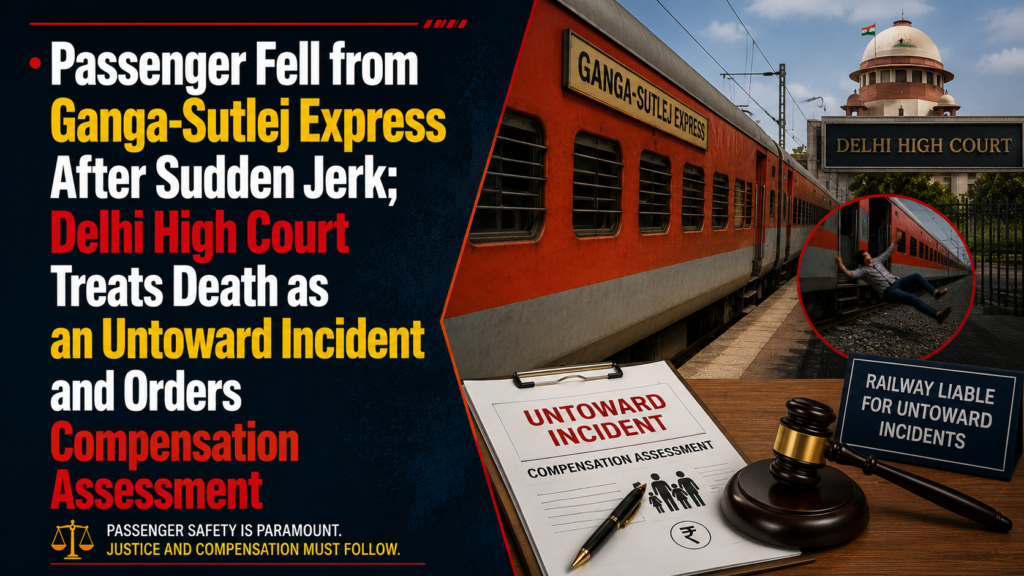
Missing Train Ticket Could Not Defeat Fatal-Fall Claim; Delhi High Court Holds Deceased Was a Bona Fide Passenger and Remands Case for Compensation
Facts
- On 30 September 2017, Riyasat Ali was travelling from Rampur to Lucknow aboard Train No. 13308, the Ganga-Sutlej Express.
- According to his family, when the train reached near Malihabad Railway Station, it gave a sudden jerk. Riyasat Ali accidentally fell from the train, came under it and sustained fatal injuries.
- His dependants, including Smt Sahana, filed a compensation claim before the Railway Claims Tribunal under the Railways Act, 1989.
- The Railway Claims Tribunal, Principal Bench, Delhi, dismissed the claim on 28 February 2022. It held that:
- the deceased had not been proved to be a bona fide passenger because no journey ticket was recovered from him; and
- the accident was not an “untoward incident” because Train No. 13308 had no scheduled stop at Malihabad and the deceased was presumed to have attempted to alight from a moving train.
- The claimants challenged that decision before the Delhi High Court under Section 23 of the Railway Claims Tribunal Act, 1987.
- There was a delay of 234 days in re-filing the appeal. The appellants explained that certain documents were illegible, certified copies had to be obtained, and the copies were inadvertently placed with another case file in their lawyer’s office.
Issues
- Whether sufficient cause existed to condone the 234-day delay in re-filing the appeal.
- Whether Riyasat Ali could be treated as a bona fide passenger even though his journey ticket was not recovered after the accident.
- Whether the evidence of the deceased’s son regarding the purchase of the ticket and boarding of the train was reliable.
- Whether the passenger’s fatal fall qualified as an “untoward incident” under Section 123(c), read with Section 124-A, of the Railways Act.
- Whether the absence of a scheduled stop at Malihabad justified the inference that the deceased voluntarily attempted to get down from a moving train.
- Whether the Railways had proved that the case fell within any statutory exception to compensation under the proviso to Section 124-A.
Appellants’ Arguments
- The Tribunal ignored contemporaneous records, including the Roznamcha entry, the statement of the RPF Sub-Inspector, the Panchnama and the post-mortem report. These documents connected the deceased’s injuries and death with the train accident.
- The deceased’s son, Shuab Ali, testified as AW-2 that he had personally purchased the Rampur-to-Lucknow ticket for his father and accompanied him to Rampur Railway Station, where he saw him board the train.
- AW-2 maintained this account during cross-examination, and nothing material was elicited to discredit his testimony.
- The Tribunal wrongly rejected AW-2’s evidence merely because the claim application did not specifically mention that he had purchased the ticket and accompanied his father to the station.
- Pleadings need to contain the material facts and are not required to include every detail that may later emerge in evidence.
- The mere non-recovery of the ticket did not establish that the deceased was travelling without authority.
- The absence of a scheduled stop at Malihabad did not prove that the deceased attempted to get down from the moving train.
- The consistent case of the family was that the deceased accidentally fell because of a sudden jerk.
Respondent’s Arguments
- No journey ticket was recovered from the deceased.
- There was allegedly no independent evidence proving that the deceased had travelled aboard Train No. 13308.
- The Railways relied upon the Divisional Railway Manager’s report and the Guard’s Memo Book to show that the train had no scheduled stop at Malihabad Railway Station.
- It was argued that the deceased must have attempted to get down from the moving train at a place where it was not scheduled to stop.
- Such conduct, according to the Railways, could not be treated as an untoward incident warranting compensation.
Analysis of the Law
- Section 23 of the Railway Claims Tribunal Act permits an appeal against the Tribunal’s decision on the grounds recognised by law.
- Section 123(c) of the Railways Act includes the accidental falling of a passenger from a train within the meaning of an “untoward incident.”
- Section 124-A creates statutory liability to pay compensation for death or injury caused by an untoward incident, subject to the specific exceptions contained in its proviso.
- A claimant must first place sufficient material showing that the victim was a bona fide passenger. This initial burden does not necessarily require the physical production of the journey ticket.
- A supporting affidavit or credible oral evidence regarding the purchase of the ticket and boarding of the train can discharge the initial burden. The Railways must then rebut that evidence with cogent material.
- Non-recovery of the ticket, without more, cannot establish that the victim was travelling without a valid ticket. A ticket may be lost or destroyed during the accident or subsequent handling of the body.
- Pleadings are required to state the material facts. Every detail of a witness’s proposed evidence need not be reproduced in the original claim application.
- The absence of a scheduled halt is merely a surrounding circumstance. It cannot, without direct or cogent supporting evidence, prove that a passenger voluntarily attempted to deboard a moving train.
- Once bona fide travel and an accidental railway fall are shown, the Railways must establish that the case falls within one of the statutory exceptions to compensation.
Precedent Analysis
- Mohsina v. Union of India, (2017) SCC OnLine Del 10003
- The Delhi High Court had condoned a delay of 804 days in filing a railway compensation appeal, taking account of the claimant’s weak financial circumstances.
- The precedent supported a liberal approach to delay in proceedings arising from beneficial compensation legislation.
- Relying partly on this principle, the Court condoned the 234-day re-filing delay in the present case.
- Reshma v. Union of India, FAO 25/2022
- A delay of 598 days was condoned because railway compensation law is beneficial legislation intended to provide relief to victims and their dependants.
- The decision reinforced that procedural delays should not ordinarily defeat a genuine compensation claim where sufficient cause is shown.
- Union of India v. Rina Devi, (2019) 3 SCC 572
- The Supreme Court held that the mere non-recovery or loss of a journey ticket does not automatically establish that the victim was not a bona fide passenger.
- A claimant may discharge the initial evidentiary burden by filing an affidavit setting out relevant facts. The burden then shifts to the Railways to rebut the claim through cogent evidence.
- In the present case, AW-2 gave direct evidence that he purchased the ticket and saw his father board the train. The Railways produced no convincing evidence to rebut that account.
- The High Court therefore held that Riyasat Ali had been proved to be a bona fide passenger.
- Jai Pal & Others v. Union of India, 2022 SCC OnLine Del 5420
- The Court held that the mere absence of a scheduled stop cannot support an inference that a passenger voluntarily attempted to get down from a moving train.
- Compensation under the beneficial provisions of the Railways Act cannot be denied on such an unsupported assumption.
- This principle directly applied because the Railways relied almost entirely on the absence of a scheduled stop at Malihabad.
- Ramesh Suneja v. Union of India, FAO 164/2016
- The Court held that the Tribunal cannot presume that a victim attempted to deboard a moving train merely because the train had no scheduled halt at the station concerned.
- Such a conclusion must be supported by direct or reliable evidence, rather than assumptions.
- Since no direct evidence of attempted deboarding existed in the present case, the Tribunal’s inference was legally unsustainable.
Court’s Reasoning
- AW-2 gave clear evidence that he purchased the journey ticket for his father, accompanied him to Rampur Railway Station and saw him board the train.
- His testimony remained consistent during cross-examination, and no material contradiction was brought out.
- AW-1, Smt Sahana, also stated that she had informed counsel about her son purchasing the ticket and helping the deceased board the train. Thus, AW-2’s evidence was not an afterthought or an improvement invented during the trial.
- The Tribunal should have assessed AW-2’s testimony on its own merits instead of rejecting it solely because every evidentiary detail was not mentioned in the claim application.
- The Railways did not produce any evidence contradicting the claim that the ticket had been purchased.
- Under Rina Devi, the non-recovery of the ticket was insufficient to deny the deceased the status of a bona fide passenger.
- The railway’s own records supported the occurrence of the accident. The Untoward Incident Report, Station Master’s diary, RPF entry, and the statements of the Station Master and Token Porter recorded that a person had fallen from Train No. 13308 near Malihabad and suffered fatal injuries.
- The inquest and post-mortem evidence further supported the connection between the death and the railway accident.
- The fact that the train did not have a scheduled stop at Malihabad did not prove that the deceased attempted to get down voluntarily.
- The Railways produced no eyewitness, direct evidence or other cogent material showing an attempted deboarding.
- The Railways also failed to plead or establish any of the statutory exceptions contained in the proviso to Section 124-A.
- Accordingly, the Tribunal’s findings that the deceased was neither a bona fide passenger nor a victim of an untoward incident were contrary to the evidence.
Conclusion
The Delhi High Court condoned the 234-day delay in re-filing the appeal and allowed the family’s appeal. It held that Riyasat Ali had been proved to be a bona fide passenger and that the Tribunal could not exclude the fatal fall from the scope of an untoward incident merely because the train had no scheduled stop at Malihabad.
The Tribunal’s judgment dated 28 February 2022 was set aside. The matter was remanded to the Tribunal solely to assess the compensation payable and direct its disbursement. The Tribunal was instructed to have the compensation disbursed within two months of receiving the High Court’s order. The parties were directed to appear before it on 13 August 2026.
Case Details
Case: Smt Sahana and Others v. Union of India
Court: High Court of Delhi at New Delhi
Case Number: FAO 287/2022; CM APPL. 49428/2022
Original Claim: OA/II(u)/GZB/72/2018
Judge: Hon’ble Mr Justice Manoj Kumar Ohri
Reserved on: 13 July 2026
Date of Judgment: 22 July 2026
Result: Re-filing delay condoned; appeal allowed; Tribunal’s rejection set aside; deceased held to be a bona fide passenger and the fatal fall treated as an untoward incident; matter remanded for assessment and disbursement of compensation.