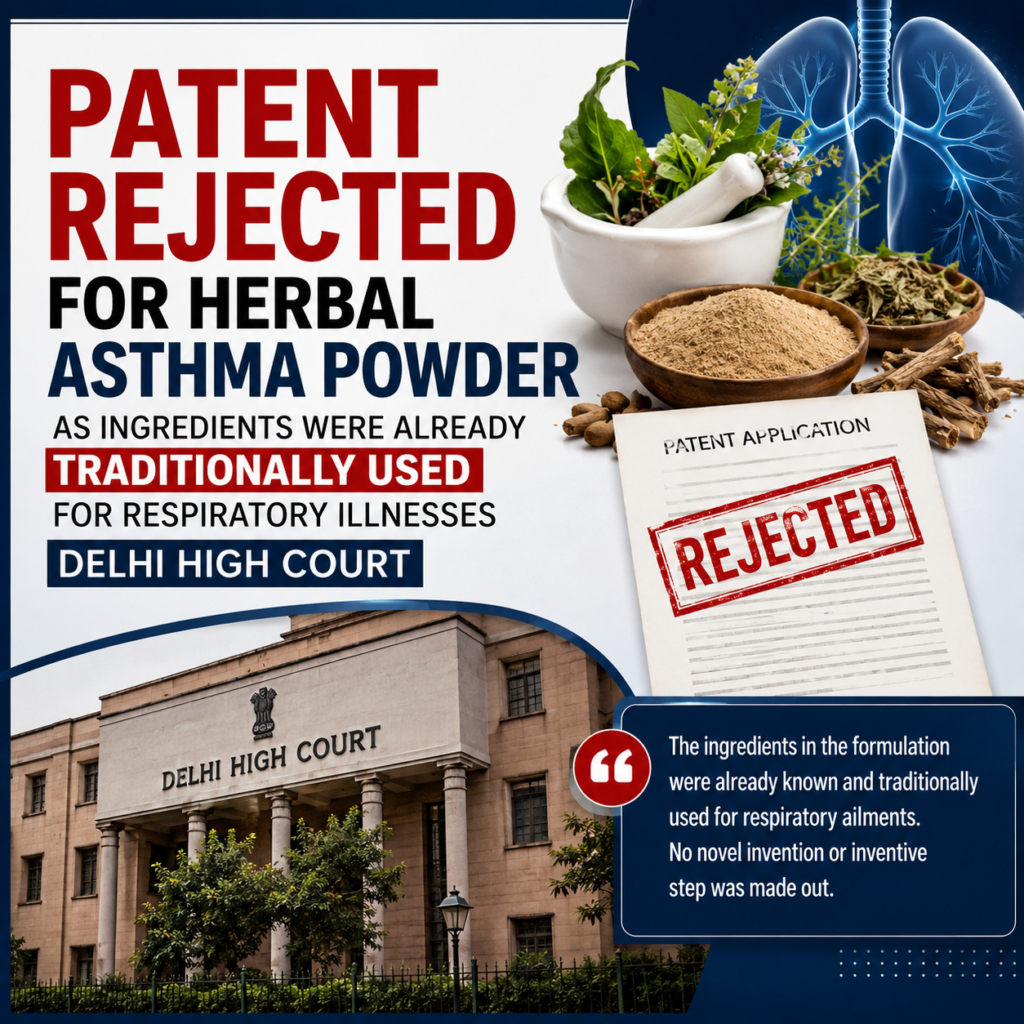
Patent Refused for Six-Herb Asthma Powder as Traditional Knowledge and Lacking Inventive Step: Delhi High Court
Facts
Shaafi Naturcure LLP filed a patent application on 27 November 2019 for an invention titled “A Herbal Powder Composition for the Treatment of Asthma.”
The claimed composition consisted of six Indian herbs in specified proportions:
- Tephrosia purpurea;
- Cuscuta reflexa;
- Morinda citrifolia;
- Terminalia arjuna;
- Piper longum; and
- Piper nigrum.
The application also claimed a process involving shade-drying, grinding and mixing the herbs in prescribed weight ranges.
The Patent Office issued a First Examination Report and later conducted a hearing. The applicant submitted amended claims, written submissions and an affidavit from the inventor containing additional data.
The inventor claimed that the six-herb composition:
- was effective against five different types of asthma;
- produced better results than individual herbs or smaller combinations;
- had been tested on approximately 300 persons;
- produced no apparent side effects within the claimed ratios; and
- caused adverse effects when the ratios were altered.
On 16 September 2020, the Assistant Controller refused the patent application under:
- Section 2(1)(j) for failure to qualify as an invention;
- Section 2(1)(ja) for absence of inventive step;
- Section 3(p) for being traditional knowledge or an aggregation of known properties; and
- Sections 10(4)(a) and 10(4)(b) for insufficient disclosure and failure to disclose the best method of performing the invention.
Shaafi Naturcure LLP challenged the refusal before the Delhi High Court under Section 117A of the Patents Act, 1970.
Issues
- Whether the six-herb asthma composition involved an inventive step despite each ingredient being traditionally known for treating asthma or related respiratory conditions.
- Whether the cited traditional-knowledge and prior-art documents adequately disclosed the therapeutic use of the individual herbs.
- Whether the inventor’s affidavit and post-filing experimental data could establish synergy, enhanced efficacy and absence of side effects.
- Whether approval granted by the National Biodiversity Authority prevented the Patent Office from raising an objection under Section 3(p) of the Patents Act.
- Whether the composition amounted to a patentable invention or merely an aggregation of traditionally known ingredients.
- Whether the complete specification fully and particularly described the invention and disclosed the best method of performing it.
Petitioner’s Arguments
The appellant argued that the Patent Controller had failed to follow the structured test for examining inventive step laid down in Hoffmann-La Roche Ltd. v. Cipla Ltd.
It contended that the invention did not merely combine randomly selected herbs. According to the appellant, the inventive contribution lay in:
- selecting six specific herbs from a much larger pool of medicinal plants;
- determining their optimum proportions;
- combining them in powdered form; and
- developing a composition capable of treating all five types of asthma.
The appellant argued that none of the prior-art documents disclosed the same six-herb combination in the claimed ratios.
It submitted that several citations from the Traditional Knowledge Digital Library were too brief or skeletal to constitute enabling disclosures.
The appellant maintained that the prior-art documents mainly referred to individual herbs or different plant parts, extracts and dosage forms. They did not teach a skilled person to arrive at the claimed powdered composition.
The inventor’s affidavit was relied upon to show that:
- the claimed combination produced an unexpected and synergistic effect;
- other combinations were less effective;
- altered ratios produced side effects;
- the claimed composition had been tested on around 300 persons; and
- the composition was effective across different age groups and five categories of asthma.
The appellant also argued that post-filing evidence could be considered to explain or confirm the technical advantages of an invention.
On the Section 3(p) objection, the appellant relied on an agreement entered into with the National Biodiversity Authority. It contended that once the authority had approved the use of biological resources, the traditional-knowledge objection should no longer survive.
Regarding sufficiency of disclosure, it argued that the complete specification, read with the inventor’s affidavit, sufficiently disclosed the ingredients, ratios, preparation process, working examples and therapeutic results.
Respondent’s Arguments
The Patent Controller argued that approval under the Biological Diversity Act served an entirely different purpose from examination of patentability.
The National Biodiversity Authority regulates:
- access to biological resources;
- conservation of biodiversity;
- sustainable use;
- benefit sharing; and
- commercial exploitation of biological material.
It does not examine novelty, inventive step, traditional knowledge or sufficiency of disclosure under the Patents Act.
The respondent submitted that all six herbs were individually known in traditional systems of medicine for treating asthma, bronchitis, cough or related respiratory conditions.
The claimed composition was therefore merely an aggregation of traditionally known ingredients without any reliably demonstrated technical advancement.
The respondent argued that the claim of treating five types of asthma had not appeared in the original complete specification. It was introduced only through the inventor’s affidavit at the hearing stage.
Similarly, the alleged side effects caused by altered ratios and the claimed testing on 300 persons were absent from the original specification.
The Controller contended that such post-filing material could not be used to introduce a technical effect for the first time.
It was also argued that the affidavit was internally inconsistent with the original specification. For example:
- the specification indicated that some four-herb compositions also relieved asthma;
- the affidavit claimed that all six herbs were necessary;
- the treatment duration in the specification differed from that stated in the affidavit; and
- one formulation falling within the claimed range was itself stated to cause increased kapha and tridosha.
The respondent therefore maintained that the additional data was unreliable and failed to prove synergy or enhanced efficacy.
Analysis of the Law
The Court examined the patentability requirements under Sections 2(1)(j), 2(1)(ja), 3(p), 10(4)(a) and 10(4)(b) of the Patents Act.
Inventive Step
An invention must involve a technical advancement or economic significance that is not obvious to a person skilled in the relevant art.
Where every component is already known for the same therapeutic purpose, merely combining those components or adjusting their proportions through routine experimentation does not ordinarily establish inventive step.
A patent applicant must demonstrate a credible and unexpected technical effect, such as genuine synergy, which is supported by the original specification.
Traditional Knowledge
Section 3(p) excludes from patentability:
- traditional knowledge; and
- an aggregation or duplication of known properties of traditionally known components.
The Traditional Knowledge Guidelines state that combining plants already known to treat the same disease is generally obvious.
They also provide that discovering optimum or workable ranges of traditionally known ingredients through routine experimentation is not inventive.
Post-Filing Evidence
Post-filing evidence may be used to confirm a technical effect already disclosed or reasonably embedded in the original specification.
It cannot be used to introduce:
- an entirely new therapeutic benefit;
- a new scientific theory;
- a new classification of disease;
- previously undisclosed side effects; or
- synergy for the first time.
Sufficiency of Disclosure
Section 10(4)(a) requires the specification to fully and particularly describe the invention and its operation or use.
Section 10(4)(b) requires disclosure of the best method of performing the invention known to the applicant.
A patent cannot be sustained where the specification does not support the claimed therapeutic effect, contains inconsistent examples or leaves the skilled reader uncertain about which formulation actually works.
Biodiversity Approval and Patentability
The Court held that the Biological Diversity Act and the Patents Act operate in different fields.
Approval from the National Biodiversity Authority permits regulated access to and use of biological resources. It does not certify that an invention is novel, inventive or patentable.
The Patent Office therefore remains independently bound to examine objections under Section 3(p).
Precedent Analysis
AstraZeneca AB v. Alkem Laboratories Limited
The Court relied heavily on this decision for the principle that post-priority-date evidence may confirm a technical effect already made plausible by the original specification.
Such evidence cannot be used to establish the existence of the technical effect for the first time.
Applying this principle, the Court held that the inventor’s affidavit could not introduce claims regarding five types of asthma, altered-ratio side effects and enhanced efficacy where those matters were absent from the original specification.
Bayer Pharm Aktiengesellschaft v. Controller General of Patents and Designs
The appellant relied on this decision to argue that working examples merely establish feasibility and do not define the entire scope of the patent.
The Court distinguished its application because the examples in the present case did not merely illustrate the invention. They contradicted the claim that all six ingredients were essential to produce synergy.
Hoffmann-La Roche Ltd. v. Cipla Ltd.
The appellant relied on this judgment concerning the structured approach to evaluating inventive step.
The Court nevertheless found that, even on a substantive assessment of the prior art, the composition lacked an inventive step because each ingredient was already known for respiratory treatment and no credible synergy was established.
Traditional Knowledge Guidelines
The Court applied Guiding Principles 2 and 4, which state that:
- combining plants already known for the same therapeutic effect is ordinarily obvious; and
- determining optimum ranges of traditionally known ingredients through routine experimentation is not inventive.
Court’s Reasoning
The Court first rejected the argument that approval from the National Biodiversity Authority eliminated the objection under Section 3(p).
It held that the Biodiversity Authority has no jurisdiction to examine patentability. Its role is confined to regulation, conservation and benefit sharing concerning biological resources.
The Court then examined the original specification and the inventor’s affidavit.
It found that the specification did not mention the alleged five categories of asthma or provide evidence supporting that classification.
The assertion that the composition treated all five types of asthma was introduced for the first time in the affidavit and could not be relied upon.
The Court also found that the alleged negative effects of changing the ratios were not disclosed in the specification.
One formulation described in the affidavit fell within the claimed ranges but was itself stated to cause adverse effects. This undermined the claim that the full claimed range was consistently safe and effective.
The Court further noted that the complete specification contained examples where a composition using only four herbs provided significant relief from asthma.
This contradicted the appellant’s claim that the combination of all six herbs was necessary to produce synergy.
The treatment periods stated in the complete specification were also inconsistent with those contained in the affidavit.
The Court held that the affidavit was therefore incapable of establishing an unexpected technical effect.
The prior-art documents showed that the individual herbs were already traditionally known for treating asthma, cough, bronchitis or related respiratory ailments.
Combining those herbs and selecting workable proportions was regarded as an obvious exercise falling within routine experimentation.
Since no reliable synergy or technical advancement was disclosed, the claimed composition lacked inventive step under Section 2(1)(ja) and did not qualify as an invention under Section 2(1)(j).
The Court also held that the composition was barred by Section 3(p) because it amounted to an aggregation of known properties of traditionally known components.
Finally, because the complete specification did not adequately disclose the alleged technical benefits, side effects, necessary proportions or best-performing formulation, it failed to satisfy Sections 10(4)(a) and 10(4)(b).
Conclusion
The Delhi High Court dismissed Shaafi Naturcure LLP’s appeal and upheld the refusal of its patent application for a six-herb asthma powder.
The Court held that:
- approval from the National Biodiversity Authority does not establish patentability;
- all six herbs were already known in traditional medicine for respiratory ailments;
- merely combining known herbs and identifying workable ratios through routine experimentation does not amount to an inventive step;
- the original specification did not establish synergy or an unexpected therapeutic effect;
- post-filing affidavits could not introduce new technical claims absent from the original specification;
- the affidavit contained inconsistencies and could not reliably prove safety or enhanced efficacy;
- the claimed composition was barred as traditional knowledge under Section 3(p); and
- the specification failed to fully describe the invention and disclose the best method of performing it.
Case Details
Case: Shaafi Naturcure LLP v. Assistant Controller of Patents and Designs
Court: Delhi High Court
Case Number: C.A.(COMM.IPD-PAT) 109 of 2022
Judge: Justice Tushar Rao Gedela
Date: 22 June 2026
Result: Appeal dismissed; refusal of patent for six-herb asthma composition upheld