


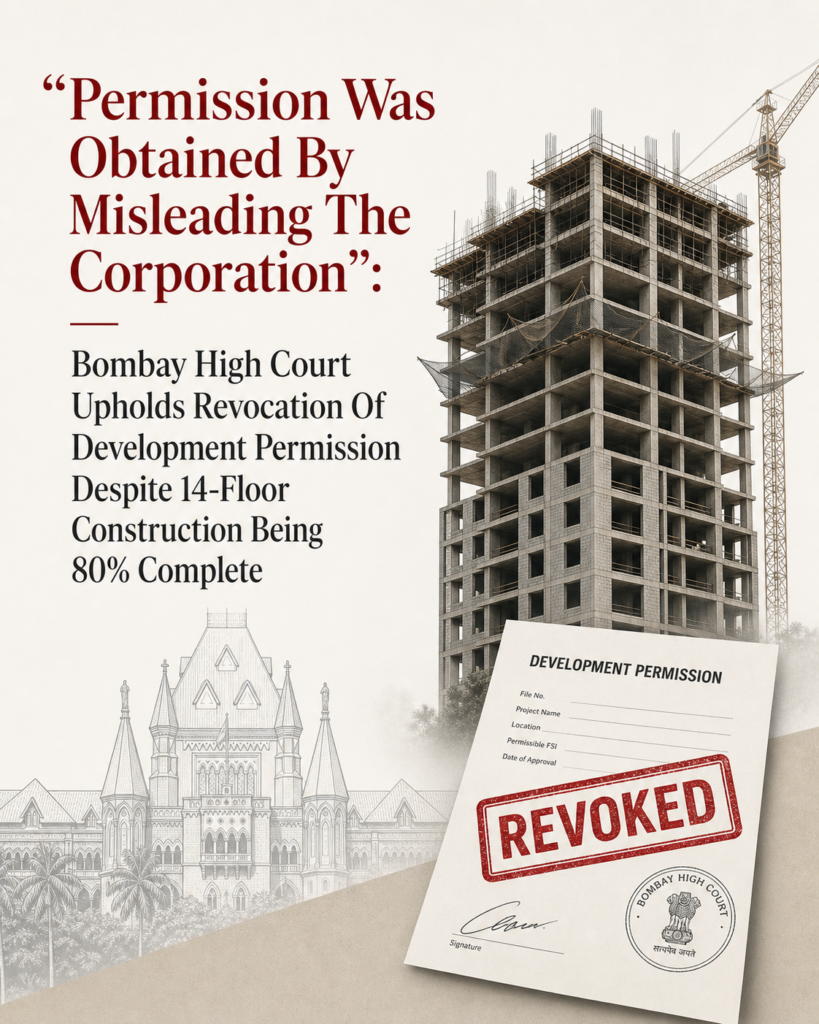
The Bombay High Court dismissed a writ petition filed by a developer challenging the Ulhasnagar Municipal Corporation’s order dated 16 August 2024, by which development permission for a project at Ulhasnagar was revoked under Section 51 of the Maharashtra Regional and Town Planning Act, 1966. The Court held that the developer had misled the Corporation by submitting incorrect documents and could not claim protection merely because substantial construction had already been carried out.
Court’s Decision
The Division Bench refused to interfere with the order revoking development permission.
The Court held that a party which misleads an authority by tendering incorrect documents cannot take advantage of its own wrong. It observed that “fraud vitiates all Orders”, and therefore the permissions granted to the developer stood vitiated and were non-est in the eyes of law.
The Court also rejected the request to stay the order for four weeks to enable the developer to approach the Supreme Court.
Final Outcome: Writ Petition dismissed. UMC directed to take necessary action in accordance with law. Matter kept for compliance on 17 June 2026.
Facts
The petitioners claimed to have purchased the subject property at Ulhasnagar by a registered conveyance deed dated 28 May 2019.
On 25 November 2019, they applied for development permission under Section 45 of the MRTP Act. The Ulhasnagar Municipal Corporation invited public objections, scrutinised the proposal, and later directed payment of development charges.
The petitioners deposited development charges and executed release deeds in favour of the Corporation for portions of land required for proposed Development Plan roads.
On 3 December 2020, development permission was granted for construction up to 7 floors. Later, on 2 November 2021, revised development permission was granted for construction up to 16 floors. The project was registered with MahaRERA as “Jhalak Paradise”, with completion date stated as 31 December 2025.
The petitioners obtained a plinth level certificate on 9 December 2022, and construction had reached up to 14 floors.
Thereafter, a stop-work notice was issued, followed by proceedings under Section 51 of the MRTP Act. The Corporation ultimately revoked the development permission by order dated 16 August 2024, alleging that the subject property was affected by 24-metre and 36-metre DP roads and that permission was obtained by misleading the Corporation.
Issues
The principal issues before the Court were:
- Whether the Corporation was justified in revoking the development permission under Section 51 of the MRTP Act.
- Whether the petitioners had obtained development permission by misleading the Corporation.
- Whether substantial construction and expenditure could protect the project from action.
- Whether the show cause notice was defective for allegedly not setting out all grounds.
- Whether relief could be granted to a party alleged to have approached with unclean hands.
Petitioners’ Arguments
The petitioners argued that they had followed all procedures required by the Corporation before obtaining development permission.
They contended that public notice had been issued, scrutiny fees and development charges had been paid, and portions of land had been released in favour of the Corporation for DP road purposes.
They further argued that the Corporation itself had earlier recorded, in a report dated 1 October 2021, that the subject property was not affected by the 24-metre or 36-metre DP road.
The petitioners also submitted that construction had already reached 14 floors, around 80% of the permitted construction, and that they had spent more than ₹17 crore on the project.
They alleged that the stop-work notice and subsequent action were triggered by complaints made by an advocate and another politically connected person.
They further argued that the show cause notice failed to set out all necessary grounds and therefore the action deserved to be set aside.
Respondents’ Arguments
The Corporation opposed the petition and submitted that the permissions were granted on the basis of incorrect material and misleading plans submitted by the petitioners and their architect.
The Corporation stated that after inspection and superimposition of the sanctioned development plan with the subject plot and DP roads at the actual site, it was found that about 80% of the subject plot was affected by proposed DP roads.
The Corporation also submitted that the officer responsible for granting permission had been relieved from the post of Town Planner by order dated 9 May 2024, after the Municipal Commissioner took note of misconduct.
It was argued that a developer who had played fraud on the Corporation was not entitled to any equitable relief.
Analysis Of The Law
The Court applied the settled principle that fraud vitiates all orders.
It held that when permission is obtained by misrepresentation or submission of incorrect material, the resulting permission cannot be treated as valid merely because it was formally granted.
The Court relied on the Supreme Court judgment in Rajendra Kumar Barjatya v. U.P. Avas Evam Vikas Parishad, where it was held that constructions put up in violation of approved plans or without proper approval cannot be encouraged, and that courts must act with “iron hands” against illegal constructions.
The Court also relied on Kaniz Ahmed v. Sabuddin, where the Supreme Court held that courts must adopt a strict approach in illegal construction matters and should not readily engage in judicial regularisation of buildings erected without required permissions.
Precedent Analysis
The Court placed reliance on two Supreme Court decisions:
- Rajendra Kumar Barjatya v. U.P. Avas Evam Vikas Parishad — relied upon for the principle that illegal or unauthorised constructions must not be protected on grounds such as delay, administrative failure, investment, or negligence of authorities.
- Kaniz Ahmed v. Sabuddin — relied upon for the proposition that courts must adopt a strict approach against illegal construction and should not rescue those who flout the law.
The Court used these authorities to hold that cost of construction, investment by developer, or hardship to flat purchasers cannot justify regularising an illegality.
Court’s Reasoning
The Court noted that the petitioners relied on the report dated 1 October 2021 to argue that the plot was unaffected by DP roads. However, the Court found this inconsistent with their own case that they had released 386.68 sq. metres of land to the Corporation because it was required for DP roads.
The Court observed that the petitioners appeared to be approbating and reprobating. On one hand, they claimed that the plot was unaffected by DP roads; on the other hand, they had executed release deeds in favour of the Corporation for DP road purposes.
The Court found that the petitioners were aware that the property was affected by DP roads on either side and had, with the help of their architect, presented misleading documents to obtain development permissions.
The Court rejected the argument that 80% construction or expenditure of over ₹17 crore should protect the project. It held that investment by a developer or flat purchasers cannot be a ground to regularise illegality or irregularity.
The Court further held that the objection regarding insufficiency of the show cause notice appeared to be an afterthought. Even if a fresh notice were issued, it would not change the result because the permissions had been obtained by misrepresentation.
The Court also emphasized that municipal authorities are guardians of planned development and must take strict action against unauthorised or illegal construction. It noted that erring municipal officers must also face stern action, as such failures pollute the system and must be removed.
Conclusion
The Bombay High Court dismissed the petition and upheld the revocation of development permission.
The Court held that the permissions were procured by misrepresentation and submission of incorrect material, making the construction illegal. The Court refused to grant sympathy or equitable relief merely because the building was substantially constructed or because large sums had been invested.
Final Outcome: Petition dismissed. Interim application disposed of. UMC directed to take necessary action in accordance with law. Stay refused. Compliance listed on 17 June 2026.