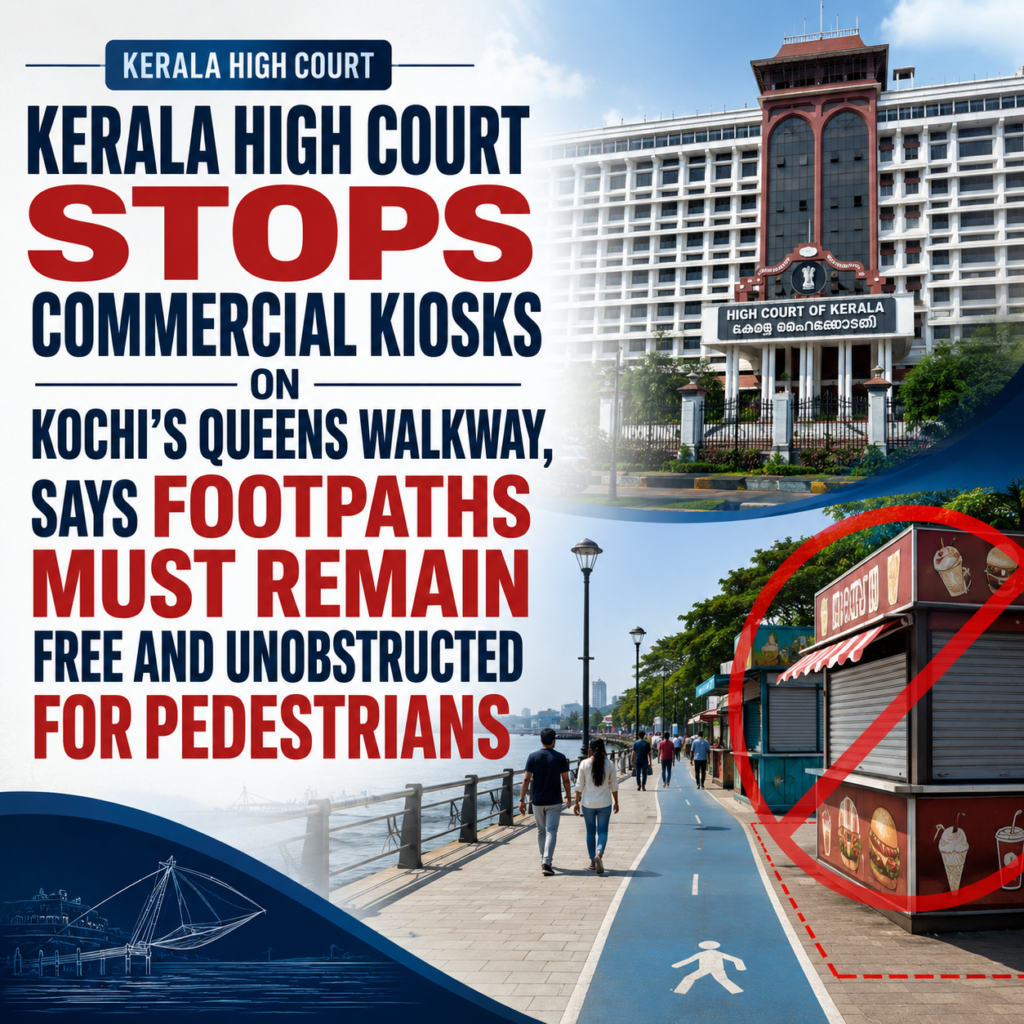
Commercial Kiosks Cannot Be Built on Kochi’s Queens Walkway as Footpaths Must Remain Unobstructed for Pedestrians: Kerala High Court
The Kerala High Court has restrained the authorities from constructing, installing or operating commercial kiosks on the Queens Walkway in Kochi, holding that footpaths and pedestrian walkways cannot be converted into commercial spaces at the cost of public safety and the fundamental right to walk.
Justice Bechu Kurian Thomas held that the right to life and personal liberty includes the right to walk freely on safe and unobstructed footpaths. The Court further found that the Goshree Islands Development Authority did not possess the authority to establish kiosks on the walkway, which statutorily vested in the Kochi Municipal Corporation.
Facts
The Tritvam Apartment Owners Association and its President approached the Kerala High Court challenging the proposal of the Goshree Islands Development Authority to construct and operate commercial food kiosks on the Queens Walkway in Kochi.
The Queens Walkway was developed along the Goshree-Chathiyath Road beside the Kochi backwaters. It included a pedestrian pathway, a cycling track, a jogging area and tactile paving intended for visually impaired persons.
The petitioners alleged that GIDA proposed to relocate and establish 20 commercial kiosks along the walkway, including in front of their apartment complex.
According to the petitioners, the kiosks would occupy substantial space on the walkway, obstruct pedestrians and cyclists, interfere with tactile pathways, increase traffic congestion and create health and civic problems.
They further contended that GIDA had no statutory authority to permit commercial establishments on the footpath and that the area was situated within a prohibited vending zone.
GIDA defended the project as part of the “GIDA Happiness Zone Project,” aimed at improving public recreational facilities and promoting tourism. It claimed that the kiosks were portable structures proposed on deck space adjacent to the walkway and would cause minimal inconvenience.
The selected contractor stated that it had paid ₹84 lakh under the tender, spent more than ₹50 lakh and had already erected seven kiosks.
Issues
The Court considered the following principal issues:
- Whether GIDA had ownership or statutory authority over the Goshree-Chathiyath Road and the adjoining Queens Walkway.
- Whether a public footpath or walkway could be used for setting up commercial kiosks.
- Whether the proposed kiosks would unlawfully interfere with the right of pedestrians, cyclists and persons with disabilities to use the walkway.
- Whether the area was a prohibited or no-vending zone under the applicable street-vending framework.
- Whether the commercial and revenue-generating objectives of GIDA could override the statutory purpose of the walkway.
Petitioner’s Arguments
The petitioners argued that GIDA had no authority to construct or permit kiosks on the Queens Walkway.
They submitted that the Goshree-Chathiyath Road and the adjoining footpaths were public streets that vested in the Kochi Municipal Corporation under Section 207 of the Kerala Municipality Act, 1994.
The petitioners contended that GIDA’s powers under the Kerala Town and Country Planning Act, 2016 were expressly subject to the Kerala Municipality Act. Therefore, even if GIDA originally held title over the reclaimed land, the road and footpaths vested in the municipal authority after their formation as public streets.
It was further argued that the construction of 20 kiosks on a 6.5-metre-wide walkway would substantially reduce the space available to pedestrians, cyclists, joggers and visually impaired persons using tactile paving.
The petitioners submitted that the walkway was developed specifically for public mobility and recreation and could not be converted into a commercial vending area.
They also argued that the road fell within Ward or Division No. 68 of the Kochi Municipal Corporation and had not been declared a vending zone. Under the municipal street-vending bye-laws, all areas not declared as vending zones were prohibited vending zones.
The proposal was therefore alleged to violate the Street Vendors (Protection of Livelihood and Regulation of Street Vending) Act, 2014 and the right to safe and unobstructed pedestrian movement.
Respondent’s Arguments
GIDA argued that it had ownership and absolute authority over the Goshree-Chathiyath Road and the adjoining walkway because the underlying reclaimed land had originally been assigned to it.
It submitted that similar kiosks had existed until 2025 without objections from the petitioners.
GIDA stated that the Happiness Zone Project was intended to convert the walkway into a recreational public space with modern facilities, including eateries, and to enhance tourism potential.
It contended that the proposed kiosks were not permanent constructions but modular and portable structures that could be removed without demolition.
GIDA further argued that revenue was necessary for maintaining the walkway and that the kiosks were proposed on designated deck spaces rather than on the actual pedestrian footpath.
The selected contractor argued that it had invested substantial amounts after being selected through a tender process. It also questioned the locus standi of the petitioners and maintained that the area had not been specifically declared a no-vending zone.
The Kochi Municipal Corporation stated that the road was not reflected in its asset register, while Cochin Smart Mission Limited stated that it had paved and beautified the walkway after spending considerable public funds.
Analysis of the Law
The Court examined the powers of GIDA under the Kerala Town and Country Planning Act, 2016.
Section 56 of the Act provides that the powers and functions of a development authority are subject to the Kerala Municipality Act, 1994 and the Kerala Panchayat Raj Act, 1994.
The Court then considered Section 207 of the Kerala Municipality Act, which provides that all public roads, streets, lanes, paths and adjoining lands, other than specified highways and major district roads, vest absolutely in the municipality.
The definition of “public street” under Section 2(34) includes the roadway, attached footways, drains and land lying between the roadway and the boundary of adjacent properties.
The Court held that even though GIDA may have originally held title over the reclaimed land, the Goshree-Chathiyath Road and its footpaths vested statutorily in the Kochi Municipal Corporation after their formation as public roads.
Such statutory vesting could not be defeated merely because the road was not entered in the Corporation’s asset register.
The Court also examined the dimensions and intended use of the Queens Walkway. The walkway was only 6.5 metres wide and included a cycle track, tactile paving and pedestrian space.
Each proposed kiosk would occupy approximately 4 metres by 3 metres, apart from the additional area that would be occupied by customers. The Court found that the kiosks would inevitably reduce the available space and obstruct the continuous movement of pedestrians and cyclists.
The Court further held that footpaths are intended primarily for pedestrian movement. Commercial use may be permitted only in spaces specifically designated or demarcated for such purposes.
Under the Kochi Corporation’s Street Vending Bye-laws, areas not identified as vending zones were treated as prohibited vending zones. Since no road in the concerned division had been notified as a vending zone, the Goshree-Chathiyath Road constituted a prohibited vending area.
Precedent Analysis
Palakkad Municipality v. Krishnanunni
The Kerala High Court had held that statutory vesting of a public road in a municipality could not be defeated by title claims or executive action.
The Court applied this principle to hold that the Goshree-Chathiyath Road and its footpaths vested in the Kochi Municipal Corporation notwithstanding GIDA’s title over the original reclaimed land.
Sivaprasad v. State of Kerala
The Court had held that pedestrians must not be compelled to walk in unsafe conditions and that local authorities are legally bound to provide proper pedestrian facilities in accordance with applicable guidelines.
This precedent supported the obligation to keep pedestrian pathways safe and unobstructed.
Kottamom Sri Dharmashastha Temple Advisory Committees v. State of Kerala
The Kerala High Court held that vehicles could not be parked on footpaths because such obstruction forced pedestrians onto public roads and endangered their safety.
The principle was extended to commercial kiosks, which would similarly encroach upon pedestrian space and force users away from the designated walkway.
S. Rajaseekaran v. Union of India
The Supreme Court observed that the right to properly maintained footpaths and footways is an essential component of Article 21.
The absence of proper pedestrian pathways forces people onto roads and exposes them to accidents and danger.
Maniyar Iliyaz v. P. Ayyappan
The Supreme Court declared that the right to walk is a fundamental right flowing from Articles 19 and 21 of the Constitution.
The right includes access to demarcated, uninterrupted and well-maintained footpaths, while local authorities have a corresponding duty to construct, maintain and protect pedestrian infrastructure.
The Kerala High Court relied heavily upon this ruling to hold that pedestrian rights must receive priority over commercial and motorised interests.
Court’s Reasoning
The Court held that the Queens Walkway was specifically created for pedestrians, cyclists, joggers and persons with disabilities.
The proposed kiosks would occupy a substantial portion of the limited walkway and would restrict free movement. Customers gathering around the kiosks would create further obstruction.
The Court rejected GIDA’s claim that the kiosks would be placed on a separate deck area, noting that no material had been produced to establish the existence of such independent deck space beyond the 6.5-metre-wide walkway.
It observed that if commercial kiosks were intended to form part of the project, specific areas outside the pedestrian walkway ought to have been reserved during the planning and design stage.
The later decision to reduce pedestrian space for commercial activity was treated as an afterthought.
The Court recognised that the kiosks could generate revenue and improve economic viability. However, commercial gain could not override the fundamental right of pedestrians to safe, comfortable and unobstructed movement.
It held that once kiosks or vendors are permitted on a footpath, pedestrians and cyclists are forced out of their designated space, increasing the risk of accidents and adversely affecting persons with disabilities.
The Court further held that GIDA had no authority over the road and walkway after their statutory vesting in the Kochi Municipal Corporation.
Even the Corporation could not permit kiosks at the location because the area was not a notified vending zone and was therefore a prohibited vending zone.
Conclusion
The Kerala High Court allowed the writ petition and issued a writ of mandamus restraining the respondents from constructing, installing or operating any kiosks on the Queens Walkway in Kochi.
The Court held that:
• the Goshree-Chathiyath Road and its footpaths vested in the Kochi Municipal Corporation;
• GIDA had no legal authority to construct commercial kiosks on the walkway;
• the walkway was situated in a prohibited vending zone;
• footpaths cannot be commercially occupied unless specific spaces are lawfully designated for such use; and
• the right to life and liberty includes the fundamental right to walk freely and safely on unobstructed pedestrian pathways.
The Court concluded that pedestrian convenience, safety and accessibility must take priority over commercial revenue and tourism-related considerations.
Case: Tritvam Apartment Owners Association (TAOA) & Anr. v. District Collector, Ernakulam & Ors.
Court: High Court of Kerala at Ernakulam
Case Number: W.P.(C) No. 6851 of 2026
Judge: Justice Bechu Kurian Thomas
Date: 22 June 2026
Result: Writ petition allowed; authorities restrained from constructing, installing or operating commercial kiosks on the Queens Walkway in Kochi.