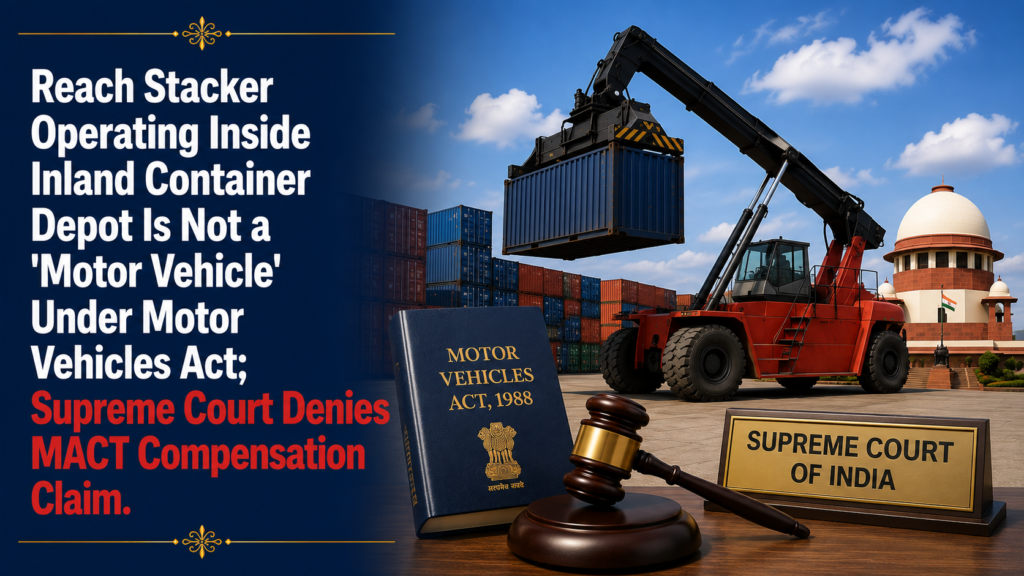
Supreme Court Holds Reach Stacker Used Exclusively Within Inland Container Depot Is Not a Motor Vehicle Under the Motor Vehicles Act.
Facts
The case arose from a serious accident inside the Inland Container Depot (ICD), Tughlakabad, New Delhi. The claimant visited the depot when a Reach Stacker, a heavy container-handling machine, struck him and ran over his pelvic region, resulting in multiple surgeries and amputation of his right leg. He suffered 90% permanent physical disability and claimed that his functional disability was effectively 100%.
He filed a compensation claim under Section 166 of the Motor Vehicles Act, 1988 before the Motor Accident Claims Tribunal (MACT), seeking ₹75 lakh. The insurer objected to the maintainability of the claim, arguing that a Reach Stacker was not a “motor vehicle” under the Act. The Tribunal accepted the objection and rejected the claim, but the Delhi High Court reversed that decision, holding that the Reach Stacker qualified as a motor vehicle. Container Corporation of India Ltd. challenged the High Court’s judgment before the Supreme Court.
Issues
The Supreme Court considered:
- Whether a Reach Stacker operating within an Inland Container Depot is a “motor vehicle” under Section 2(28) of the Motor Vehicles Act, 1988.
- Whether an Inland Container Depot constitutes a “public place” under Section 2(34) of the Motor Vehicles Act.
- Whether a compensation claim under Section 166 of the Motor Vehicles Act was maintainable for the accident.
Appellant’s Arguments
Container Corporation of India contended that the Reach Stacker is a specialised machine designed exclusively for lifting and transporting shipping containers within enclosed customs-bonded premises.
It argued that the ICD is an enclosed area accessible only to authorised persons and therefore does not constitute a “public place”. The Reach Stacker weighs over 70 tonnes even when unloaded, substantially exceeds statutory road weight limits, operates only on specially reinforced internal roads, and is transported in dismantled form whenever shifted from one location to another. Consequently, it is a special-purpose vehicle adapted only for enclosed premises and falls within the statutory exclusion contained in Section 2(28) of the Motor Vehicles Act.
Respondent’s Arguments
The claimant argued that the ICD comprises an extensive network of interconnected roads and is accessible to authorised members of the public, thereby qualifying as a public place.
It was further contended that the Reach Stacker is mechanically propelled, mounted on wheels and chassis, driven by an operator, capable of movement on roads, and therefore satisfies the definition of a motor vehicle. The mere fact that it is ordinarily used inside the container depot should not exclude it from the Motor Vehicles Act.
Analysis of the Law
The Supreme Court closely analysed the definition of “motor vehicle” under Section 2(28) and “public place” under Section 2(34) of the Motor Vehicles Act.
The Court explained that although a mechanically propelled vehicle adapted for use on roads ordinarily falls within the definition of a motor vehicle, Parliament has expressly excluded special vehicles adapted for use only in factories or other enclosed premises.
The Court held that the inquiry is not limited to whether the vehicle possesses wheels or can technically move upon roads. Instead, courts must examine its dominant purpose, practical suitability, intended use, statutory weight restrictions, operational characteristics and whether it is designed exclusively for enclosed premises.
The Court further observed that merely possessing rubber tyres or a chassis does not automatically make every machine a motor vehicle. Suitability for ordinary road use remains an essential statutory requirement.
Precedent Analysis
The Supreme Court undertook an extensive review of earlier decisions including Bolani Ores Ltd., Goodyear India Ltd., Ultratech Cement Ltd., Tarachand Logistic Solutions Ltd., Bose Abraham, Road Rollers Owners Welfare Association, Natwar Parikh, and Western Coalfields Ltd.
The Court held that Bolani Ores establishes the “suitability for road use” test rather than mere mechanical capability.
It relied heavily upon Goodyear India, which emphasised that the dominant and principal use of the vehicle determines whether it is adapted for road use.
The Court considered Ultratech Cement to be directly applicable, reaffirming that special-purpose construction and industrial vehicles intended exclusively for enclosed premises fall within the exclusion contained in Section 2(28), even though they possess characteristics ordinarily associated with motor vehicles.
The Court also relied upon Tarachand Logistic Solutions, which clarified that an area permitting access only to authorised persons does not become a “public place” merely because certain members of the public may enter upon permission.
Court’s Reasoning
The Supreme Court first held that the Inland Container Depot is not a public place within the meaning of Section 2(34). Being a customs-bonded area, entry is restricted to authorised persons, and the public has no unrestricted right of access. Accordingly, the internal roads of the depot cannot be equated with ordinary public roads.
The Court then examined the nature of the Reach Stacker itself. It found that the machine weighs more than 70 tonnes even without cargo, exceeds permissible statutory road weight limits, operates only upon specially designed reinforced roads within container terminals, lacks ordinary roadworthiness certification, is transported in dismantled form between locations, and is manufactured solely for specialised container-handling operations.
The Court rejected the argument that rubber tyres alone establish road suitability. Instead, it held that the Reach Stacker is specifically adapted for use only within enclosed premises and therefore falls squarely within the exclusion contained in Section 2(28).
The Court also noted that transport authorities themselves had clarified that Reach Stackers do not require registration under Section 39 because they are not motor vehicles within the meaning of the Act.
However, the Court clarified that its decision is confined to Reach Stackers and similar specialised machinery. If an ordinary registered motor vehicle causes an accident inside an Inland Container Depot, the victim may still pursue compensation under the Motor Vehicles Act.
Conclusion
The Supreme Court allowed the appeal and restored the Motor Accident Claims Tribunal’s order dismissing the compensation claim.
It held that the Inland Container Depot is not a public place within the meaning of the Motor Vehicles Act and that a Reach Stacker is a specialised vehicle adapted exclusively for enclosed premises, thereby falling outside the statutory definition of a motor vehicle.
Consequently, the claim under Section 166 of the Motor Vehicles Act was held to be not maintainable. Nevertheless, the Court directed that any compensation already paid to the claimant should not be recovered.
Case Details
Case: Container Corporation of India Ltd. v. Rishi Ranjan Mishra & Others
Court: Supreme Court of India
Case Number: Civil Appeal No. 10526 of 2024
Bench: Justice Sanjay Karol and Justice Nongmeikapam Kotiswar Singh
Date: 29 July 2026
Result: The Supreme Court allowed the appeal, restored the MACT’s dismissal of the compensation claim, held that a Reach Stacker operating exclusively inside an Inland Container Depot is not a “motor vehicle” under the Motor Vehicles Act, and clarified that compensation already paid shall not be recovered