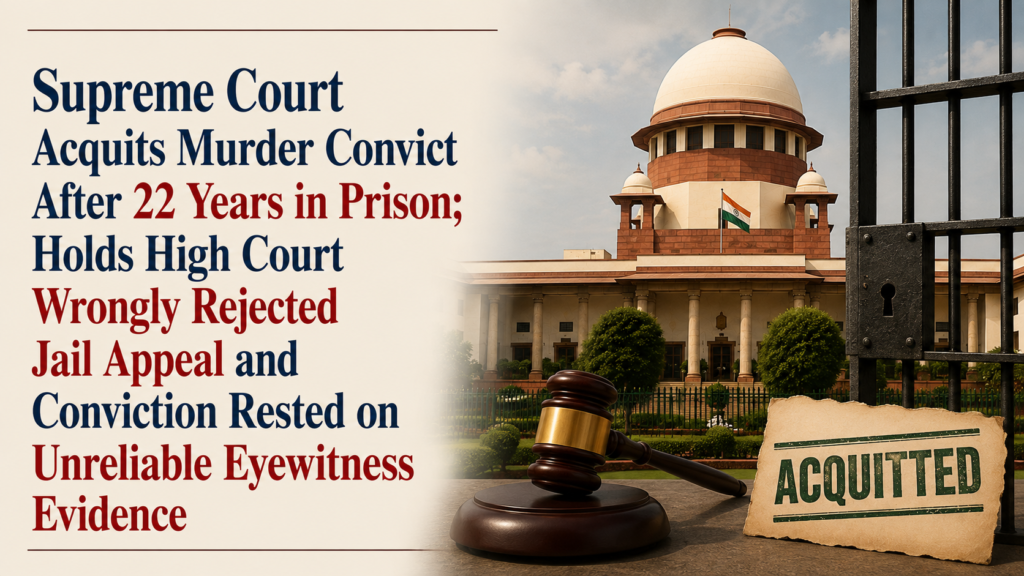
High Court Should Have Condoned Delay in Jail Appeal Instead of Denying Convict Opportunity to Challenge Life Sentence, Rules Supreme Court
Facts
The appellant was convicted under Section 302 IPC and sentenced to life imprisonment for the murder of one of three women who were found bludgeoned to death. His appeal before the High Court was filed through a jail memo but was dismissed solely because of a delay of 3,157 days, without examining the merits of the conviction.
By the time the matter reached the Supreme Court, the appellant had already undergone 22 years of imprisonment. The Supreme Court first condoned the delay, released him on bail, and proceeded to examine the conviction on merits. It also considered the repeated rejection of his remission applications and the circumstances surrounding the prosecution.
Issues
- Whether the High Court was justified in rejecting the delayed jail appeal without considering the merits of the conviction.
- Whether the conviction based substantially on the testimony of a sole eyewitness could be sustained.
- Whether the prosecution had proved the appellant’s guilt beyond reasonable doubt.
Petitioner’s Arguments
- The appellant contended that the High Court adopted an unduly technical approach by refusing to condone the delay in a jail appeal despite his prolonged incarceration.
- The conviction rested upon an unreliable and contradictory eyewitness account.
- The investigation suffered from serious defects, including inconsistent recovery evidence and reliance upon an inadmissible confession.
- The prosecution failed to establish guilt beyond reasonable doubt.
Respondent’s Arguments
- The State supported the conviction recorded by the Trial Court.
- It relied upon the testimony of the eyewitness who claimed to have witnessed the murder.
- The prosecution argued that the evidence on record sufficiently established the appellant’s involvement in the offence.
- The State also referred to the repeated rejection of the appellant’s remission requests under the applicable remission policy.
Analysis of the Law
The Supreme Court emphasised that access to justice forms an essential component of personal liberty, and courts must adopt a proactive and liberal approach while considering delay in criminal appeals filed by prisoners, especially where life imprisonment is involved.
The Court reiterated that:
- conviction may legally rest upon the testimony of a solitary eyewitness;
- however, such testimony must be wholly reliable, credible, consistent and capable of inspiring complete confidence;
- where serious inconsistencies create reasonable doubt, the accused is entitled to the benefit of doubt.
The Court also reaffirmed that confessions made to police officers are inadmissible under Section 25 of the Indian Evidence Act, and recoveries unsupported by credible evidence cannot strengthen the prosecution case.
Precedent Analysis
The Court relied principally upon settled criminal law principles governing:
- liberal condonation of delay in jail appeals affecting personal liberty;
- appreciation of solitary eyewitness testimony;
- admissibility of police confessions under Section 25 of the Evidence Act;
- proof of recoveries under Section 27 of the Evidence Act; and
- the principle that conviction must be established beyond reasonable doubt.
The judgment primarily applies these well-established principles to the peculiar facts rather than laying down a new legal doctrine.
Court’s Reasoning
The Supreme Court found numerous circumstances creating serious doubt regarding the prosecution story.
The alleged sole eyewitness gave inconsistent versions regarding:
- how she witnessed the incident;
- whom she informed immediately thereafter;
- the number of murders she had actually seen; and
- the movements of both herself and the accused.
The Court noted that:
- no proper scene-of-offence sketch had been prepared;
- the investigating officer failed to explain how the accused became a suspect;
- the alleged confession was legally inadmissible;
- one recovery witness even stated that the police had beaten the accused to extract the confession;
- the alleged murder weapons contained no blood stains, and forensic examination did not connect them with the crime;
- witnesses contradicted the investigating officer regarding where the alleged weapons had been recovered.
The Court also found several surrounding circumstances inherently improbable, making the prosecution version unsafe to accept.
Accordingly, it held that the sole eyewitness testimony failed to inspire confidence and could not sustain a conviction for murder.
Conclusion
The Supreme Court allowed the appeal, set aside the conviction under Section 302 IPC and acquitted the appellant.
The Court observed that the appellant had lost 22 years of his life without reliable evidence, criticised the High Court for mechanically rejecting the jail appeal on limitation, and directed the District Legal Services Authority and the District Administration to assist in the appellant’s rehabilitation and resettlement.
Case Details
Case: Arjun Jani @ Tuntun v. State of Orissa
Court: Supreme Court of India
Case Number: Criminal Appeal of 2026 (Arising out of SLP (Criminal) No. 7128 of 2026)
Judges: Justice J.B. Pardiwala and Justice K. Vinod Chandran
Date: 4 August 2026
Result: Appeal Allowed; conviction under Section 302 IPC set aside, appellant acquitted, and directions issued for his rehabilitation and resettlement