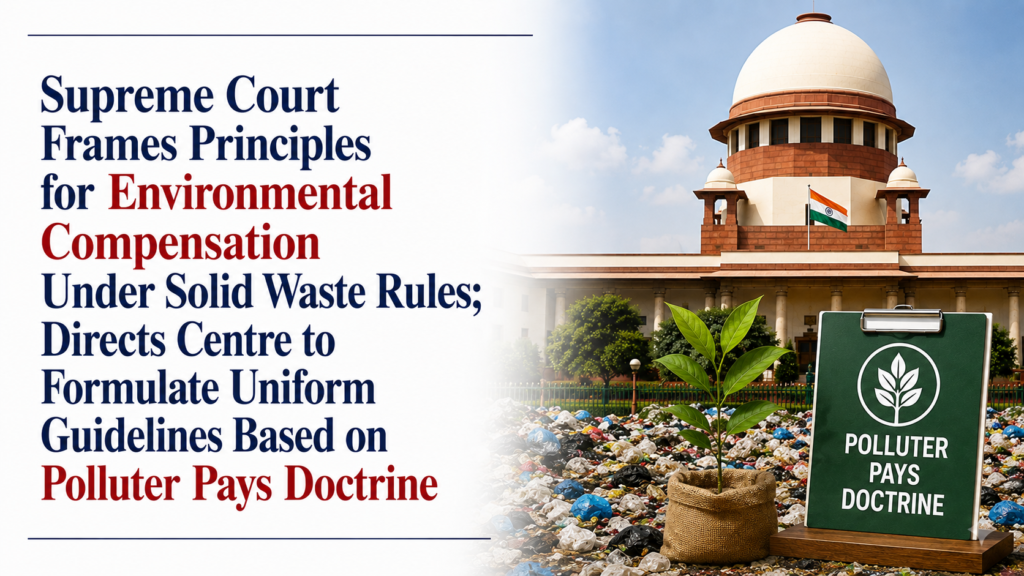
Environmental Compensation Must Be Restitutionary, Proportionate and Based on Polluter Pays Principle, Holds Supreme Court
Facts
The appeals arose in the broader context of implementation of the Solid Waste Management Rules, 2026. While hearing the matter, the Supreme Court expanded the scope of the proceedings to examine whether an institutional framework existed for effective implementation of the new Rules and whether uniform principles governing environmental compensation should be evolved.
The Court noted that although the Solid Waste Management Rules, 2026 had already been notified, effective implementation required creation of regulatory institutions, formulation of guidelines and a transparent mechanism for imposing environmental compensation.
Pursuant to the Court’s earlier directions, the Ministry of Environment, Forest and Climate Change (MoEF&CC) placed on record an Office Memorandum constituting the Central Implementation Committee under Rule 18 of the 2026 Rules. The Court then proceeded to examine the legal principles governing environmental compensation and the future functioning of the Committee.
Issues
- Whether the Central Implementation Committee contemplated under the Solid Waste Management Rules, 2026 had been properly constituted.
- Whether uniform legal principles should govern determination and collection of environmental compensation.
- What factors should guide authorities while assessing environmental compensation under Rule 17 of the Solid Waste Management Rules, 2026.
Petitioner’s Arguments
- The appellant municipal corporation’s dispute became secondary once the Court took up larger questions concerning implementation of the Solid Waste Management Rules.
- During the proceedings, the Union Government, represented through the Additional Solicitor General, placed before the Court the Office Memorandum constituting the Central Implementation Committee and explained the proposed institutional framework for implementation of the 2026 Rules.
Respondent’s Arguments
- The matter primarily proceeded as a public law exercise involving implementation of environmental legislation.
- Various governmental authorities assisted the Court regarding the statutory framework, institutional mechanisms and formulation of guidelines for environmental compensation.
Analysis of the Law
The Supreme Court undertook an extensive examination of:
- the Environment (Protection) Act, 1986;
- the Solid Waste Management Rules, 2026, particularly Rules 17, 18 and 38;
- the Polluter Pays Principle;
- the principle of environmental restitution; and
- earlier Supreme Court decisions governing environmental compensation.
The Court observed that environmental compensation should no longer depend upon ad hoc judicial determination. Instead, a structured, transparent and predictable statutory framework should govern assessment of compensation so that both regulators and regulated entities clearly understand the legal consequences of environmental violations.
The Court also emphasised institutionalisation of environmental governance by ensuring that statutory regulatory bodies are not merely constituted but function effectively with accountability and adequate infrastructure.
Precedent Analysis
The Supreme Court extensively relied upon earlier environmental jurisprudence, including:
- M.C. Mehta v. Union of India — absolute liability and deterrent compensation.
- Vellore Citizens’ Welfare Forum v. Union of India — Polluter Pays Principle and sustainable development.
- M.C. Mehta v. Kamal Nath — compensation for restoration of ecology and exemplary damages.
- Research Foundation for Science v. Union of India — environmental compensation includes tangible and intangible losses.
- Vellore District Environment Monitoring v. District Collector — polluter’s liability continues until environmental damage is reversed.
- Delhi Pollution Control Committee v. Lodhi Property Co. Ltd. — environmental compensation is restitutionary, distinct from criminal penalties.
- Sterlite Industries (India) Ltd. v. Union of India — financial capacity of the polluter is relevant.
- Rhythm County v. Satish Sanjay Hegde — compensation must satisfy proportionality and rational nexus with environmental harm.
Court’s Reasoning
The Supreme Court held that environmental compensation performs a restitutionary function and is distinct from statutory fines or criminal punishment. Compensation must aim to restore environmental damage rather than merely penalise the violator.
To ensure uniformity, the Court formulated eight governing principles for determination of environmental compensation, including:
- compensation is payable in addition to statutory penalties;
- liability continues until environmental damage is fully restored;
- authorities must assess both tangible and intangible environmental harm;
- imminent environmental risk may also justify compensation even before actual damage occurs;
- financial capacity of the polluter, restoration costs and public loss are relevant factors;
- compensation must remain proportionate to the environmental harm caused; and
- courts and tribunals must record reasons, valuation methods and applicable formulae while determining compensation.
The Court further directed that the Central Implementation Committee and the MoEF&CC should also consider existing CPCB guidelines relating to plastic waste, hazardous waste and environmental penalties while framing comprehensive guidelines under Rule 17(2) of the Solid Waste Management Rules, 2026.
Conclusion
The Supreme Court directed the Ministry of Environment, Forest and Climate Change to formulate comprehensive guidelines for determination and collection of environmental compensation under Rule 17(2) of the Solid Waste Management Rules, 2026 by applying the principles laid down in the judgment together with existing statutory rules and CPCB guidelines.
The Court also directed the Ministry to file an affidavit indicating the progress made in framing and issuing the guidelines, thereby strengthening institutional enforcement of environmental law in India.
Case Details
Case: Amravati Municipal Corporation v. Ganesh Dadarao Anasane & Others
Court: Supreme Court of India
Case Number: Civil Appeal No. 4020 of 2020 (with Civil Appeal No. 8630 of 2022)
Judges: Justice Pamidighantam Sri Narasimha and Justice Alok Aradhe
Date: 4 August 2026
Result: Directions issued to the MoEF&CC to formulate uniform guidelines for determination and imposition of environmental compensation under the Solid Waste Management Rules, 2026; matter directed to be listed for monitoring compliance.