

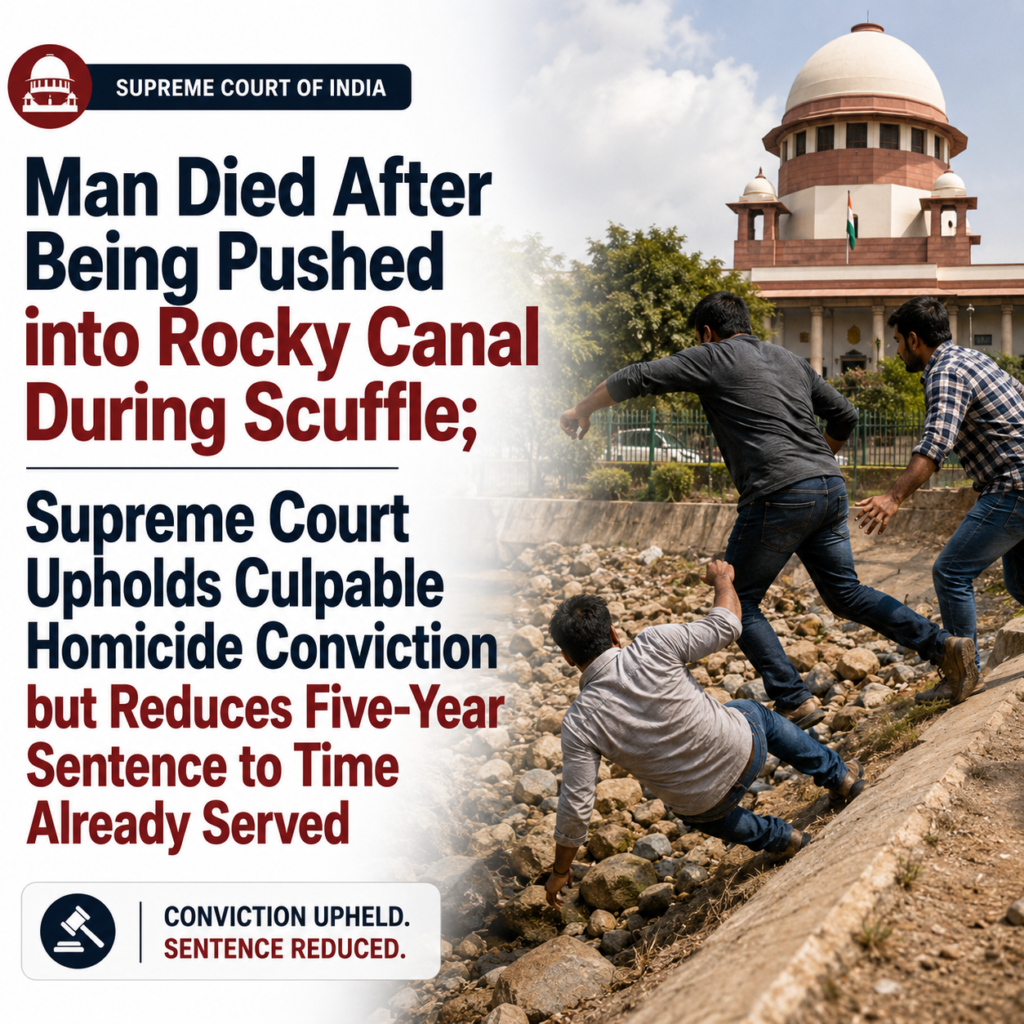
Man Died After Being Pushed into Dry Canal During Scuffle; Supreme Court Reduces Convict’s Five-Year Jail Term to Period Undergone
Facts
The case arose from an incident dated 12 February 1997 involving the deceased, Padam Singh Shahi, and four accused persons, including Mathu alias Jagdish.
Approximately 15 days before the incident, Padam Singh had sold a wristwatch to one of the accused, Manua alias Puran, for ₹500. Manua was reportedly dissatisfied with the watch and asked Padam Singh to take it back.
The disagreement over the watch escalated into an altercation and physical scuffle near a dry canal. According to the prosecution, Manua, Ramu and Mathu assaulted Padam Singh and pushed him into the dry canal. It was further alleged that Mathu and another accused, Kaley alias Kaloo, threw stones at Padam Singh after he fell.
Padam Singh sustained serious injuries to his skull and face and later died in the hospital.
The Sessions Court acquitted Kaley alias Kaloo but convicted Manua, Ramu and Mathu under Section 304 read with Section 34 of the Indian Penal Code. Each was sentenced to five years’ rigorous imprisonment and a fine of ₹2,000.
The Uttarakhand High Court upheld the conviction and sentence.
During the pendency of the appeal before the Supreme Court, Manua and Ramu died. Consequently, the appeal survived only in respect of Mathu alias Jagdish.
Issues
- Whether the evidence established that Mathu caused the fatal injuries by throwing stones at the deceased.
- Whether the injuries were caused by the deceased’s fall into the dry canal rather than by the stones allegedly thrown by the accused.
- Whether the conviction under Section 304 IPC was legally sustainable.
- Whether Part I or Part II of Section 304 IPC applied to the case.
- Whether the sentence of five years’ rigorous imprisonment required modification considering the passage of nearly three decades, the appellant’s present age and the period of imprisonment already undergone.
Petitioner’s Arguments
The appellant challenged the prosecution’s version that the fatal injuries were caused by stones allegedly thrown at the deceased.
The defence relied upon inconsistencies in the eyewitness evidence. The deceased’s father stated during cross-examination that the stone thrown by Kaley had struck the deceased’s head, whereas the stone thrown by Mathu had hit some other part.
Another eyewitness stated that although Mathu and Kaley had thrown stones, he had not actually seen which stone struck the deceased.
The defence also relied on the nature of the injuries recorded in the post-mortem report. It was argued that the extensive skull and facial injuries were consistent with the deceased falling into a dry canal having a rocky bed rather than being struck by stones thrown by hand.
The appellant further relied upon the absence of any forensic report connecting the stone allegedly seized from the scene with the blood of the deceased.
It was also submitted that the incident was not premeditated and had arisen suddenly from a minor dispute concerning a wristwatch.
Respondent’s Arguments
The State relied upon the testimony of the deceased’s father and brother-in-law, who stated that the accused persons had jointly assaulted and pushed the deceased into the dry canal.
The prosecution contended that Mathu had actively participated in the assault and had thrown stones at the deceased after the fall.
It relied upon the consistent portion of the eyewitness evidence showing the appellant’s participation in the incident.
The State therefore supported the concurrent findings of the Sessions Court and the High Court and sought maintenance of the conviction and sentence.
Analysis of the Law
Section 304 IPC
The Supreme Court examined the distinction between the two parts of Section 304 IPC.
Part I applies where the act causing death is committed with the intention of causing death or causing such bodily injury as is likely to cause death.
Part II applies where the act is committed with the knowledge that it is likely to cause death, but without any intention to cause death or such bodily injury as is likely to cause death.
The Trial Court and the High Court had not clearly specified which part of Section 304 applied.
After examining the circumstances, the Supreme Court held that the case fell within Part II of Section 304 IPC.
The altercation had arisen suddenly from a dispute over the return of a wristwatch. There was no material indicating a pre-planned intention to cause death.
However, the act of jointly assaulting and pushing the deceased into a dry canal having a rocky surface was sufficiently dangerous to attract knowledge that death was likely to result.
Common Intention
Although the judgment did not undertake an elaborate separate analysis of Section 34 IPC, the conviction remained based on the collective participation of the accused in the assault and in pushing the deceased into the canal.
The Court maintained the conviction while altering only the sentence.
Medical and Forensic Evidence
The post-mortem disclosed three significant lacerated injuries, including a large wound extending into the brain cavity with an underlying comminuted fracture.
The Supreme Court found that the nature and extent of these injuries were more consistent with an abrupt fall into a dry canal with a rocky bed.
The prosecution alleged that the appellant had caused the fatal injuries by throwing stones. However, the Court found that version implausible considering the medical evidence.
The investigating officer had stated that a stone was seized and sent for forensic examination. Nevertheless, no forensic report was produced to establish the presence of human blood or to connect the stone with the deceased.
The Court therefore did not accept that the fatal injuries were caused by stones thrown by Mathu.
Precedent Analysis
The Supreme Court did not rely upon or discuss any specific earlier precedent in detail.
Its decision was based primarily on:
- the statutory distinction between Part I and Part II of Section 304 IPC;
- the eyewitness evidence;
- the post-mortem findings;
- the absence of supporting forensic evidence; and
- the individual circumstances relevant to sentencing.
The judgment is therefore significant as a fact-specific application of the principles governing culpable homicide not amounting to murder and proportional sentencing.
Court’s Reasoning
The Supreme Court concluded that the prosecution’s allegation that Mathu caused the fatal injuries by throwing stones was not supported by the medical evidence.
The injuries were of such a nature that they were more likely to have resulted from the deceased falling into the rocky canal.
However, the Court did not acquit the appellant because the evidence established his participation in the assault and in pushing the deceased into the canal.
The Court found that the incident arose suddenly during a scuffle and that there was no intention to kill. Nevertheless, pushing a person into a dry canal with a rocky bed involved knowledge that the act was likely to cause death.
Accordingly, the Court held that Section 304 Part II IPC was attracted.
On the question of sentence, the Court considered the following circumstances:
- the incident had occurred in February 1997;
- nearly three decades had passed;
- the appellant was approximately 33 years old at the time of the incident and was over 60 years old at the time of the judgment;
- the occurrence arose from a minor dispute that escalated into a scuffle;
- the fatal injuries were caused by the fall rather than by the alleged stone attack; and
- the appellant had already undergone more than one-and-a-half years of imprisonment.
In view of these circumstances, the Court held that the ends of justice would be served by reducing the sentence from five years’ rigorous imprisonment to the period already undergone.
Conclusion
The Supreme Court maintained the conviction of Mathu alias Jagdish under Section 304 Part II read with Section 34 IPC.
However, it reduced the sentence of five years’ rigorous imprisonment to the period already undergone by the appellant.
Since the appellant was already on bail, his bail bond was discharged.
The appeal was allowed only to the limited extent of modification of sentence.
Case: Mathu alias Jagdish v. State of Uttarakhand
Court: Supreme Court of India
Case Number: Criminal Appeal No. 2024 of 2012
Judge: Justice Ujjal Bhuyan and Justice Arun Palli
Date: 25 June 2026
Result: Conviction under Section 304 Part II read with Section 34 IPC maintained; sentence reduced from five years’ rigorous imprisonment to the period already undergone.

READ ALSO: Karnataka High Court Upholds Closure of Lokayukta Complaints in Family Property and Khata Dispute