


Court’s decision
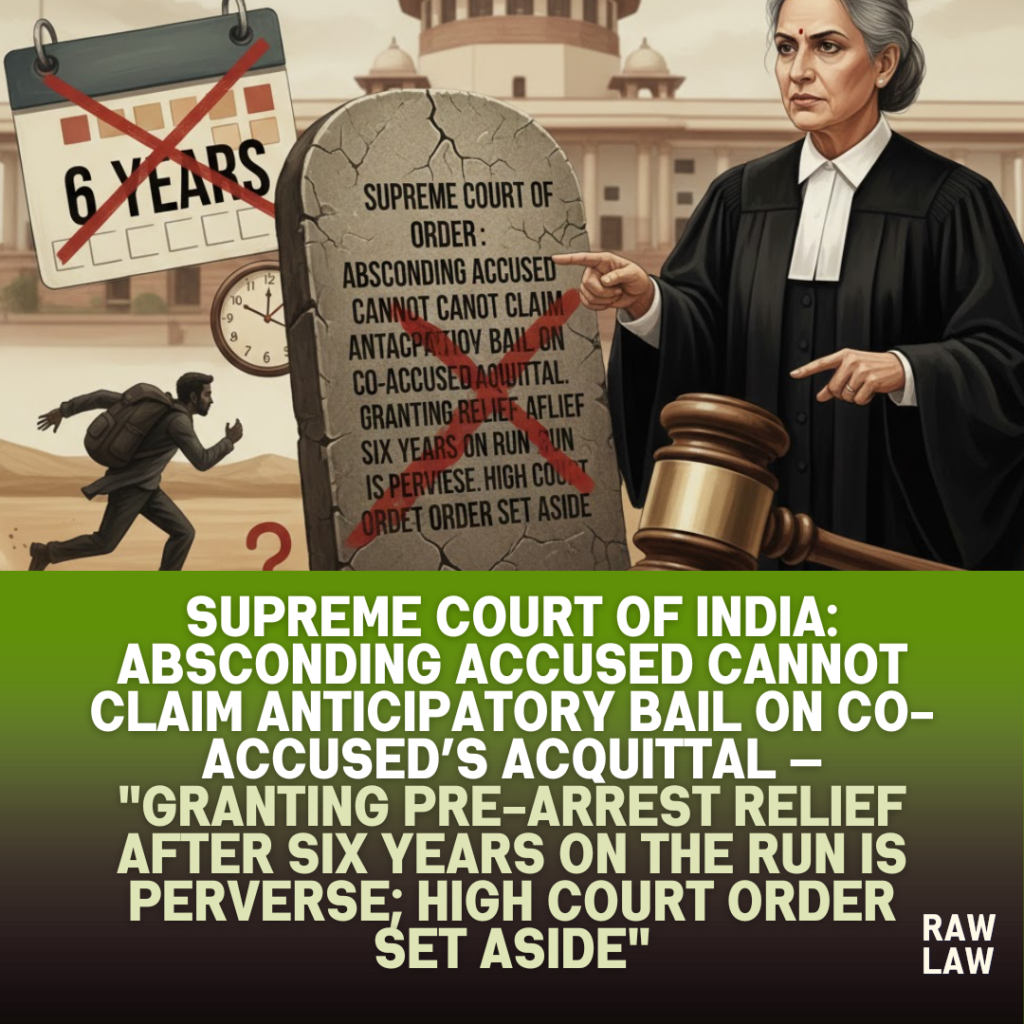
The Supreme Court of India set aside the Madhya Pradesh High Court’s order granting anticipatory bail to an accused in a murder case arising from political rivalry. The Court held that an absconding accused, who evaded investigation for nearly six and a half years and allegedly threatened witnesses, cannot claim pre-arrest bail merely because co-accused were acquitted. Terming the High Court’s exercise of discretion as unjustified and perverse, the Supreme Court directed the accused to surrender within four weeks and clarified that he may apply for regular bail thereafter, to be decided independently on merits.
Facts
The case arose from violent incidents dated 02.06.2017 allegedly triggered by political rivalry between two factions. Three FIRs were registered. The principal FIR alleged that a mob of 100–150 persons wrongfully restrained the complainant’s vehicle, attacked the occupants with weapons including firearms, and opened fire. One person succumbed to bullet injuries and another sustained gunshot wounds. Offences under Sections 302, 307, 147, 148, 149 IPC and Sections 25 and 27 of the Arms Act were invoked.
A cross-FIR was lodged by the rival faction, implicating the complainant and others. The accused in question was named in the principal FIR but remained absconding from the date of the incident. Proceedings under Sections 82 and 83 of the Code of Criminal Procedure were initiated, rewards were declared for his arrest, and supplementary investigation under Section 173(8) CrPC was kept pending.
Two anticipatory bail applications were earlier dismissed. In 2023, the trial court acquitted the co-accused in the principal FIR but convicted the complainant and others in the cross-case. Relying on the acquittal of co-accused, the accused filed a third anticipatory bail application. The High Court directed him to surrender and ordered that he be granted regular bail on the same day. This order was challenged before the Supreme Court.
Issues
The central issue was whether an absconding accused, who had not cooperated with investigation for several years, could be granted anticipatory bail under Section 438 CrPC on the ground that co-accused had been acquitted.
A related issue was whether the High Court correctly exercised discretion by relying on findings recorded in the trial of co-accused, despite the accused not having faced trial.
The Court also examined the distinction between an appeal against grant of bail and an application for cancellation of bail.
Petitioner’s arguments
The complainant argued that the accused had deliberately evaded arrest for over six years and had been declared absconding, with rewards announced for his arrest. It was submitted that such conduct disentitled him from the equitable relief of anticipatory bail. The High Court, it was contended, mechanically applied parity based on acquittal of co-accused without considering the accused’s distinct role, criminal antecedents, and the need for custodial interrogation.
Reliance was placed on precedents holding that absconders are ordinarily not entitled to anticipatory bail. The complainant also highlighted an FIR lodged in 2019 alleging that the accused threatened the injured eyewitness to deter opposition to his bail application.
Respondent’s arguments
The State supported the complainant and argued that the accused had remained untraceable for years and posed a serious threat to witnesses. It emphasized the gravity of the offence involving murder and attempted murder, as well as the accused’s criminal antecedents.
The accused, on the other hand, denied being lawfully declared a proclaimed offender. He argued that co-accused had been acquitted and that the prosecution failed to establish involvement during trial. It was contended that parity and subsequent developments justified anticipatory bail. The accused further asserted that there was no post-bail misconduct after regular bail was granted pursuant to the High Court’s order.
Analysis of the law
The Supreme Court reiterated the settled principles governing anticipatory bail under Section 438 CrPC. Relying on decisions such as Balchand Jain v. State of Madhya Pradesh (1976) 4 SCC 572, Gurbaksh Singh Sibbia v. State of Punjab (1980) 2 SCC 565, and Sushila Aggarwal v. State (NCT of Delhi) (2020) 5 SCC 1, the Court emphasized that anticipatory bail is an extraordinary remedy to protect liberty against arbitrary arrest, not a shield for those who evade due process.
The Court underscored that while absconding does not automatically bar anticipatory bail in every case, relief may be granted only in exceptional circumstances where accusations appear prima facie false or exaggerated. No such exceptional case was made out.
The judgment also relied on Vipan Kumar Dhir v. State of Punjab (2021) 15 SCC 518, holding that even procedural irregularity in declaring an accused absconding does not justify pre-arrest bail in grave offences absent strong prima facie grounds.
Precedent analysis
The Court referred to Mahipal v. Rajesh Kumar (2020) 2 SCC 118, clarifying that appellate scrutiny of bail orders focuses on perversity, illegality, or failure to consider relevant factors. It further cited Prasanta Kumar Sarkar v. Ashis Chatterjee (2010) 14 SCC 496, outlining factors such as gravity of offence, likelihood of absconding, and witness intimidation.
Significantly, the Court relied on the Full Bench decision in Moosa v. Sub Inspector of Police (2005 SCC OnLine Ker 605), which held that acquittal of co-accused does not benefit an absconding accused since evidence against him is not tested in their trial. Applying this rationale, the Supreme Court found that the High Court erred in granting anticipatory bail solely on the basis of acquittal of co-accused.
The Court also cited Ashok Dhankad v. State of NCT of Delhi (2025 SCC OnLine SC 1690) to reiterate that post-bail conduct is irrelevant in appeals against grant of bail; such considerations apply only in cancellation proceedings.
Court’s reasoning
The Supreme Court observed that the accused had evaded investigation from 2017, despite rewards being announced. Firearms allegedly used were not recovered. An FIR alleging witness intimidation was registered in 2019. The accused’s conduct demonstrated disregard for the judicial process.
The High Court’s reliance on acquittal of co-accused was found misplaced. Since the accused never faced trial, findings recorded in favor of co-accused could not automatically extend to him. Granting anticipatory bail in such circumstances, the Court noted, would incentivize evasion of law and undermine public confidence in the criminal justice system.
The Court concluded that the High Court failed to consider gravity of the offence, abscondence, criminal antecedents, and threat to witnesses. The order was therefore perverse and unsustainable.
Conclusion
The Supreme Court allowed the appeal and set aside the High Court’s order granting anticipatory bail. The accused was directed to surrender within four weeks. The Court clarified that he may seek regular bail after surrender, which shall be decided independently and without prejudice.
Implications
This judgment reinforces a strong judicial stance against granting anticipatory bail to absconding accused in serious offences such as murder. It clarifies that acquittal of co-accused does not create automatic parity for fugitives from justice. The ruling strengthens the principle that anticipatory bail cannot be used as a strategic shield after evading investigation for years.
For trial courts and High Courts, the decision underscores the need for rigorous scrutiny of anticipatory bail in cases involving grave offences, witness intimidation, and criminal antecedents. It also sends a clear message that evasion of due process will weigh heavily against grant of pre-arrest protection.
Case law references
- Balchand Jain v. State of Madhya Pradesh (1976) 4 SCC 572
Defined anticipatory bail as “bail in anticipation of arrest.” - Gurbaksh Singh Sibbia v. State of Punjab (1980) 2 SCC 565
Laid down foundational principles governing anticipatory bail discretion. - Sushila Aggarwal v. State (NCT of Delhi) (2020) 5 SCC 1
Clarified scope, duration, and conditions of anticipatory bail. - Prasanta Kumar Sarkar v. Ashis Chatterjee (2010) 14 SCC 496
Enumerated factors to consider in bail decisions. - Mahipal v. Rajesh Kumar (2020) 2 SCC 118
Distinguished appeal against grant of bail from cancellation proceedings. - Vipan Kumar Dhir v. State of Punjab (2021) 15 SCC 518
Held that procedural irregularities in proclamation do not justify anticipatory bail in grave offences. - Moosa v. Sub Inspector of Police (2005 SCC OnLine Ker 605)
Acquittal of co-accused does not benefit absconding accused. - Ashok Dhankad v. State of NCT of Delhi (2025 SCC OnLine SC 1690)
Outlined principles governing appeals against grant of bail.
FAQs
1. Can an absconding accused get anticipatory bail in a murder case?
Generally, no. The Supreme Court has reiterated that absconding accused are ordinarily not entitled to anticipatory bail unless exceptional circumstances show that accusations are prima facie false or exaggerated.
2. Does acquittal of co-accused automatically entitle another accused to bail?
No. Acquittal of co-accused does not create automatic parity, especially if the accused seeking bail did not face trial and remained absconding.
3. What factors must courts consider before granting anticipatory bail?
Courts must assess the gravity of offence, role of the accused, likelihood of absconding, criminal antecedents, possibility of witness intimidation, and overall impact on justice.