


Court’s decision
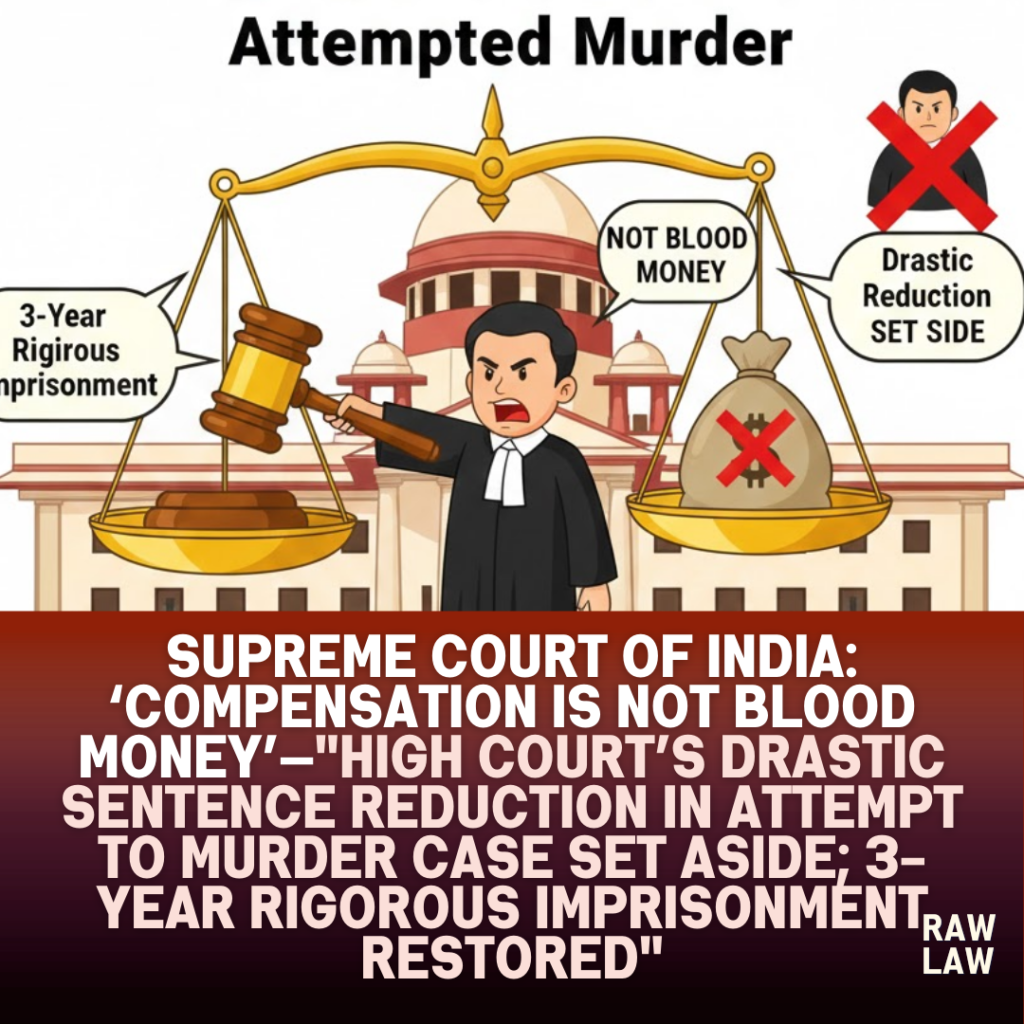
The Supreme Court of India allowed the appeal filed by Parameshwari, wife of the injured victim, and set aside the Madras High Court’s order reducing the sentence of the accused in an attempt to murder case to “period already undergone.” The Court restored the three-year rigorous imprisonment awarded by the Trial Court under Sections 307, 326 and 324 IPC, holding that undue sympathy and enhancement of fine in lieu of custodial sentence undermines sentencing jurisprudence. It ruled that victim compensation cannot substitute punishment and warned against treating monetary payments as “blood money.”
Facts
The prosecution case arose from Crime No. 142/2009 registered at Thiruppachethi Police Station. On 6 June 2009, the private respondents, armed with knives, attacked the victim due to prior enmity. The victim sustained four stab injuries to the chest, ribs, abdomen and palm. Medical evidence established that the injuries were life-threatening if untreated.
The Trial Court convicted the private respondents under Sections 307, 326 and 324 IPC and sentenced them to three years’ rigorous imprisonment with fine of ₹5,000 each. The appellate court affirmed the conviction and sentence.
In revision, the High Court maintained conviction but reduced the sentence to two months (period already undergone), enhancing the fine to ₹50,000 each, noting passage of time and the victim’s subsequent murder in an unrelated incident.
Issues
- Whether the High Court was justified in reducing the sentence to period already undergone despite conviction under Section 307 IPC.
- Whether lapse of time and offer of compensation constitute valid grounds for drastic sentence reduction.
- Whether victim compensation can substitute custodial punishment.
Petitioner’s arguments
The appellant contended that the High Court showed undue sympathy and ignored settled sentencing principles. Relying on precedents such as State of Madhya Pradesh v. Suresh and State of Madhya Pradesh v. Kashiram, it was argued that punishment must be proportionate to the gravity of the offence and that mere lapse of time is not a mitigating factor.
It was further contended that compensation to the victim’s family cannot replace punishment and that revisional jurisdiction was improperly exercised to dilute a well-reasoned sentence.
Respondents’ arguments
The private respondents argued that over ten years had elapsed since the incident, the victim had later been murdered in an unrelated occurrence, and they had already undergone two months’ imprisonment.
They expressed willingness to pay ₹1,00,000 as compensation to the victim’s wife and submitted that the High Court rightly balanced reformation and restitution while reducing the sentence.
Analysis of the law
The Supreme Court undertook an extensive discussion on sentencing jurisprudence, penology and victimology. It reiterated that proportionality is the cardinal principle of sentencing. Courts must balance aggravating and mitigating factors, but punishment must reflect societal condemnation of grave offences.
The Court emphasized that Section 357 CrPC (now Section 395 BNSS) provides for victim compensation as a restitutive measure, but it is supplementary to punishment—not a substitute.
It cautioned that reducing custodial sentences in serious offences merely because compensation is paid risks sending a dangerous message that liability can be “purchased.”
Precedent analysis
The Court relied upon a line of authorities including:
- Hazara Singh v. Raj Kumar – Sentence must be proportionate to gravity.
- State of M.P. v. Saleem – Undue sympathy leading to inadequate sentence undermines public confidence.
- State of Punjab v. Saurabh Bakshi – Courts must avoid leniency that erodes deterrence.
- State of M.P. v. Suresh – Mere passage of time is not decisive for reduction.
- Shivani Tyagi v. State of U.P. – Monetary compensation cannot replace punitive justice; rejection of “blood money” approach.
Applying these precedents, the Court found the High Court’s reasoning legally unsustainable.
Court’s reasoning
The Supreme Court held that the High Court acted in “complete defiance of law” by drastically reducing the sentence without cogent reasoning.
The injuries inflicted were grievous and life-threatening. The Trial Court had already exercised leniency by awarding three years’ imprisonment against a maximum of ten years under Section 307 IPC.
The High Court’s reliance on lapse of time and subsequent death of the victim in an unrelated case was held irrelevant. Compensation, the Court observed, is restitutory and cannot replace punitive sanction.
The Court crystallized four guiding factors for sentencing: proportionality, consideration of facts, societal impact, and balancing aggravating/mitigating circumstances.
It concluded that the High Court’s undue sympathy undermined the administration of justice.
Conclusion
The impugned judgment of the High Court was set aside. The conviction and sentence of three years’ rigorous imprisonment imposed by the Trial Court and affirmed by the appellate court were restored.
The private respondents were directed to surrender within four weeks and serve the remaining sentence.
Implications
This judgment delivers a strong reaffirmation of proportional sentencing in serious criminal offences. It sends a clear message that compensation cannot dilute punishment, particularly in cases involving attempt to murder.
The Court’s articulation of sentencing principles serves as a guideline for subordinate courts and High Courts exercising revisional powers.
By condemning the “blood money” approach, the Supreme Court has strengthened deterrence-based justice while preserving the supplementary role of victim compensation.
Case Law References
- Hazara Singh v. Raj Kumar (2013) 9 SCC 516
- State of M.P. v. Saleem (2005) 5 SCC 554
- State of Punjab v. Saurabh Bakshi (2015) 5 SCC 182
- State of M.P. v. Suresh (2019) 14 SCC 151
- Shivani Tyagi v. State of U.P. (2024 SCC OnLine SC 842)
FAQs
1. Can compensation replace imprisonment in attempt to murder cases?
No. The Supreme Court has clarified that victim compensation is supplementary and cannot substitute custodial punishment.
2. Is passage of time a sufficient ground to reduce sentence?
No. Mere lapse of time, without other compelling mitigating factors, cannot justify drastic sentence reduction.
3. What factors must courts consider while sentencing?
Proportionality, gravity of offence, societal impact, and balanced evaluation of aggravating and mitigating circumstances.