


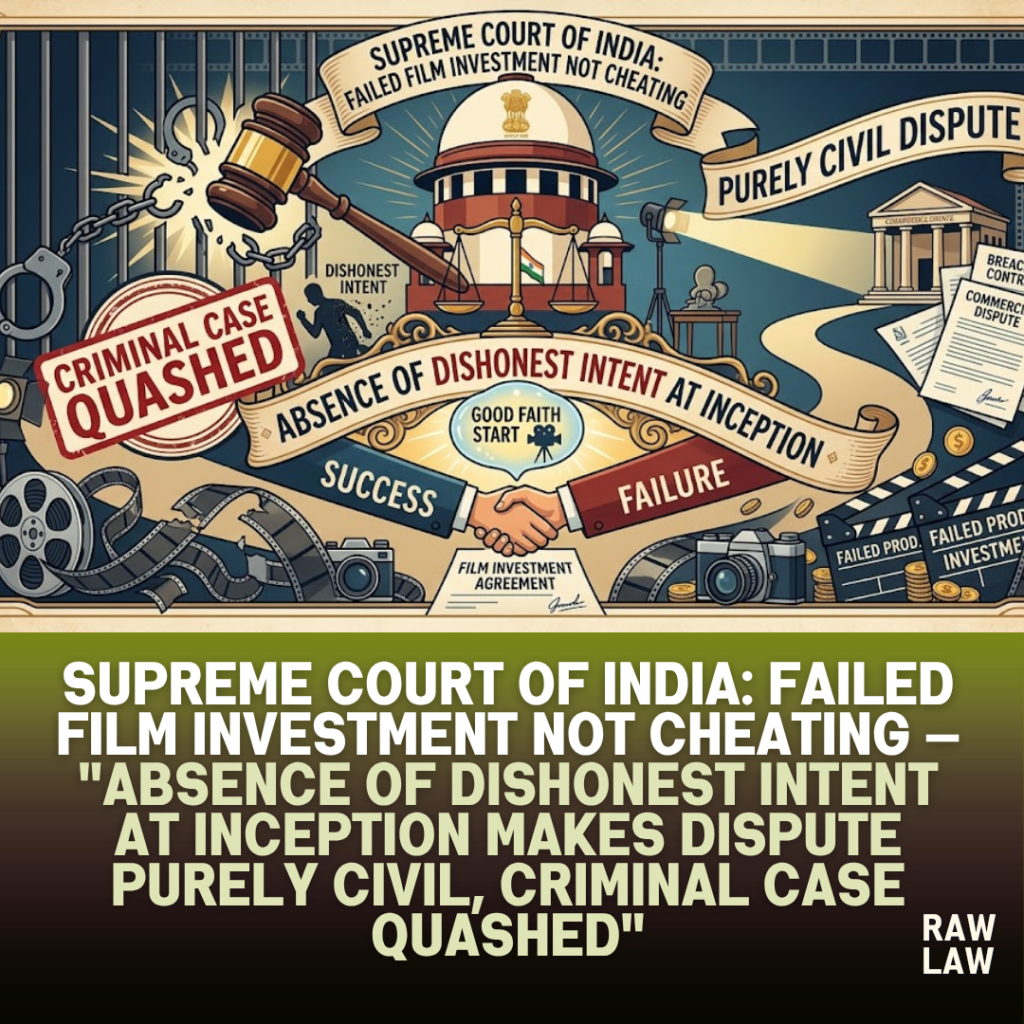
Court’s decision
The Supreme Court allowed the criminal appeal and quashed proceedings under Section 420 of the Indian Penal Code, holding that failure of a film project to generate returns does not constitute cheating in absence of dishonest intention at the inception. The Court ruled that the dispute was purely civil in nature arising from a commercial investment and continuation of criminal proceedings amounted to abuse of process of law.
Facts
The case arose from a financial transaction relating to production of a movie. The appellant, a film producer, had sought funds from the complainant to finance the movie project.
As recorded on pages 2–3 of the judgment, the complainant invested money in stages on the promise of sharing profits—initially 30% and later an enhanced share of 47%.
Subsequently, due to financial constraints, the appellant issued two post-dated cheques of ₹24 lakhs each to repay the principal amount. These cheques were dishonoured due to insufficient funds.
Based on these events, criminal proceedings were initiated alleging offences under Sections 406 (criminal breach of trust) and 420 (cheating) IPC.
The High Court quashed the charge under Section 406 but allowed prosecution under Section 420, leading to the present appeal before the Supreme Court.
Issues
The primary issue was whether failure to fulfil a promise of profit-sharing in a commercial venture amounts to cheating under Section 420 IPC.
The Court also examined whether dishonour of post-dated cheques could establish dishonest intention.
Another key issue was whether the allegations disclosed a criminal offence or merely a civil dispute arising out of breach of contract.
Petitioner’s arguments
The appellant argued that the transaction was purely commercial, involving investment in a high-risk film project where returns were uncertain.
It was contended that the movie was indeed produced and released, but failed to generate profits, making it impossible to fulfil the promise of returns.
The appellant emphasized that there was no dishonest intention at the inception of the transaction, which is a necessary ingredient for the offence of cheating.
It was further argued that criminal proceedings were being misused to recover money arising out of a civil dispute.
Respondent’s arguments
The respondent argued that the appellant induced the complainant to invest money through false promises of profit-sharing.
It was contended that dishonour of cheques and failure to return money demonstrated fraudulent intent.
The respondent maintained that repeated assurances and undertakings to repay indicated deception from the beginning, thereby constituting cheating.
Analysis of the law
The Court undertook a detailed analysis of Section 415 IPC defining cheating. It reiterated that deception and dishonest intention at the inception are essential ingredients.
It clarified that mere breach of contract or failure to fulfil a promise does not amount to cheating unless it is shown that the promise was false from the very beginning.
The Court emphasized that criminal law cannot be invoked to settle civil disputes arising from commercial transactions.
It also examined the nature of post-dated cheques, holding that they are generally issued to discharge existing liability and do not by themselves establish fraudulent inducement.
Precedent analysis
The Court relied on Iridium India Telecom Ltd. v. Motorola Inc., which laid down the essential ingredients of cheating, including deception and inducement.
It also relied on Vesa Holdings Pvt. Ltd. v. State of Kerala, where it was held that breach of contract amounts to cheating only if fraudulent intention existed at the inception.
These precedents were applied to distinguish between civil liability and criminal culpability, reinforcing that criminal prosecution cannot be used for recovery of money in commercial disputes.
Court’s reasoning
The Court found that the initial transaction was an investment in a film project with an agreement to share profits. It noted that film production is inherently risky, and returns are uncertain.
As observed on pages 12–13, the movie was actually completed and released, demonstrating that the promise to produce the film was genuine and not false.
The Court held that absence of profits meant that the promise of profit-sharing could not be fulfilled, but this did not imply dishonest intention.
It further held that issuance of post-dated cheques was for repayment of existing liability and not an inducement to obtain funds.
The Court emphasized that dishonour of such cheques may give rise to proceedings under the Negotiable Instruments Act but does not automatically constitute cheating.
Ultimately, the Court concluded that the allegations disclosed a civil dispute and not a criminal offence.
Conclusion
The Supreme Court allowed the appeal and quashed the criminal proceedings under Section 420 IPC. It held that continuation of the prosecution would amount to abuse of process of law.
Implications
This judgment is a significant reaffirmation of the distinction between civil and criminal liability in commercial transactions.
It protects individuals and businesses from criminal prosecution in cases of genuine business failure.
The ruling also clarifies that high-risk investments, such as film production, inherently involve uncertainty and cannot be criminalised merely due to lack of returns.
It further strengthens safeguards against misuse of criminal law for recovery of money, ensuring that such disputes are resolved through civil remedies.
Case law references
- Iridium India Telecom Ltd. v. Motorola Inc. (2011)
Defined essential ingredients of cheating, including deception and inducement. - Vesa Holdings Pvt. Ltd. v. State of Kerala (2015)
Held that breach of contract constitutes cheating only if dishonest intention existed at inception.
FAQs
1. Does failure to return investment amount to cheating?
No. It amounts to cheating only if there was dishonest intention at the time of making the promise. Otherwise, it is a civil dispute.
2. Can dishonour of cheques prove cheating?
Not by itself. It may attract proceedings under the Negotiable Instruments Act but does not automatically establish cheating.
3. Can criminal law be used for recovery of investment losses?
No. Courts discourage misuse of criminal proceedings for resolving civil or commercial disputes.