


Court’s decision
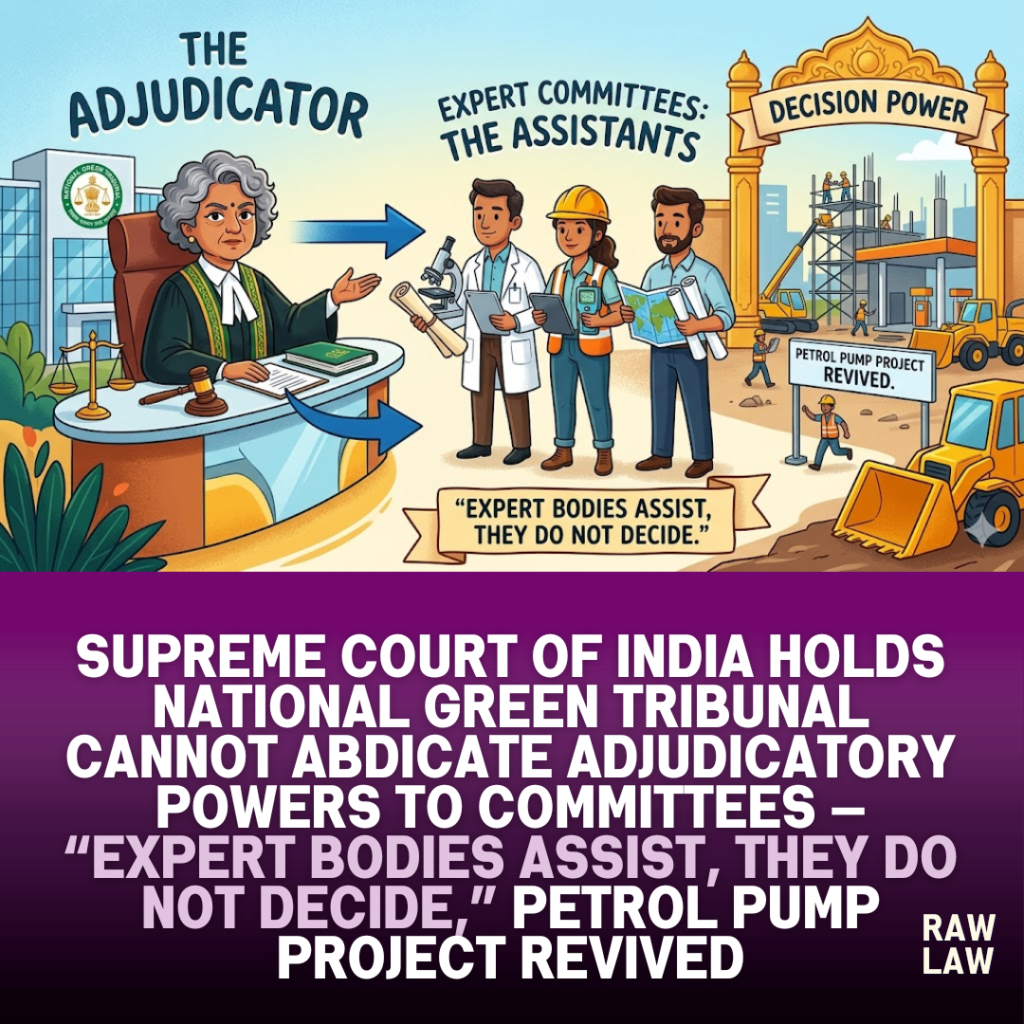
The Supreme Court of India set aside the orders of the National Green Tribunal (NGT) that had stalled the establishment of a petrol pump for over six years. The Court held that the NGT had unlawfully abdicated its adjudicatory function by delegating decision-making to expert committees and by violating principles of natural justice. It permitted reconsideration of the project and directed authorities to proceed in accordance with law.
Facts
The dispute arose from objections to the establishment of a petrol pump near a gas agency and a play school. The objector approached the NGT alleging violation of environmental guidelines issued by the Central Pollution Control Board (CPCB), particularly the minimum distance requirement from schools, hospitals, and residential areas.
The NGT initially constituted a committee to examine the issue and, despite a favorable report, refrained from deciding the matter itself. Instead, it delegated the final decision to the committee and kept approvals in abeyance.
Subsequently, an execution petition was filed, and the NGT, without notice to affected parties, directed compliance with earlier orders, further stalling the project.
Issues
The key issue was whether the NGT could delegate its adjudicatory functions to expert committees instead of deciding disputes itself.
Another issue was whether the NGT violated principles of natural justice by passing orders without notice or hearing affected parties.
The Court also examined whether the objection raised against the petrol pump had legal merit under CPCB siting guidelines.
Petitioner’s arguments
The appellants argued that all statutory approvals and clearances had been obtained and that the project complied with environmental norms. They contended that the objector lacked locus standi and was acting with ulterior motives. It was submitted that the committee reports supported the establishment of the petrol pump and confirmed that the area was commercial in nature. The appellants further argued that the NGT failed to adjudicate the dispute and instead improperly delegated its powers, resulting in prolonged delay and economic loss.
Respondent’s arguments
The respondent argued that the petrol pump violated CPCB guidelines on minimum distance from sensitive locations such as schools and residential areas. It was contended that environmental safety and the precautionary principle justified halting the project. The respondent also alleged suppression of material facts by the appellants and argued that the committee findings should be treated as conclusive evidence against the project.
Analysis of the law
The Supreme Court examined the statutory framework governing the NGT, particularly its role as an adjudicatory body under the National Green Tribunal Act, 2010.
It emphasized that the NGT exercises judicial functions and must decide disputes based on evidence and legal principles. Expert committees may assist the tribunal, but cannot replace its decision-making role.
The Court also highlighted the centrality of natural justice, noting that parties must be given an opportunity to respond before adverse orders are passed.
Precedent analysis
The Court relied on prior decisions emphasizing that adjudicatory bodies cannot delegate their core functions.
In earlier rulings, it was held that expert committees serve only an advisory role and that final decisions must rest with the adjudicating authority.
The Court also reiterated that violation of natural justice, particularly lack of notice and hearing, renders orders legally unsustainable.
Court’s reasoning
The Court found that the NGT had clearly abdicated its adjudicatory role by directing a committee to decide the issue instead of delivering its own findings.
It held that the tribunal’s approach of relying on committee reports without independent evaluation was legally impermissible.
The Court also found a serious violation of natural justice, as the NGT passed orders without notice and without considering objections from affected parties.
On merits, the Court observed that the area was classified as commercial and that there was no clear violation of CPCB guidelines. The objections were found to lack substantiation, and the objector’s locus standi remained doubtful.
Conclusion
The Supreme Court allowed the appeals and set aside the NGT’s orders. It directed that the matter be reconsidered by competent authorities and that the petrol pump be permitted if it complies with applicable laws.
Implications
This judgment reinforces the fundamental principle that adjudicatory bodies cannot outsource their decision-making responsibilities.
It strengthens procedural safeguards by reiterating the importance of natural justice in environmental adjudication.
The ruling also provides relief to businesses facing delays due to prolonged litigation and improper regulatory processes.
For environmental governance, the decision clarifies the limited role of expert committees and ensures accountability of tribunals.
Case law references
Sanghar Zuber Ismail v. Union of India
Held that NGT must adjudicate disputes and cannot rely solely on committee findings.
Kantha Vibhag Yuva Koli Samaj Parivartan Trust v. State of Gujarat
Reaffirmed that expert committees assist but cannot replace adjudicatory functions.
Singrauli Super Thermal Power Station v. Ashwani Kumar Dubey
Emphasized compliance with natural justice and proper adjudication by NGT.
FAQs
1. Can the National Green Tribunal delegate decisions to committees?
No. The Supreme Court held that committees can assist but cannot decide cases.
2. What happens if natural justice is violated in NGT proceedings?
Orders passed without notice or hearing are liable to be set aside.
3. Are environmental objections enough to stop commercial projects?
Only if supported by evidence and legal violations; unsupported claims will not suffice.