


Court’s decision
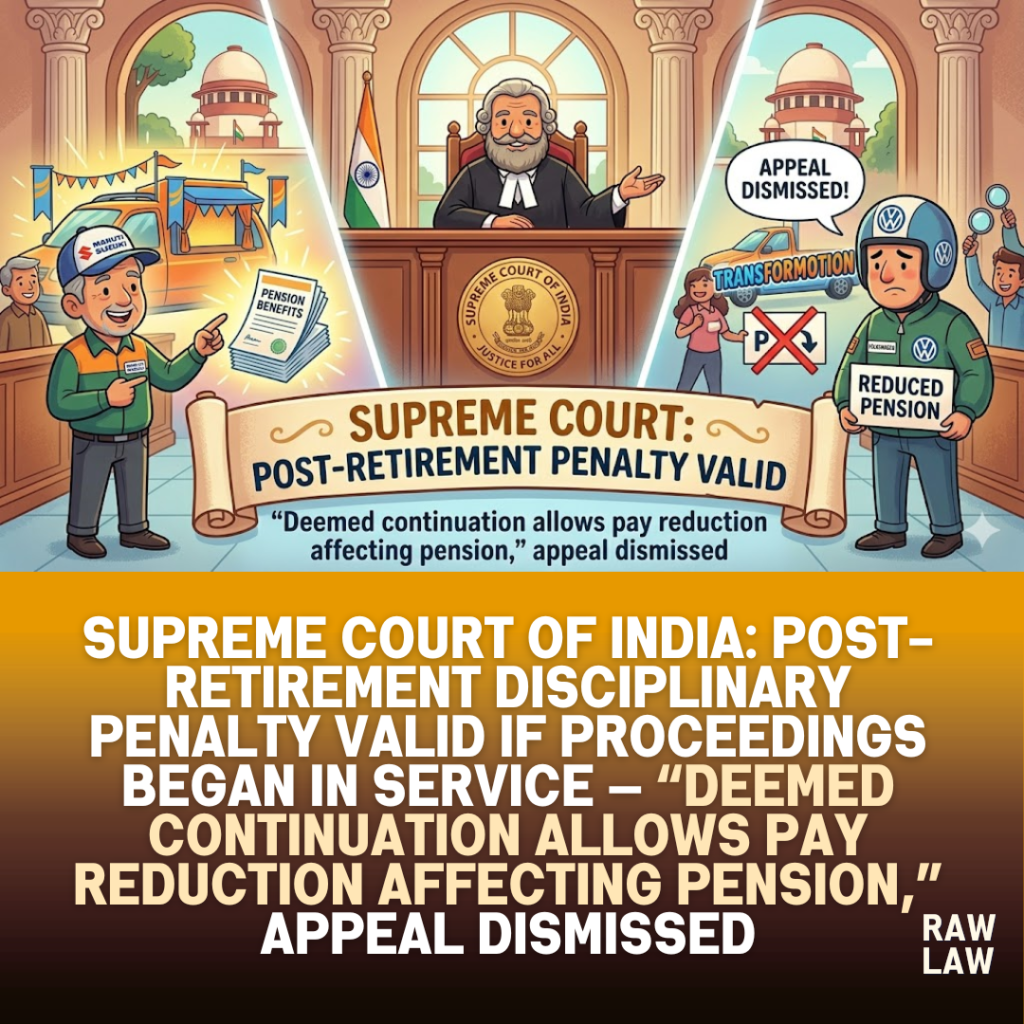
The Supreme Court upheld the validity of disciplinary proceedings continued after retirement and ruled that reduction in pay scale imposed post-superannuation is legally permissible where service regulations allow continuation of proceedings. The Court dismissed the appeal, affirming that such penalties can validly impact pension computation.
Facts
The appellant, a bank officer, was served a charge sheet on the very day of his superannuation in 2011 for alleged irregularities in loan disbursement.
Despite retirement, disciplinary proceedings continued under the applicable Service Regulations.
The Inquiry Officer found one charge—failure to ensure end-use of loan funds—partly proved, noting that large cash withdrawals lacked supporting documentation.
Based on this finding, the disciplinary authority imposed a penalty of reduction by three stages in the time scale of pay on a permanent basis in 2013.
The High Court Single Judge set aside the punishment, holding that post-retirement penalties must be governed by Pension Regulations.
However, the Division Bench reversed this decision, prompting the appeal before the Supreme Court.
Issues
The Court examined whether disciplinary proceedings can continue after superannuation under service regulations.
It also considered whether a penalty of reduction in pay scale can be imposed post-retirement.
Another issue was whether such penalty is enforceable, given its impact on pension.
Additionally, the Court examined whether the findings of misconduct suffered from perversity or procedural illegality.
Petitioner’s arguments
The appellant argued that once an employee retires, the employer-employee relationship ceases, and service regulations no longer apply.
It was contended that only Pension Regulations could govern post-retirement action, limiting penalties to withholding or reducing pension.
The appellant further argued that reduction in pay scale is impermissible after retirement and cannot be enforced.
Additionally, it was submitted that the disciplinary findings were flawed and that the High Court failed to consider key legal and factual grounds.
Respondent’s arguments
The bank argued that Service Regulations expressly permit continuation of disciplinary proceedings even after superannuation if initiated before retirement.
It was contended that a legal fiction treats the employee as continuing in service for the limited purpose of concluding proceedings.
The bank further argued that the penalty imposed was proportionate and legally sustainable.
It was emphasized that ensuring end-use of loan funds is a core duty, and failure to do so exposes the bank to financial risk.
Analysis of the law
The Court undertook a detailed analysis of service jurisprudence governing disciplinary proceedings in banking institutions.
It held that where service rules explicitly allow continuation of proceedings post-retirement, such continuation is valid.
The Court emphasized the concept of legal fiction, whereby a retired employee is deemed to remain in service solely for completing disciplinary proceedings.
It clarified that the nature of permissible penalties depends on the regulatory framework and the factual context.
The Court also distinguished between penalties that are incapable of enforcement post-retirement and those that can operate through pension recalculation.
Precedent analysis
The Court relied on several precedents:
- Chairman-cum-Managing Director, Mahanadi Coalfields Ltd. v. Rabindranath Choubey
Held that disciplinary proceedings can continue post-retirement and major penalties may be imposed where rules permit. - Ramesh Chandra Sharma v. Punjab National Bank
Recognized validity of continuing disciplinary proceedings through legal fiction. - UCO Bank v. Prabhakar Sadashiv Karvade
Distinguished as applicable where charge sheet was issued after retirement. - Canara Bank v. D.R.P. Sundharam
Affirmed continuation of proceedings under service rules.
The Court harmonized these decisions to conclude that continuation and penalty are both permissible when proceedings begin before retirement.
Court’s reasoning
The Court found no perversity in the findings of the Inquiry Officer.
It noted that the appellant failed to ensure end-use of loan funds, as significant cash withdrawals lacked supporting bills.
The Court emphasized that bank officers hold positions of trust and must exercise diligence in handling public funds.
On the legal issue, the Court held that Regulation 20(3)(iii) creates a legal fiction allowing continuation of proceedings post-retirement.
It reasoned that denying the power to impose penalties would render such provisions meaningless.
Importantly, the Court held that reduction in pay scale is implementable post-retirement because pension is calculated based on last drawn pay.
Thus, the penalty indirectly affects pension and remains enforceable.
Conclusion
The Supreme Court dismissed the appeal, upholding the disciplinary action and confirming that post-retirement penalties are valid where proceedings were initiated during service.
Implications
This judgment is a significant clarification in service and employment law.
It establishes that disciplinary jurisdiction does not automatically end with retirement where rules provide otherwise.
The ruling also clarifies that penalties affecting pay can be enforced indirectly through pension computation.
It strengthens accountability of public sector employees, especially in financial institutions.
Further, it harmonizes conflicting precedents and provides clear guidance on post-retirement disciplinary powers.
Case law references
- Mahanadi Coalfields Ltd. v. Rabindranath Choubey (2020)
Post-retirement continuation of disciplinary proceedings permissible. - Ramesh Chandra Sharma v. Punjab National Bank (2007)
Legal fiction allows continuation of service for disciplinary purposes. - UCO Bank v. Prabhakar Sadashiv Karvade (2018)
Distinguished—applies where proceedings initiated after retirement. - Canara Bank v. D.R.P. Sundharam (2016)
Validated continuation of proceedings under service rules.
FAQs
1. Can disciplinary proceedings continue after retirement?
Yes, if service rules permit and proceedings were initiated before retirement.
2. Can penalties like reduction in pay be imposed after retirement?
Yes, if they affect pension computation and are supported by service regulations.
3. Do pension rules override service rules after retirement?
Not necessarily. Courts examine both frameworks together to determine permissible action.