


Court’s decision
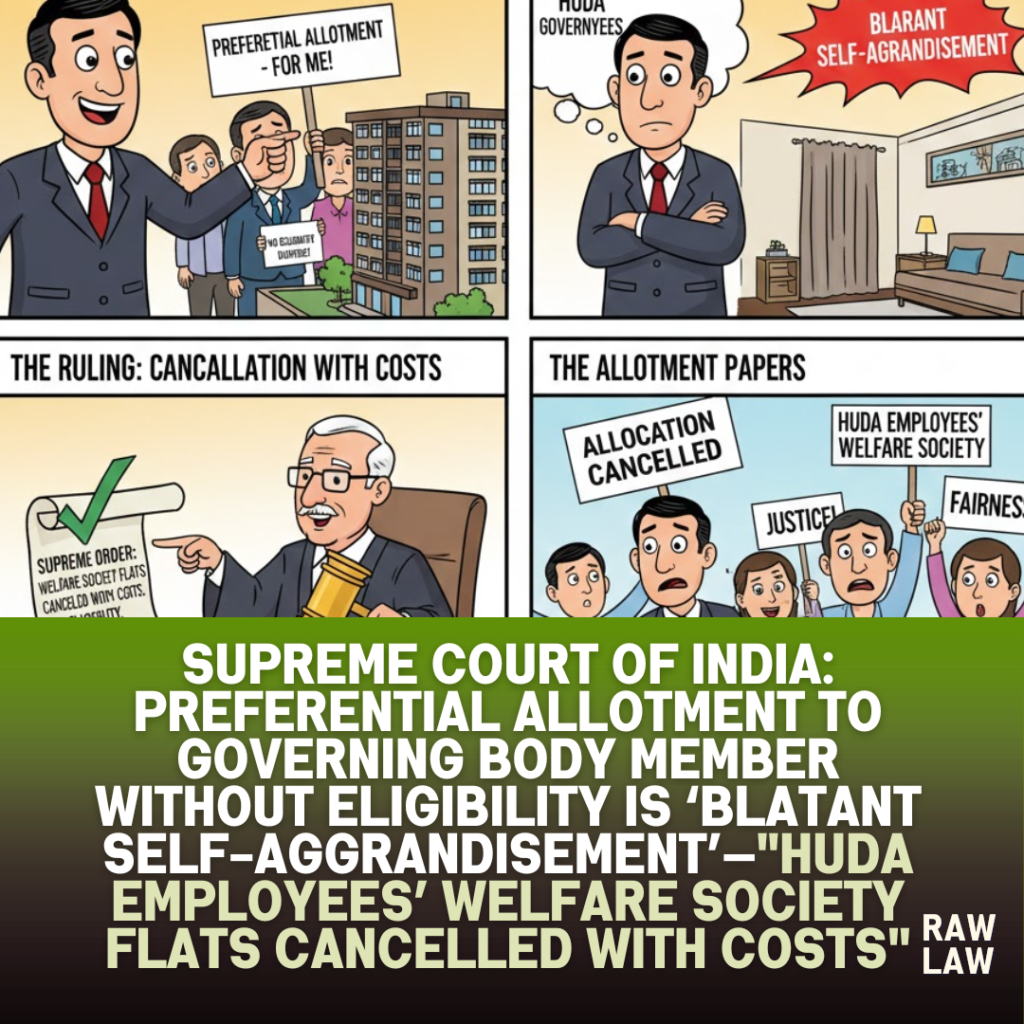
The Supreme Court of India set aside the Punjab and Haryana High Court judgment and cancelled the allotment of two super deluxe flats made by the HUDA Employees Welfare Organization to a governing body member and his subordinate. The Court held that the allotments were vitiated by favouritism, ineligibility, and procedural manipulation, observing that “nepotism and self-aggrandizement are anathema to a democratic system.” The Court imposed costs of ₹1 lakh on the Society, ₹50,000 on the governing body member, and ₹25,000 on the subordinate beneficiary, directing fresh allotment through a lawful draw of lots.
Facts
The dispute concerned allotment of two super deluxe flats by the HUDA Urban Estate and Town and Country Planning Employees Welfare Organization, a society registered under the Societies Registration Act, 1860, formed to benefit employees of HUDA/HSVP.
The appellant, eligible by virtue of 14 years’ deputation in HUDA, challenged allotments made to a governing body member (third respondent) and an accountant working under him (fourth respondent).
Two flats became available after cancellation of memberships. Applications were invited, prescribing eligibility including minimum six months’ service and a specified pay band level.
Before the last date expired, one flat was allotted to the presiding governing body member. Subsequently, after his surrender, the third respondent—who assumed office later—sought and obtained preferential allotment. The fourth respondent secured the other flat through a draw of lots, despite not meeting pay-band criteria.
Issues
- Whether Article 226 jurisdiction was maintainable against the Society.
- Whether preferential allotment to a governing body member who did not satisfy eligibility criteria was valid.
- Whether the fourth respondent satisfied stipulated pay-band requirements.
- Whether participation in the draw estopped the appellant from challenging allotment.
Petitioner’s arguments
The appellant alleged arbitrariness, lack of transparency, and favouritism. He contended that the third respondent was not even a member or eligible employee on the last date of application and had not deposited application fee or earnest money within time. The allotment letter was described as a farcical communication addressed by the third respondent to himself in official and personal capacities.
As regards the fourth respondent, the appellant argued that eligibility criteria relating to pay-band level were violated and subsequent “regularisation” by the governing body was impermissible.
Respondents’ arguments
The respondents contended that the Society was not “State” under Article 12 and that allotments were consistent with past governing body decisions permitting preference to its members. They argued that the fourth respondent satisfied basic pay criteria and that the appellant, having participated in the draw, was estopped from challenging it.
Analysis of the law
The Supreme Court agreed with the High Court that Article 226 was maintainable given governmental control over land allotment and the fiduciary obligations of ex officio members holding public office.
The Court emphasized that governing body members, though functioning within a society, remain public officials bound by standards of fairness, transparency, and accountability.
Preferential allotment cannot override foundational eligibility conditions in bye-laws. A governing body member who did not meet the six-month deputation requirement or pay-band criteria could not be granted allotment.
The Court rejected estoppel, holding that participation does not legitimise an illegal process.
Precedent analysis
The judgment reinforces constitutional principles against arbitrariness and abuse of public office. Though not extensively citing precedent, the Court relied on settled doctrines of fairness, fiduciary responsibility, and public law accountability in actions involving public land and government-linked societies.
The ruling underscores that even registered societies must adhere to constitutional values when operating within governmental frameworks.
Court’s reasoning
The Court found that on the last date of application, the third respondent was neither an employee of HUDA nor a governing body member and had not satisfied the six-month service requirement. No application or earnest money had been deposited within time.
The allotment letter was described as a “complete farce,” evidencing blatant favouritism and self-aggrandisement.
Regarding the fourth respondent, the Court found that he did not satisfy the stipulated pay-band level and that subsequent regularisation could not cure ineligibility. The fact that he worked under the third respondent strengthened the inference of bias.
The Court held both allotments illegal and abusive of authority.
Conclusion
The appeal was allowed. The High Court judgment was set aside. The allotments to the third and fourth respondents were cancelled.
The Court directed refund of amounts deposited without interest, vacation of premises within one month, and conduct of a fresh draw of lots among eligible applicants. If only one eligible applicant remains, one flat shall be allotted to the appellant with six months’ time to deposit payment.
Costs were imposed personally and institutionally to deter misuse of authority.
Implications
This judgment sends a strong message against nepotism and abuse of fiduciary positions within government-linked societies. It reinforces that eligibility norms cannot be diluted through internal resolutions and that public functionaries must act transparently.
The ruling strengthens accountability in allotment of public housing schemes and clarifies that courts will intervene where favoritism undermines fairness.
Case Law References
The Court relied on constitutional principles of fairness, transparency, fiduciary duty, and non-arbitrariness in public law governance while interpreting the bye-laws of the Society.
FAQs
1. Can a governing body member receive preferential allotment in a housing society?
Only if they strictly satisfy eligibility criteria. Preference cannot override statutory or bye-law requirements.
2. Does participation in a draw of lots prevent legal challenge?
No. Participation does not validate an illegal or arbitrary process.
3. Can courts impose personal costs for arbitrary allotment?
Yes. Courts may impose personal and institutional costs where abuse of authority is evident.