


Court’s decision
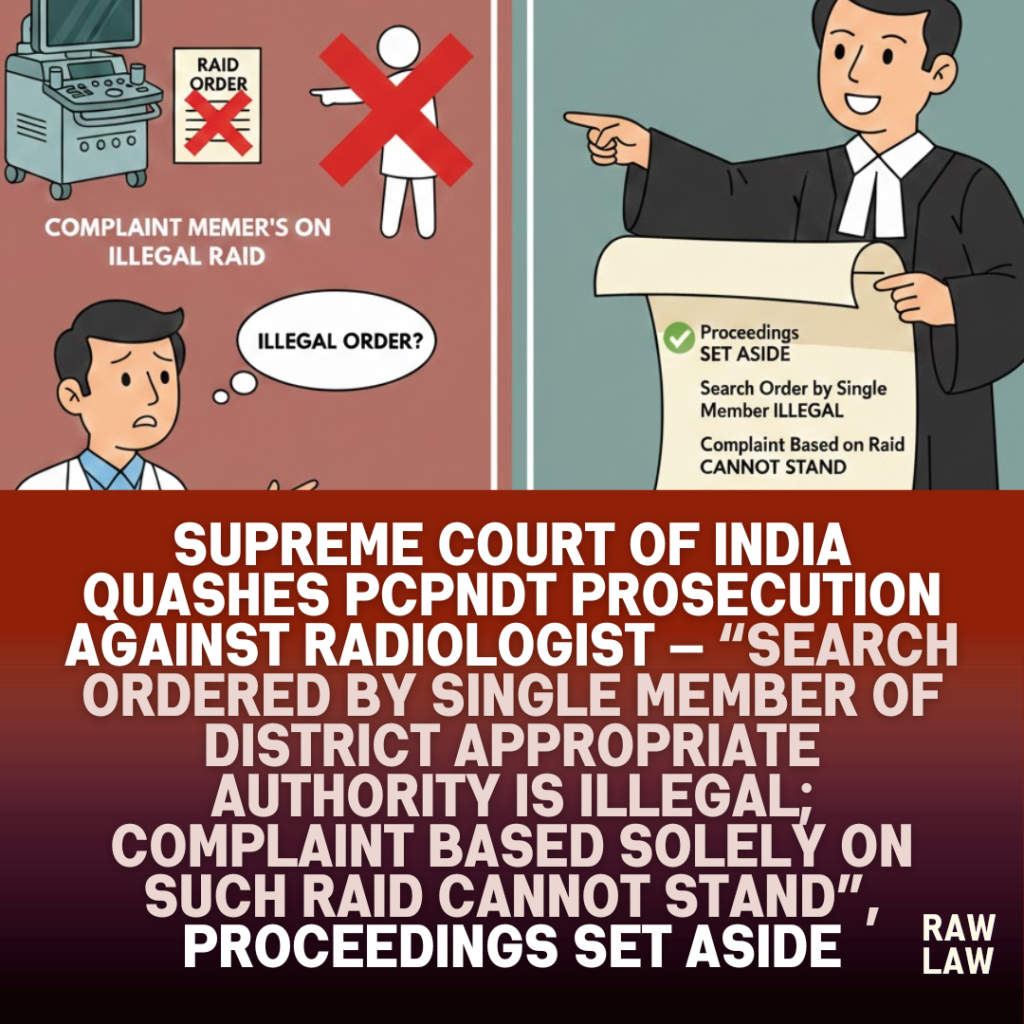
The Supreme Court of India allowed the appeal filed by a radiologist and quashed the complaint proceedings initiated under the Pre-Conception and Pre-Natal Diagnostic Techniques (Prohibition of Sex Selection) Act, 1994.
The Court held that the raid conducted at the diagnostic centre was authorized only by the Civil Surgeon acting alone, without a collective decision of the District Appropriate Authority as mandated under Section 30 of the PCPNDT Act. Applying the ratio in Ravinder Kumar v. State of Haryana, the Court ruled that a search authorized by a single member is illegal. Since the complaint was founded entirely on the materials seized in that illegal search, continuation of prosecution would amount to abuse of process. The proceedings were accordingly quashed.
Facts
The appellant, a qualified radiologist employed at a diagnostic centre in Gurugram, was implicated in a sting operation conducted on 17 September 2015. Acting upon a complaint alleging illegal sex determination, the Civil Surgeon constituted a team to conduct a raid.
A decoy pregnant woman was allegedly sent to the clinic after an intermediary doctor demanded ₹25,000 for sex determination. It was alleged that the appellant conducted ultrasonography without filling Form F or maintaining required records.
An FIR was registered the same day. However, after police investigation, the appellant was discharged on 28 October 2015 for lack of incriminating material.
Subsequently, the District Advisory Committee recommended filing of a complaint under the PCPNDT Act. In 2018, a complaint was lodged and the appellant was summoned. The High Court refused to quash the complaint, leading to the present appeal.
Issues
The Supreme Court framed the core legal questions as follows:
- Whether the search and seizure conducted on 17 September 2015 was valid under Section 30 of the PCPNDT Act.
- Whether a search authorized solely by the Chairperson of the District Appropriate Authority is legally sustainable.
- Whether a complaint based entirely on materials seized during an illegal search can be allowed to proceed.
The case required interpretation of Sections 17, 17A, 23, 28 and 30 of the PCPNDT Act and Rule 18A of the PCPNDT Rules.
Appellant’s arguments
The appellant contended that the raid was illegal because the order dated 17 September 2015 was issued only by the Civil Surgeon, who was merely the Chairperson of the District Appropriate Authority. Under the statutory notification, the Authority comprised three members — the Civil Surgeon, the District Programme Officer and the District Attorney.
Relying heavily on Ravinder Kumar v. State of Haryana, it was argued that Section 30(1) requires a collective decision of the Appropriate Authority before authorizing search and seizure. Since there was no material to show a meeting of minds among the three members, the search was void.
It was further argued that the appellant had already been discharged in the FIR arising from the same incident, and the subsequent complaint based on identical material was untenable.
Respondent’s arguments
The State contended that the PCPNDT Act is a social welfare legislation aimed at preventing female foeticide and must be strictly enforced. It was argued that minor procedural irregularities should not defeat substantive enforcement.
The respondents submitted that the Appropriate Authority possesses independent powers under Section 17(4)(c) and 17A to investigate complaints and initiate action. The raid was conducted promptly to prevent destruction of records.
It was also argued that even if there were irregularities in authorization, such defects should not invalidate prosecution when serious violations of mandatory record-keeping requirements under Form F were found.
Analysis of the law
The Court undertook an elaborate review of the statutory framework. It reiterated that the PCPNDT Act is a stringent social welfare legislation intended to combat sex selection and protect the right to life of the girl child under Article 21.
Referring to Section 30(1), the Court emphasized that the power to conduct search and seizure is drastic in nature. Such power must therefore be exercised strictly in accordance with the statute.
The Court extracted and analysed the decision in Ravinder Kumar, which categorically held that authorization under Section 30 must be by the Appropriate Authority collectively and not by a single member acting alone.
Precedent analysis
The Court relied primarily on Ravinder Kumar v. State of Haryana (2024 SCC OnLine SC 2495). In that case, it was held that if only the Chairperson authorizes a search without participation of other members, the search is illegal.
The Court distinguished Federation of Obstetrics and Gynaecological Societies of India (FOGSI) v. Union of India, where strict compliance with Form F requirements was upheld. It clarified that while Form F compliance is mandatory, the present case concerned the legality of the search itself, not merely record maintenance.
Thus, the ratio of Ravinder Kumar was found directly applicable.
Court’s reasoning
Upon examining the record, the Court found that the communication dated 17 September 2015 directing the raid was issued solely by the Civil Surgeon acting as Chairperson. There was no material to show that the other two members of the District Appropriate Authority participated in or approved the decision.
Applying the binding precedent in Ravinder Kumar, the Court held that the search was illegal.
It further noted that the FIR and the subsequent complaint were entirely based on materials seized during that search. There was no independent evidence connecting the appellant with sex determination.
Once the search was held illegal, continuation of prosecution would amount to abuse of process.
Conclusion
The Supreme Court concluded that the raid conducted at the clinic was vitiated due to non-compliance with Section 30(1) of the PCPNDT Act. Since the complaint was founded entirely on the illegal search and seizure, it could not be sustained.
The appeal was allowed. The High Court’s judgment was set aside and the complaint proceedings against the appellant were quashed.
Implications
This ruling clarifies that strict compliance with statutory safeguards is mandatory even in enforcement of social welfare legislation like the PCPNDT Act.
While the Act mandates rigorous maintenance of Form F and related records, enforcement agencies must equally adhere to procedural safeguards when exercising search and seizure powers.
The judgment reinforces the principle that collective statutory bodies must act collectively when conferring drastic powers. It also reaffirms that prosecutions founded solely on illegal searches cannot survive judicial scrutiny.
Case Law References
- Ravinder Kumar v. State of Haryana (2024 SCC OnLine SC 2495) – Held that authorization for search under Section 30 must be by the Appropriate Authority collectively; single-member authorization is illegal. Applied directly.
- Federation of Obstetrics and Gynaecological Societies of India v. Union of India (2019) 6 SCC 283 – Held that complete compliance with Form F is mandatory; distinguished as present case concerns legality of search.
The Court applied these authorities to quash the prosecution.
FAQs
1. Can a single member of the District Appropriate Authority order a raid under the PCPNDT Act?
No. The Supreme Court has held that authorization under Section 30 must be a collective decision of the Appropriate Authority.
2. Does non-maintenance of Form F automatically justify prosecution?
Form F compliance is mandatory, but enforcement actions like search and seizure must also strictly comply with statutory procedure.
3. Can prosecution continue if the search itself is illegal?
If the complaint is entirely based on materials seized during an illegal search, the proceedings are liable to be quashed.