


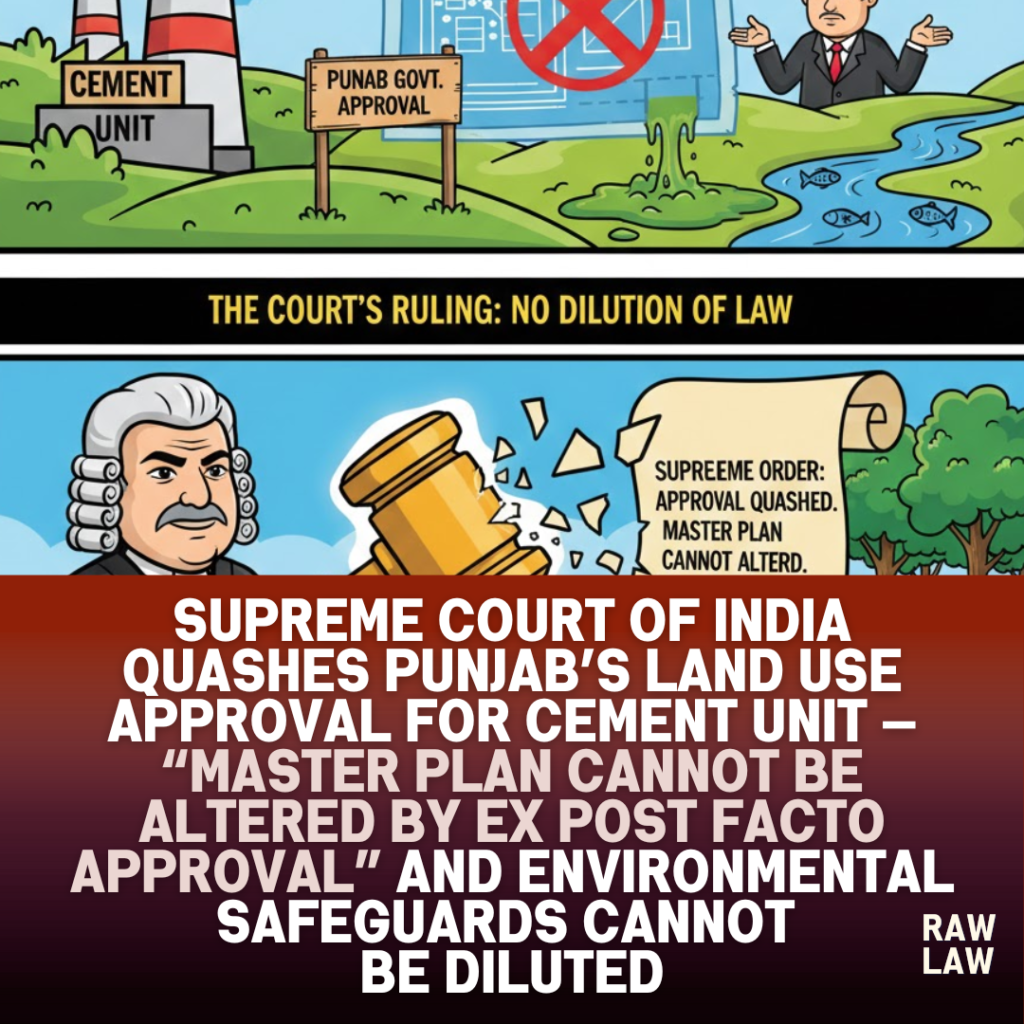
Court’s decision
The Supreme Court allowed the civil appeals and quashed the Change of Land Use (CLU) dated 13.12.2021 granted for a cement grinding unit in Sangrur, Punjab. The Court held that a CLU issued in violation of the operative Master Plan cannot be validated through subsequent ex post facto approval by the Planning Board. It further held that preventive environmental safeguards and siting norms cannot be diluted by later regulatory reclassification. The High Court’s judgment upholding the CLU was set aside, and the consequential No Objection Certificate was also quashed.
Facts
The case arose from a challenge to a Change of Land Use granted to a private cement company for establishing a cement grinding unit on approximately 47.82 acres of land in Sangrur, Punjab. The appellants comprised agriculturists residing near the site and a public school located in close proximity.
Under the Master Plan for Sangrur, the land in question fell within a rural agricultural zone. On 13.12.2021, the Punjab Bureau of Investment Promotion issued a CLU in favour of the company. The following day, the Pollution Control Board granted consent to establish under a single-window mechanism.
The appellants challenged the CLU before the High Court of Punjab and Haryana, contending that a red category polluting industry could not be permitted in a rural agricultural zone. The High Court dismissed the writ petitions, holding that subsequent approval granted by the Punjab Regional and Town Planning and Development Board in its meeting dated 05.01.2022 cured the defect in the CLU.
Aggrieved, the appellants approached the Supreme Court.
Issues
The Supreme Court framed three core issues:
- Whether the CLU dated 13.12.2021 could be granted when the site fell in a rural agricultural zone under the operative Master Plan.
- Whether the Planning Board’s “ex post facto approval” dated 05.01.2022 could cure the defect and operate as a lawful amendment of the Master Plan.
- Whether siting norms and environmental safeguards, including pollution control and proximity standards, were complied with.
Additionally, in connected writ petitions under Article 32, the Court examined the legality of the Central Pollution Control Board’s 2025 reclassification of stand-alone grinding units from “Red” to “Orange” category and related guidelines.
Appellants’ arguments
The appellants contended that the Master Plan, being a statutory instrument under the Punjab Regional and Town Planning and Development Act, 1995, had binding force. They argued that once land was zoned as rural agricultural, permitting a red category industrial unit amounted to altering the Master Plan without following statutory procedure.
They further argued that the Planning Board’s ex post facto approval could not substitute the mandatory procedure under Sections 70, 75, and 76 of the Act, which required public notice, objections, and gazette publication for valid amendment.
On environmental grounds, they asserted that siting norms prescribed minimum distance from residential clusters and educational institutions, which were violated. They also argued that environmental clearance and preventive safeguards must operate at the threshold, not retrospectively.
Respondents’ arguments
The State of Punjab and the project proponent contended that the CLU was processed under a statutory framework and that the Planning Board’s approval validated the decision.
They argued that the proposed unit was a stand-alone grinding unit without clinker manufacturing or captive power plant, and thus had lower pollution potential. Reliance was placed on pollution control safeguards, green belt development, and mitigation measures.
In relation to the 2025 CPCB reclassification, it was argued that revised Pollution Index methodology justified downgrading such units from “Red” to “Orange” category.
Analysis of the law
The Court examined the statutory scheme under the Punjab Regional and Town Planning and Development Act, 1995. It emphasized that a Master Plan, once published under Section 70(5) and brought into operation under Section 75, acquires binding force. Section 79 prohibits use of land contrary to the operative Master Plan.
The Court reiterated the settled principle that when a statute prescribes a manner for doing an act, it must be done in that manner or not at all. Alteration or revision of a Master Plan must comply with statutory safeguards, including public notice and gazette publication.
Relying on precedents such as K. Ramadas Shenoy v. Town Municipal Council and Bangalore Medical Trust v. B.S. Muddappa, the Court reaffirmed that zoning norms cannot be diluted by administrative discretion or executive convenience.
On environmental jurisprudence, the Court invoked the precautionary principle and preventive framework underlying the EIA Notification, 2006. It held that safeguards must operate before commencement of construction and cannot be diluted on assumptions of future mitigation.
Precedent analysis
The Court relied on Bangalore Medical Trust to stress that alteration of planning schemes must follow statutory procedure and cannot be effected through executive directions.
It reiterated the environmental law principles articulated in Vellore Citizens’ Welfare Forum, M.C. Mehta, and Hospitality Association of Mudumalai, underscoring that public health and environmental protection are integral to Article 21 of the Constitution.
These precedents were applied to hold that ex post facto validation and regulatory dilution cannot override statutory planning discipline or constitutional environmental guarantees.
Court’s reasoning
The Court held that the CLU dated 13.12.2021 lacked statutory backing at the time of its issuance because the Master Plan treated the land as rural agricultural zone.
The Planning Board’s approval dated 05.01.2022, recorded in meeting minutes, did not amount to lawful amendment of the Master Plan. Statutory procedure for alteration, including public participation and gazette publication, was not followed.
The Court further held that siting norms and preventive environmental safeguards were not demonstrably complied with. Reliance on later-stage compliance or pollution mitigation measures was insufficient.
In Part II of the judgment, the Court found the CPCB’s reclassification of grinding units from “Red” to “Orange” category unsustainable to the extent it diluted preventive safeguards. Sector-level assumptions could not justify regulatory downgrade where exposure risks to habitations and schools persisted.
Conclusion
The Supreme Court quashed the CLU dated 13.12.2021 and the consequential consent to establish dated 14.12.2021. The High Court’s judgment was set aside.
The ruling affirms that Master Plans have binding statutory force and cannot be altered through ex post facto administrative approvals. Environmental safeguards must operate preventively, not retrospectively.
Implications
This landmark judgment reinforces the supremacy of statutory Master Plans in land use governance. It clarifies that ex post facto approvals cannot cure jurisdictional illegality.
The ruling also strengthens environmental jurisprudence by emphasizing that preventive safeguards and siting norms cannot be diluted by regulatory reclassification based on sector-level assumptions.
For planning authorities and industries, the decision underscores the necessity of strict statutory compliance and adherence to constitutional environmental principles.
Case law references
- K. Ramadas Shenoy v. Town Municipal Council (1974) — Master Plan zoning norms are binding.
- Bangalore Medical Trust v. B.S. Muddappa (1991) — Statutory planning schemes cannot be altered arbitrarily.
- Vellore Citizens’ Welfare Forum v. Union of India (1996) — Precautionary principle is part of Indian law.
- M.C. Mehta v. Union of India (1997) — Environmental protection integral to Article 21.
- Hospitality Association of Mudumalai v. In Defence of Environment & Animals (2020) — Regulatory relaxation must satisfy environmental safeguards.
FAQs
1. Can a Change of Land Use override a Master Plan?
No. A CLU must conform to the operative Master Plan. Any alteration of zoning requires statutory amendment following prescribed procedure.
2. Can ex post facto approval validate an illegal land use permission?
No. Unless expressly permitted by statute, an unlawful permission cannot be cured by subsequent administrative approval.
3. Can pollution category reclassification reduce environmental safeguards?
Regulatory reclassification must satisfy constitutional and precautionary standards. Safeguards protecting habitations and schools cannot be diluted without objective justification.