


Court’s decision
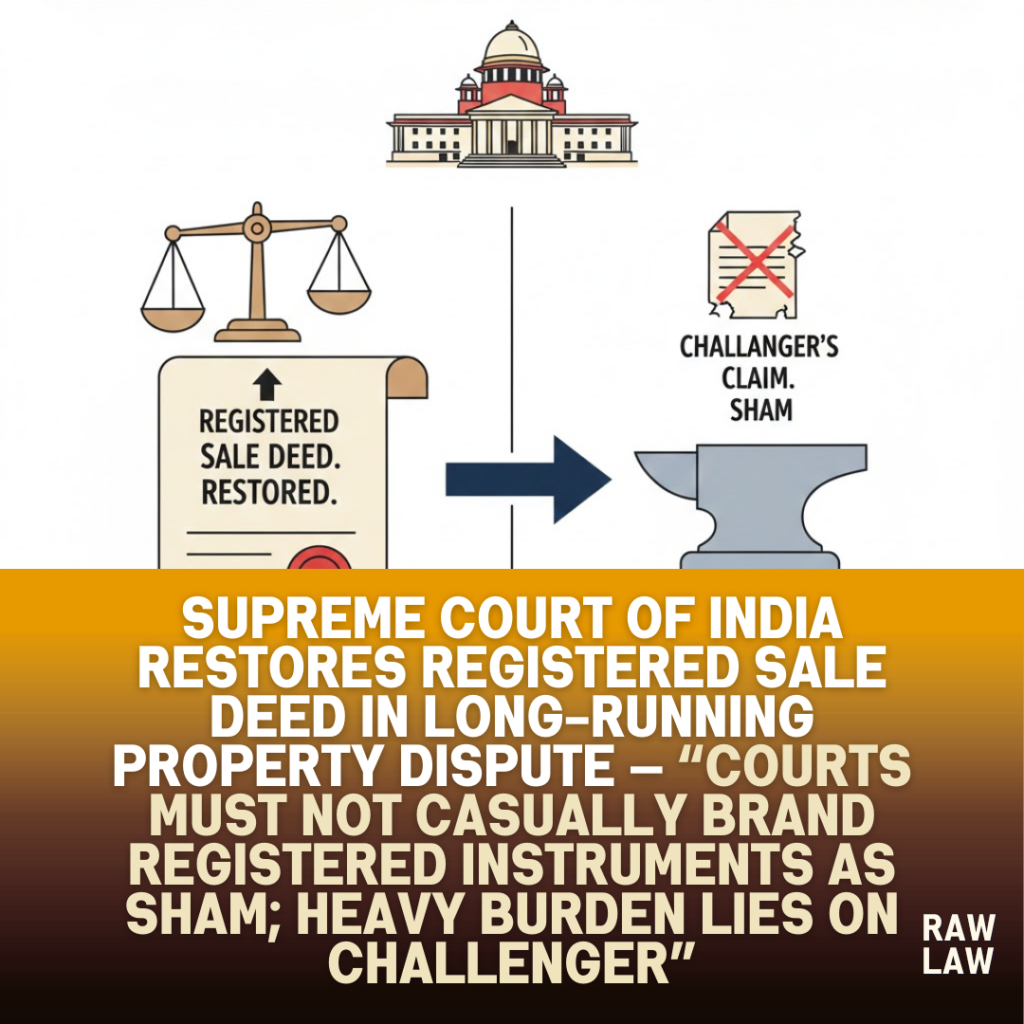
The Supreme Court of India allowed the civil appeal and set aside the Karnataka High Court’s judgment which had declared a registered sale deed and contemporaneous rental agreement as sham and nominal. The Court held that a registered sale deed carries a strong presumption of validity and genuineness and cannot be lightly nullified on vague pleadings or weak oral evidence — “courts should not casually declare a registered deed a sham”; High Court judgment overturned and first appellate court’s dismissal of the suit restored.
Court’s decision
Justice Manmohan, speaking for the Bench, ruled that the High Court erred in permitting oral evidence to defeat clear and unambiguous recitals of a registered sale deed executed in 1971. The Supreme Court held that the plaintiff failed to discharge the heavy burden required to rebut the statutory presumption attached to registered documents and that the transaction in question was an outright sale, not a mortgage by conditional sale. The appeal was allowed and the suit stood dismissed.
Facts
The dispute concerned a residential house at Bidar which had been mortgaged in 1966. In November 1971, a registered sale deed was executed in favour of the purchaser for a consideration of ₹10,000, out of which ₹8,000 was used to redeem the existing mortgage and ₹2,000 was paid in cash. On the same day, a registered rental agreement was executed, under which the original owner and his family continued to occupy the house as tenants on a monthly rent.
After paying rent for about fourteen months, the tenants defaulted. Eviction proceedings were initiated in 1975. As a counterblast, the original owner filed a civil suit in 1977 seeking declaration that the sale deed and rent agreement were nominal, sham, and not intended to be acted upon, contending that the transaction was in substance a loan secured by property. The trial court decreed the suit, the first appellate court reversed it, and the High Court restored the trial court decree — leading to the present appeal.
Issues
The central issue before the Supreme Court was the threshold required to declare a registered sale deed as sham or nominal. The Court also examined whether oral evidence could be admitted under Sections 91 and 92 of the Indian Evidence Act to contradict clear recitals of a registered sale deed, and whether the transaction could be construed as a mortgage by conditional sale in the absence of a statutory condition embedded in the document.
Appellants’ arguments
The purchasers argued that the sale deed was clear, unambiguous, and absolute, leaving no scope for oral evidence to contradict its terms. It was contended that Section 92 of the Evidence Act barred any attempt to vary or contradict the written instrument. The appellants submitted that the plaintiff’s pleadings were vague, lacked material particulars, and amounted to clever drafting to defeat eviction proceedings.
They further argued that the proviso to Section 58(c) of the Transfer of Property Act requires any condition of reconveyance to be embodied in the same document, which was admittedly absent. The execution of a registered rental agreement and payment of rent for over a year, according to the appellants, conclusively established an outright sale.
Respondents’ arguments
The original owner contended that the sale deed was executed only as a security for repayment of money and was never intended to operate as a true sale. It was argued that the consideration was grossly inadequate and that possession never truly passed to the purchaser.
Relying on earlier Supreme Court precedents, the respondent submitted that oral evidence is admissible to show that a document is sham or nominal. It was further argued that the plaintiff was illiterate and of simple nature, did not understand the implications of the documents, and continued to treat the property as his own by paying municipal taxes and effecting repairs.
Analysis of the law
The Supreme Court undertook a detailed analysis of Sections 91 and 92 of the Indian Evidence Act, the proviso to Section 58(c) of the Transfer of Property Act, and the law governing registered documents. The Court reiterated that registration is a solemn act conferring a strong presumption of validity and genuineness.
While oral evidence may be admissible to show that a document was never intended to be acted upon, the Court clarified that such a plea must meet a very high standard of pleading and proof. Vague assertions, suspicion, or inadequacy of consideration are insufficient to dislodge the presumption attached to a registered deed.
Precedent analysis
The Court harmonised earlier rulings permitting oral evidence in cases of sham transactions with later jurisprudence emphasising the sanctity of registered documents. It held that precedents allowing oral evidence cannot be read as diluting the strong presumption of genuineness or the strict pleading requirements akin to Order VI Rule 4 of the Code of Civil Procedure. The Court cautioned against mechanical reliance on earlier cases without examining whether pleadings and evidence meet the requisite threshold.
Court’s reasoning
Applying these principles, the Court found the plaintiff’s case riddled with contradictions and omissions. The pleadings lacked material particulars, no relief was sought against alleged conspirators, and the plaintiff’s own witness admitted that the property was sold to redeem the mortgage.
The Court emphasised that there was no clause in the sale deed suggesting mortgage by conditional sale, no immediate demand for reconveyance after alleged repayment, and clear conduct consistent with sale, including execution of a registered lease and payment of rent. The High Court, the Court held, erred in overlooking these decisive factors and in lightly branding a registered deed as sham.
Conclusion
The Supreme Court allowed the appeal, set aside the Karnataka High Court’s judgment, and restored the first appellate court’s decision dismissing the suit. It conclusively held that the 1971 transaction was an outright sale and that the registered sale deed and rental agreement were genuine and intended to be acted upon.
Implications
This judgment significantly strengthens the sanctity of registered property transactions. It sends a clear message that courts must exercise extreme caution before declaring registered instruments sham and that litigants cannot defeat long-concluded sales through vague pleadings and oral assertions. The ruling will have wide ramifications for property litigation, particularly in cases where registered deeds are challenged decades later to resist eviction or assert continued ownership.
Case law references
- Presumption of validity of registered deeds: Registered instruments carry strong presumption of genuineness; challenger bears heavy burden. Applied to restore sale deed.
- Section 92, Evidence Act: Oral evidence cannot contradict clear and unambiguous written terms. Applied to reject plaintiff’s case.
- Mortgage by conditional sale: Condition must be embodied in the same document under Section 58(c) TPA. Applied to hold transaction was not a mortgage.
FAQs
1. Can a registered sale deed be declared sham based on oral evidence?
Only in exceptional cases with clear pleadings and cogent proof. Courts will not lightly dislodge the presumption of validity attached to registered deeds.
2. Does inadequacy of consideration make a sale deed invalid?
No. Mere inadequacy of consideration does not render a registered sale deed void.
3. When is a sale treated as mortgage by conditional sale?
Only when the condition of reconveyance is expressly embodied in the same document, as mandated by law.