


Court’s decision
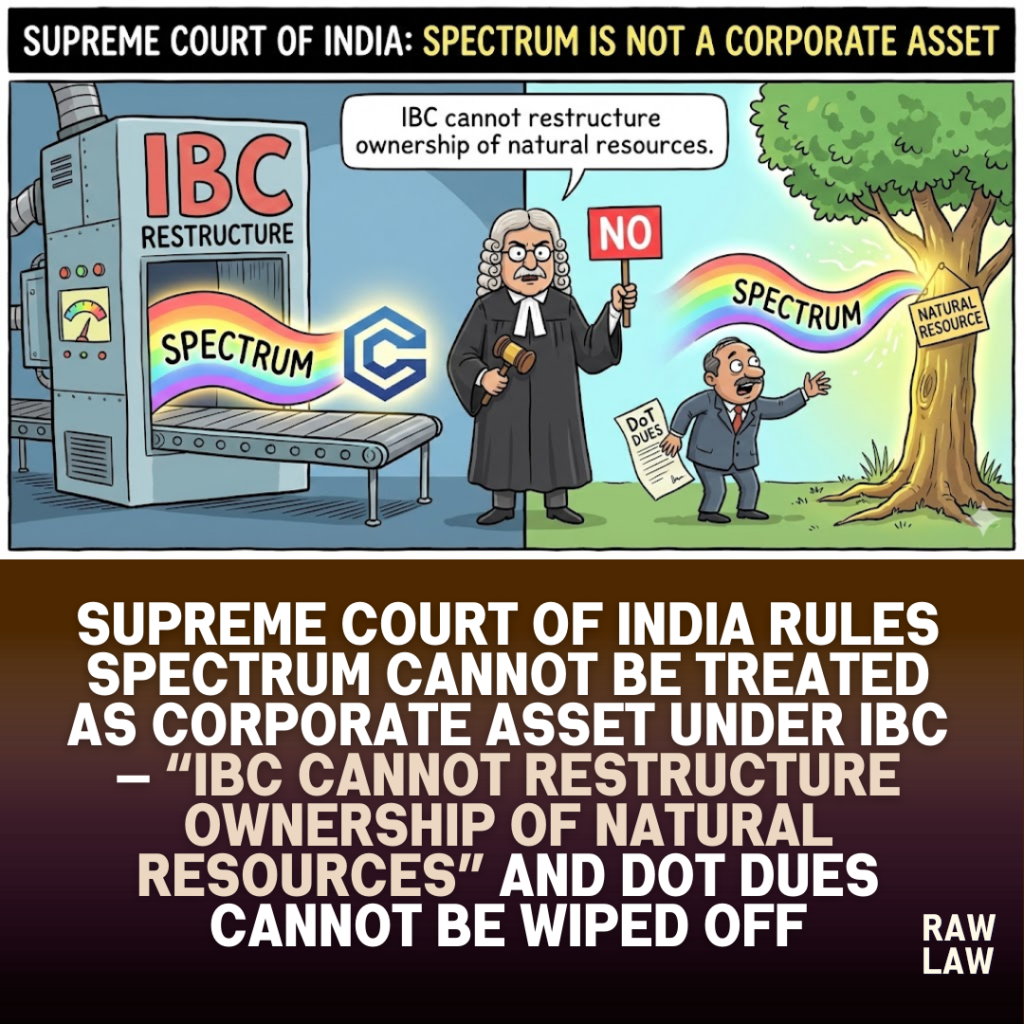
The Supreme Court of India allowed the appeals filed by the Union of India and set aside key findings of the National Company Law Appellate Tribunal (NCLAT), holding that spectrum is a natural resource held by the Union in public trust and cannot be treated as an “asset” of a telecom service provider under the Insolvency and Bankruptcy Code, 2016. The Court ruled that insolvency proceedings cannot override the Telegraph Act, Spectrum Trading Guidelines, or constitutional principles governing natural resources. It further held that spectrum usage rights are conditional privileges, not proprietary interests, and government dues cannot be extinguished through a resolution plan.
Court’s decision
The Court held that spectrum is a finite natural resource belonging to the people of India, with the Union holding it as trustee. The right granted to telecom service providers under Section 4 of the Telegraph Act is only a limited, conditional and revocable privilege to use spectrum.
It rejected the NCLAT’s conclusion that spectrum constitutes an intangible asset of the corporate debtor capable of transfer under the IBC. The Court held that the Insolvency and Bankruptcy Code cannot be used to restructure ownership or control of natural resources, nor can it override statutory and contractual conditions attached to spectrum licences.
Facts
The case arose from insolvency proceedings initiated by Aircel Group entities under Section 10 of the IBC. The corporate debtors had been granted Unified Access Service Licences in 2006 and had acquired spectrum in various auction rounds between 2010 and 2016.
Upon default in payment of licence fees and spectrum usage charges, the Department of Telecommunications (DoT) sought recovery. During Corporate Insolvency Resolution Process (CIRP), a resolution plan was approved by the Committee of Creditors and sanctioned by the NCLT.
DoT challenged the approval before NCLAT, raising fundamental questions regarding ownership of spectrum, classification of government dues, and whether spectrum could form part of insolvency assets.
Issues
The Supreme Court considered seminal questions, including:
• Whether spectrum is a natural resource held in public trust.
• Whether a telecom licence creates ownership or proprietary rights in spectrum.
• Whether spectrum usage rights can be treated as assets under Section 18 of IBC.
• Whether licence dues constitute operational debt.
• Whether resolution plans can override Spectrum Trading Guidelines requiring clearance of dues prior to transfer.
The case required reconciliation between the Telegraph Act regime and the Insolvency Code.
Appellants’ arguments
Financial creditors and resolution professionals argued that spectrum usage rights constitute valuable intangible assets forming part of the corporate debtor’s estate. They contended that once treated as operational debt, DoT dues must be dealt with under the resolution waterfall and cannot receive preferential treatment.
They relied on Section 238 of the IBC to argue that the Code overrides inconsistent statutory instruments, including licence conditions and spectrum trading guidelines.
It was further argued that transfer of licence during CIRP is distinct from spectrum trading and falls within insolvency jurisdiction.
Respondent’s arguments
The Union of India contended that spectrum is a natural resource governed by constitutional principles under Article 39(b) and the public trust doctrine.
It argued that Section 4 of the Telegraph Act vests exclusive privilege in the Union and licences do not confer proprietary interest. Spectrum trading is strictly regulated and conditional upon clearance of dues.
The Government asserted that dues arising from licence and spectrum usage are sovereign considerations and cannot be equated with operational debt in a commercial sense. Treating spectrum as insolvency asset would undermine statutory control over natural resources.
Analysis of the law
The Court undertook a detailed examination of constitutional jurisprudence, including Centre for Public Interest Litigation v. Union of India and Natural Resources Allocation, In re, reaffirming that spectrum is a scarce and finite natural resource.
It emphasised that the State acts as trustee and must ensure equitable distribution subserving common good under Article 39(b).
Referring to Association of Unified Telecom Service Providers of India and Bharti Airtel Ltd. v. Union of India, the Court clarified that a telecom licence, though contractual in form, emanates from sovereign statutory power and remains subordinate to constitutional obligations.
The Court examined the Spectrum Trading Guidelines, 2015 and held that transfer of spectrum is conditional upon prior clearance of dues and regulatory approval. Insolvency proceedings cannot bypass these mandatory conditions.
Precedent analysis
The Court relied on CPIL (2G case) to reaffirm the public trust doctrine over spectrum.
It applied the Constitution Bench ruling in Natural Resources Allocation to stress that executive policy in distributing natural resources must comply with constitutional mandates.
It also relied on earlier AUSPI decisions to reiterate the exclusive privilege of the Union under Section 4 of the Telegraph Act.
These precedents were harmoniously interpreted to hold that insolvency law cannot dilute statutory control over spectrum.
Court’s reasoning
The Court held that ownership of spectrum remains with the Nation, with Government as trustee. A licensee merely occupies the right to use spectrum; possession correlates with ownership and does not vest in telecom service providers.
It ruled that treating spectrum as an asset under IBC would effectively allow restructuring of sovereign control through private insolvency proceedings, which is impermissible.
The Court rejected the argument that Section 238 of IBC overrides telecommunication laws. It held that IBC governs insolvency of corporate persons but does not override special statutes governing natural resources.
The Court further held that licence conditions requiring clearance of dues prior to transfer cannot be bypassed under a resolution plan.
Conclusion
The Supreme Court concluded that spectrum is not an asset of the corporate debtor capable of restructuring under IBC. The right to use spectrum is conditional and subject to statutory compliance.
Resolution plans cannot extinguish or reduce government dues contrary to telecommunication laws.
The appeals were allowed, and the findings of NCLAT treating spectrum as insolvency asset were set aside.
Implications
This landmark judgment clarifies the constitutional status of spectrum and significantly limits the reach of the Insolvency and Bankruptcy Code in sectors involving natural resources.
It reinforces the public trust doctrine and preserves sovereign regulatory control over telecom licences.
The ruling ensures that statutory dues linked to natural resource allocation cannot be diluted through insolvency resolution mechanisms.
For lenders and telecom companies, the judgment signals heightened regulatory primacy over insolvency restructuring in spectrum-related matters.
Case law references
- Centre for Public Interest Litigation v. Union of India (2012) 3 SCC 1 — Spectrum is a scarce natural resource held in public trust.
- Natural Resources Allocation, In re (2012) 10 SCC 1 — Allocation of natural resources must subserve common good.
- Union of India v. Association of Unified Telecom Service Providers of India (2011) 10 SCC 543 — Exclusive privilege of Union under Telegraph Act.
- Bharti Airtel Ltd. v. Union of India (2015) 12 SCC 1 — Telecom licence is contractual but subject to constitutional mandates.
FAQs
1. Can spectrum be treated as an asset under the Insolvency and Bankruptcy Code?
No. The Supreme Court has held that spectrum is a natural resource held in public trust and cannot be treated as a corporate asset for restructuring under IBC.
2. Are telecom licence dues considered operational debt under IBC?
The Court has clarified that spectrum usage rights and licence dues arise from sovereign statutory privilege and cannot be treated as ordinary insolvency claims capable of being wiped off.
3. Can a resolution plan transfer spectrum without clearing past dues?
No. Transfer of spectrum remains subject to statutory conditions and Spectrum Trading Guidelines, including mandatory clearance of dues.