


Court’s decision
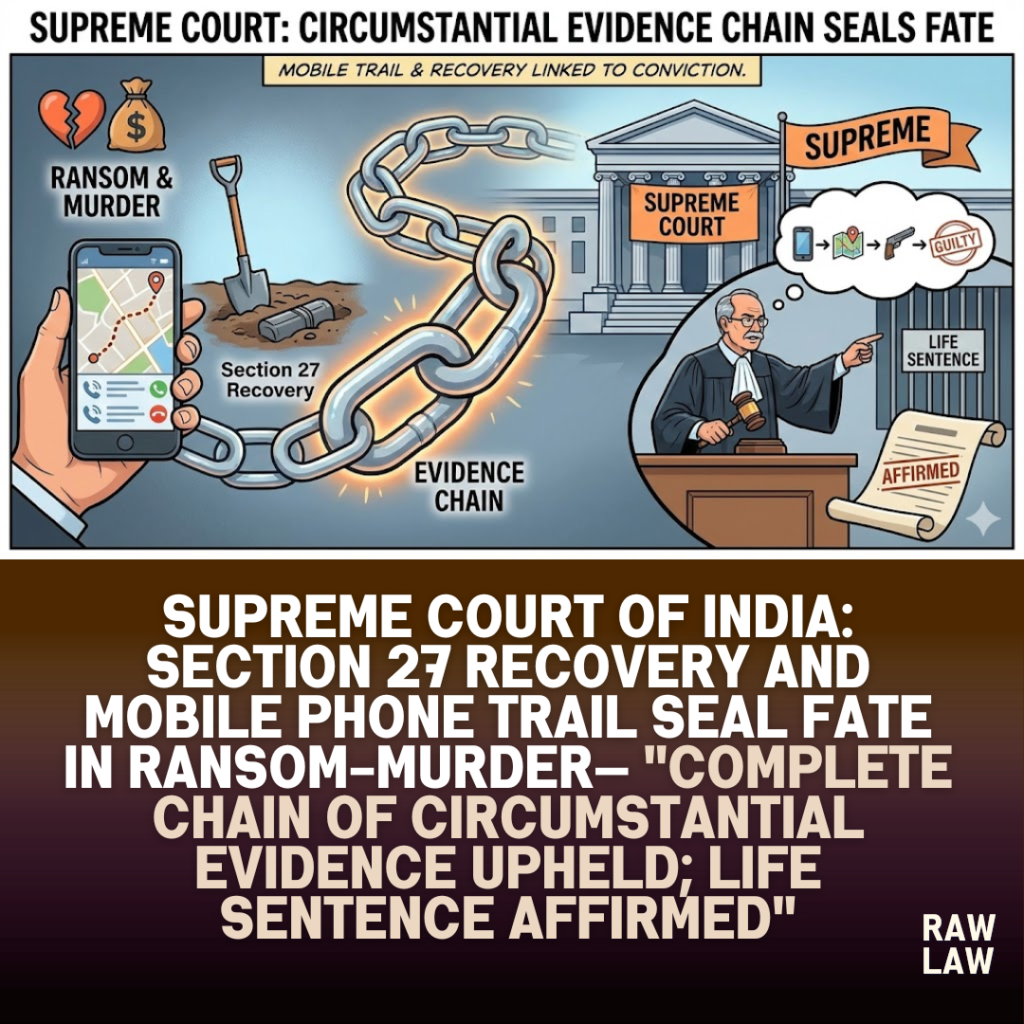
The Supreme Court of India dismissed the criminal appeal challenging concurrent findings of conviction under Sections 302 and 201 of the Indian Penal Code, 1860. The Court held that the prosecution had established an unbroken chain of circumstantial evidence, satisfying the five-fold test laid down in Sharad Birdhichand Sarda v. State of Maharashtra.
The recovery of the deceased’s body from a well at the appellant’s disclosure under Section 27 of the Evidence Act, coupled with ransom calls made from the deceased’s mobile phone and its subsequent sale by the appellant, constituted compelling incriminating circumstances. The conviction was affirmed, with liberty granted to seek remission after 15 years of incarceration.
Facts
The deceased, Archana @ Pinki, went missing on 25 July 2009. A missing report was lodged by her mother on 28 July 2009 at Pardeshipura Police Station, Indore. During investigation, it emerged that ransom calls demanding ₹5 lakh were made to her husband from the deceased’s own mobile phone.
Call detail records established active usage of her SIM until 1 August 2009. The investigation further revealed that the deceased’s mobile phone was sold by the appellant to a third party shortly after her disappearance.
On 10 August 2009, while in police custody, the appellant made a disclosure statement under Section 27 of the Evidence Act, leading to recovery of the deceased’s body from a well near Indore Bypass Road. The body was found stuffed in a sack.
Both the Trial Court and the High Court convicted the appellant under Sections 302 and 201 IPC. The Supreme Court examined the correctness of these concurrent findings.
Issues
The primary issue was whether the chain of circumstantial evidence was complete and consistent only with the hypothesis of the appellant’s guilt.
The Court also considered whether the delay of three days in lodging the missing report, alleged deficiencies in identification of the body, and absence of direct eyewitness testimony created reasonable doubt.
Appellant’s arguments
The appellant contended that the three-day delay in lodging the missing report was unexplained and fatal to the prosecution. It was argued that the alleged ransom call was unsupported by credible evidence.
The defence questioned the identification of the decomposed body, asserting that no DNA test was conducted. It was further argued that the absence of comprehensive call detail analysis weakened the prosecution’s case.
The appellant urged that the conviction rested solely on conjectures without direct evidence.
Respondent’s arguments
The State contended that the delay in lodging the missing report was natural, as families often conduct their own search before approaching authorities.
It was argued that call detail records and testimony of telecom officials proved that ransom calls were made from the deceased’s phone.
The prosecution emphasized the recovery of the dead body and the Scooty at the appellant’s disclosure under Section 27 of the Evidence Act, asserting that such recovery demonstrated exclusive knowledge.
The chain of circumstances, when viewed cumulatively, pointed unequivocally to the appellant.
Analysis of the law
The Court reiterated the settled principles governing convictions based on circumstantial evidence, relying on Sharad Birdhichand Sarda. The five golden principles require that circumstances must be fully established, consistent only with guilt, conclusive in nature, excluding all hypotheses of innocence, and forming a complete chain.
On admissibility of recovery evidence, the Court discussed Section 27 of the Evidence Act as an exception to Sections 25 and 26. Referring to Udai Bhan v. State of Uttar Pradesh and Bodhraj v. State of Jammu and Kashmir, the Court clarified that “fact discovered” includes the object recovered, the place of recovery, and the accused’s knowledge thereof.
Precedent analysis
The Court relied upon:
Sharad Birdhichand Sarda v. State of Maharashtra (1984) 4 SCC 116
Laid down the five foundational principles for conviction on circumstantial evidence.
Udai Bhan v. State of Uttar Pradesh (1962)
Clarified that discovery includes the place and knowledge of the accused.
Bodhraj v. State of Jammu and Kashmir (2002) 8 SCC 45
Reiterated the doctrine of confirmation by subsequent events under Section 27.
Mulakh Raj v. Satish Kumar (1992) 3 SCC 43
Held that failure to prove motive is not fatal when the chain of circumstances is otherwise complete.
Applying these precedents, the Court found that the prosecution had met the required threshold.
Court’s reasoning
The Court found no infirmity in the delay of three days in lodging the missing report, observing that such delay is not uncommon in missing person cases.
The ransom calls made from the deceased’s mobile phone, supported by call detail records and testimony of telecom officials, established that the phone remained operational post disappearance.
The sale of the deceased’s mobile phone by the appellant shortly after the disappearance created a strong adverse inference.
Most crucially, the recovery of the dead body from a well at the specific disclosure of the appellant constituted a “distinct fact” under Section 27. The location of the well was not publicly known, and recovery from that precise site demonstrated exclusive knowledge.
The body was identified by close relatives and acquaintances. The Court noted that decomposition in water occurs at a slower rate, particularly when protected by clothing, thereby supporting reliable identification.
The recovery of the deceased’s Scooty at the appellant’s instance further strengthened the prosecution’s case.
When viewed cumulatively, these circumstances formed a complete and unbroken chain.
Conclusion
The Supreme Court upheld the conviction under Sections 302 and 201 IPC, holding that the prosecution had proved the case beyond reasonable doubt through circumstantial evidence.
The appeal was dismissed. However, considering that the appellant had undergone more than 15 years of imprisonment, the Court granted liberty to apply for remission in accordance with applicable policy.
Implications
This judgment reinforces critical principles in criminal jurisprudence:
- Recovery under Section 27 of the Evidence Act remains a powerful incriminating circumstance when properly proved.
- Circumstantial evidence can sustain conviction if the chain is complete and excludes every hypothesis of innocence.
- Delay in lodging a missing report is not per se fatal.
- Motive strengthens but is not indispensable where evidence is conclusive.
The ruling underscores judicial reliance on cumulative evidentiary evaluation rather than isolated scrutiny of individual circumstances.
Case law references
- Sharad Birdhichand Sarda v. State of Maharashtra (1984) 4 SCC 116
Laid down five essential principles for circumstantial evidence. - Udai Bhan v. State of Uttar Pradesh (1962 SCC OnLine SC 229)
Defined scope of “fact discovered” under Section 27. - Bodhraj v. State of Jammu and Kashmir (2002) 8 SCC 45
Explained doctrine of confirmation by subsequent events. - Mulakh Raj v. Satish Kumar (1992) 3 SCC 43
Held that absence of motive is not fatal if evidence is otherwise complete.
FAQs
1. Can a murder conviction rest solely on circumstantial evidence?
Yes. If the chain of circumstances is complete and satisfies the Sharad Sarda test, conviction can be sustained.
2. What is the significance of Section 27 of the Evidence Act?
It allows admissibility of information leading to discovery of a fact while the accused is in police custody.
3. Is delay in filing a missing complaint fatal to prosecution?
Not necessarily. Courts assess whether the delay is reasonable in the circumstances.