


Court’s decision
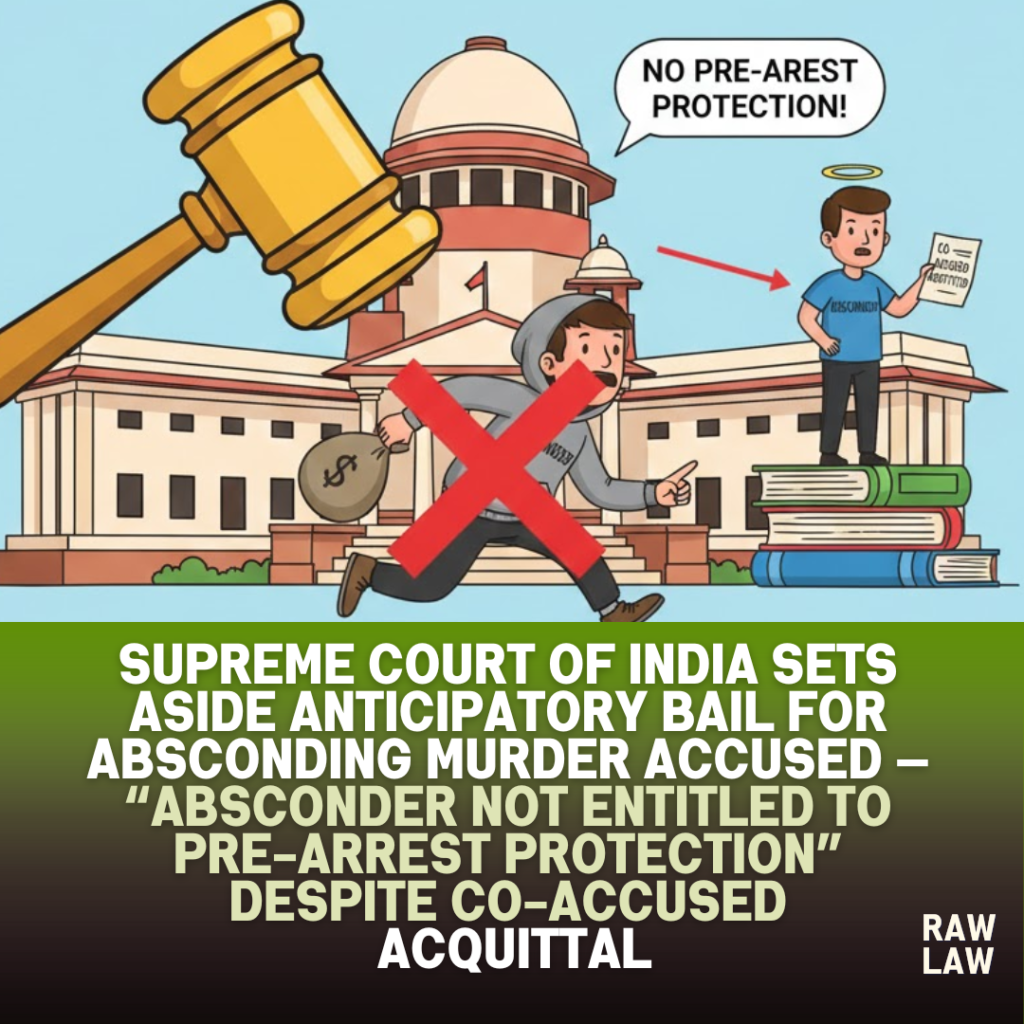
The Supreme Court set aside the High Court’s order granting anticipatory bail to an accused in a murder case arising out of political rivalry, holding that an absconding accused who evaded investigation for over six years cannot claim pre-arrest protection merely because co-accused were acquitted. The Court ruled that the High Court’s discretion was improperly exercised and emphasized that acquittal of co-accused does not create automatic parity for an absconder. The accused has been directed to surrender within four weeks, with liberty to seek regular bail thereafter.
Facts
The case arose from violent incidents on 2 June 2017 involving alleged political rivalry between two groups. Three FIRs were registered in connection with the events. The primary FIR alleged that a mob wrongfully restrained the complainant’s vehicle, attacked with deadly weapons, and opened fire. Two persons sustained gunshot injuries, and one later died, leading to addition of the charge of murder under Section 302 of the Penal Code.
A cross FIR was also registered from the rival side. The accused in question was named in the primary FIR and alleged to be part of the armed mob. He absconded from the date of the incident and did not participate in the investigation.
Despite police efforts, including reward announcements for his arrest and initiation of proceedings under Sections 82 and 83 of the Criminal Procedure Code, the accused remained untraceable. Meanwhile, the trial against other co-accused proceeded.
In June 2023, the trial court acquitted all co-accused in the primary FIR, citing failure of the prosecution to prove that the bullets fired by the accused persons caused the fatal injuries. However, in the cross FIR, the complainant and others were convicted.
Subsequently, relying on the acquittal of co-accused, the absconding accused filed a third anticipatory bail application. The High Court directed him to surrender and seek regular bail, further directing the trial court to grant bail on the same day. This order was challenged before the Supreme Court.
Issues
The central issue before the Supreme Court was whether the High Court was justified in granting anticipatory bail under Section 438 of the Criminal Procedure Code to an accused who had absconded for several years and had not cooperated with the investigation.
A related question was whether the acquittal of co-accused in the same FIR could constitute a “change in circumstance” sufficient to justify anticipatory bail on grounds of parity.
The Court also examined whether the High Court failed to apply settled principles governing pre-arrest bail in serious offences involving murder and use of firearms.
Petitioner’s arguments
The original complainant argued that the accused had deliberately absconded since 2017 and had evaded investigation despite reward announcements. It was submitted that anticipatory bail cannot be granted to an absconder as a matter of settled law. The complainant emphasized that the High Court had earlier recorded that the accused was a proclaimed offender. It was further contended that the acquittal of co-accused did not automatically entitle the accused to parity, particularly when his role had not been examined in trial. The petitioner also highlighted criminal antecedents and allegations of threats issued to an injured eyewitness.
Respondent’s arguments
The accused contended that he was never validly declared a proclaimed offender under Section 82 of the Code and that mere non-appearance cannot be equated with absconding. It was argued that the trial court’s acquittal of co-accused demonstrated weakness in the prosecution case and justified anticipatory bail. The defence also claimed absence of post-bail misconduct after grant of regular bail by the trial court and alleged that the appeal was motivated by personal vendetta.
The State supported the complainant’s position, submitting that the accused had remained absconding for over six years, had criminal antecedents, and posed risk of witness intimidation.
Analysis of the law
The Supreme Court revisited the jurisprudence governing anticipatory bail under Section 438 of the Criminal Procedure Code. It reiterated that anticipatory bail is a safeguard against arbitrary arrest but is discretionary and must be granted cautiously in serious offences.
The Court referred to leading precedents including Balchand Jain, Gurbaksh Singh Sibbia, Prasanta Kumar Sarkar, Mahipal, and Sushila Aggarwal, emphasizing factors such as gravity of offence, likelihood of absconding, antecedents, witness intimidation, and impact on justice.
The Court clarified that an appeal against grant of bail is distinct from cancellation proceedings and that appellate scrutiny focuses on perversity, illegality, or failure to consider relevant factors.
Importantly, the Court held that an absconder is generally not entitled to anticipatory bail unless exceptional circumstances demonstrate prima facie falsity of accusations. No such exceptional case was made out.
Precedent analysis
The Court relied on Vipan Kumar Dhir v. State of Punjab, holding that even procedural irregularity in declaring an accused absconding does not automatically justify anticipatory bail in grave offences.
It also referred to the Full Bench decision in Moosa v. Sub Inspector of Police, which held that acquittal of co-accused does not benefit an absconding accused because the prosecution is not required to lead evidence against an absconder during the trial of co-accused.
Further reliance was placed on Ashok Dhankad v. State of NCT of Delhi, clarifying that post-bail conduct is irrelevant while deciding appeals against grant of bail.
The Supreme Court applied these precedents to conclude that the High Court’s reliance on acquittal of co-accused for granting anticipatory bail was legally flawed.
Court’s reasoning
The Court observed that the accused absconded from the very date of the incident and did not cooperate with the investigation for over six years. Police had announced rewards for his arrest, and firearms allegedly used were not recovered.
The Court noted the seriousness of allegations involving murder, mob violence, and firearm use. It also took note of FIR alleging threats to an injured eyewitness and the accused’s criminal antecedents.
The High Court’s reasoning that acquittal of co-accused weakened the prosecution case was held to be erroneous. The Supreme Court held that findings recorded in trial of co-accused cannot bind proceedings against an absconding accused whose role remains untested.
Granting anticipatory bail in such circumstances, the Court held, would incentivize evasion of law and undermine the criminal justice system.
Conclusion
The Supreme Court set aside the High Court’s order granting anticipatory bail and directed the accused to surrender within four weeks. The Court clarified that its observations are limited to the bail issue and shall not affect merits of the case.
The accused is at liberty to apply for regular bail after surrender, which shall be decided independently in accordance with law.
Implications
This ruling reinforces the principle that anticipatory bail cannot become a shield for fugitives from justice. The decision sends a strong message that absconding accused cannot claim benefit of parity merely because co-accused are acquitted.
The judgment strengthens jurisprudence on pre-arrest bail in serious offences involving murder and organized violence. It also underscores that judicial discretion must be exercised with caution in cases involving absconders and witness intimidation.
The ruling is likely to impact future anticipatory bail applications where accused attempt to rely on co-accused acquittals while evading investigation.
Case law references
- Balchand Jain v. State of Madhya Pradesh (1976) — Defined anticipatory bail as bail in anticipation of arrest.
- Gurbaksh Singh Sibbia v. State of Punjab (1980) — Laid foundational principles for anticipatory bail.
- Prasanta Kumar Sarkar v. Ashis Chatterjee (2010) — Enumerated factors for grant of bail.
- Mahipal v. Rajesh Kumar (2020) — Clarified scope of appellate interference in bail orders.
- Sushila Aggarwal v. State (NCT of Delhi) (2020) — Constitution Bench ruling on anticipatory bail parameters.
- Vipan Kumar Dhir v. State of Punjab (2021) — Absconder not ordinarily entitled to anticipatory bail.
- Moosa v. Sub Inspector of Police (2005) — Acquittal of co-accused does not benefit absconding accused.
- Ashok Dhankad v. State of NCT of Delhi (2025) — Appeal against bail distinct from cancellation proceedings.
FAQs
1. Can an absconding accused get anticipatory bail in a murder case?
Generally, no. The Supreme Court has held that an absconder who evades investigation is not entitled to anticipatory bail unless exceptional circumstances show prima facie falsity of allegations.
2. Does acquittal of co-accused automatically entitle others to bail?
No. Acquittal of co-accused does not create automatic parity, especially when the accused seeking bail did not face trial and absconded.
3. What is the difference between appeal against bail and cancellation of bail?
An appeal against bail examines whether the order was perverse or illegal. Cancellation of bail considers supervening circumstances or violation of conditions after bail is granted.