


Court’s decision
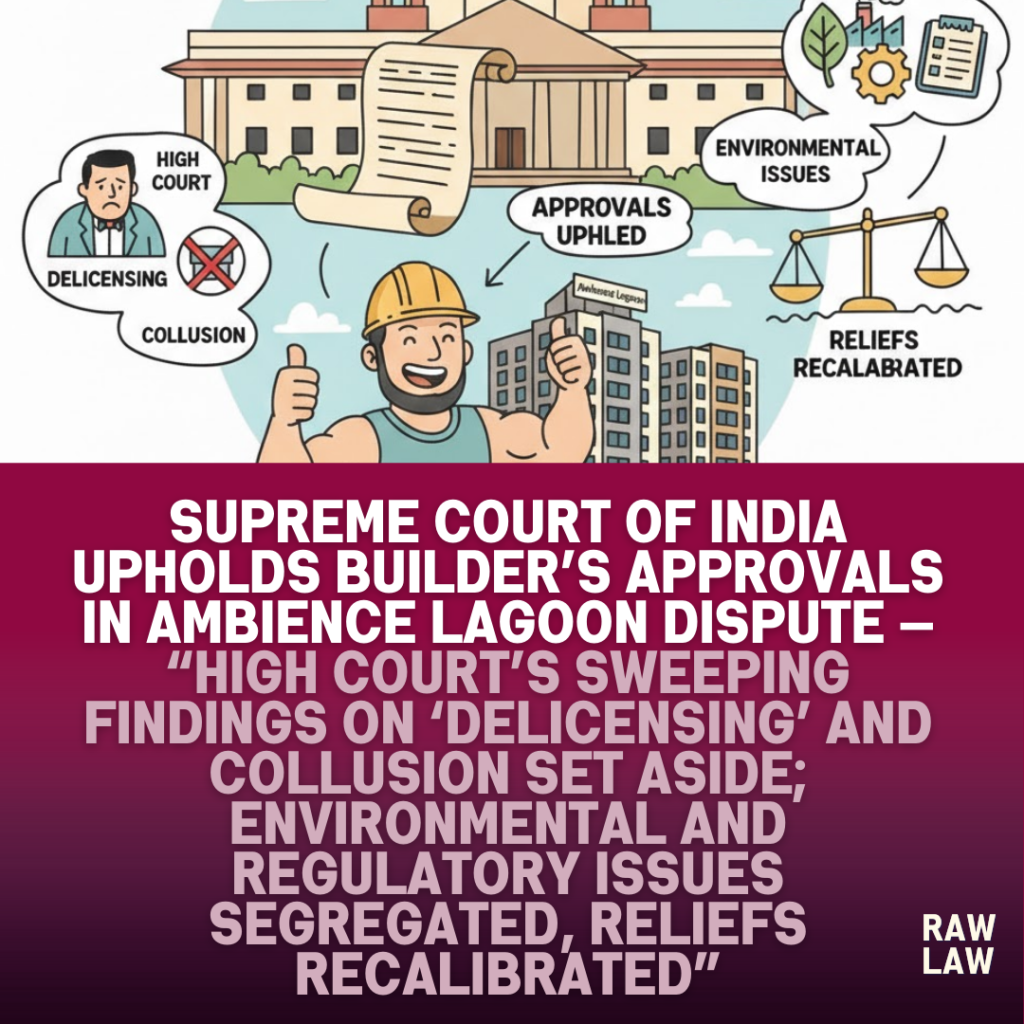
The Supreme Court of India partly allowed a batch of civil appeals arising from a long-running dispute concerning the Ambience Lagoon and Ambience Island development in Gurugram, setting aside the Punjab and Haryana High Court’s sweeping adverse findings against the developer and State authorities. The Court held that while regulatory and environmental compliance issues could be examined by competent statutory forums, the High Court exceeded its writ jurisdiction by recording definitive findings of fraud, collusion, and illegality on disputed facts — “constitutional courts cannot convert writ proceedings into a roving fact-finding inquiry”. The impugned judgment was accordingly interfered with, and matters were remitted or segregated for appropriate consideration by statutory authorities and tribunals.
Court’s decision
The Supreme Court further clarified that disputes relating to environmental violations properly fell within the exclusive domain of the National Green Tribunal, while questions concerning licences, layout approvals, and town planning permissions had to be examined within the statutory framework of the Haryana development laws. The Court underscored the limits of judicial review under Article 226, especially where complex factual controversies spanning decades of regulatory approvals were involved.
Facts
The dispute traces its origins to the early 1990s when a private developer obtained licences under the Haryana Development and Regulation of Urban Areas Act to develop a residential group housing colony at village Nathupur, Gurugram. Over time, the project expanded into a mixed-use development, including residential apartments, a hotel, and a large commercial complex.
Flat purchasers later alleged that land initially licensed for residential purposes had been unlawfully “delicensed” and converted for commercial use, resulting in reduction of open spaces and common areas promised to residents. Multiple proceedings followed — civil suits, consumer complaints, writ petitions, and proceedings before the National Green Tribunal — spanning more than two decades.
In 2015, certain apartment owners approached the Punjab and Haryana High Court seeking demolition of commercial constructions, investigation by central agencies, and restoration of alleged common areas. In July 2020, the High Court delivered a strongly worded judgment, holding that the original licence itself was vitiated, that “delicensing” was unknown to law, and that the developer had acted in collusion with State authorities. This judgment was challenged before the Supreme Court.
Issues
The Supreme Court was required to consider whether the High Court had exceeded its jurisdiction under Article 226 by conclusively determining disputed questions of fact, whether approvals and licences granted over the years could be invalidated wholesale in writ proceedings, and how overlapping jurisdictions of statutory authorities and the National Green Tribunal were to be harmonised.
Petitioners’ arguments
The appellants contended that the High Court judgment was legally unsustainable as it rested on presumptions of fraud and collusion without a full evidentiary trial. It was argued that all licences, change of land use permissions, and building plan sanctions had been granted by competent authorities over decades and had attained finality.
The appellants further submitted that the High Court improperly relied on alleged defects in initial applications from the early 1990s to invalidate subsequent approvals, ignoring statutory renewals and later licences. They also argued that environmental issues were already seized of by the National Green Tribunal and could not be re-adjudicated in writ proceedings.
Respondents’ arguments
The flat owners maintained that the developer had fundamentally altered the character of the licensed residential colony by converting substantial portions into commercial use, depriving residents of open spaces and common amenities. They supported the High Court’s reasoning that “delicensing” had no statutory basis and that approvals granted contrary to the layout and statutory norms were void.
It was further argued that the High Court was justified in exercising its extraordinary jurisdiction given the scale of alleged violations and the prolonged inaction of regulatory authorities.
Analysis of the law
The Supreme Court undertook an extensive analysis of the scope of judicial review under Article 226, reiterating that writ courts are primarily concerned with the legality of decision-making processes, not adjudication of disputed facts requiring evidence. The Court emphasised that allegations of fraud, collusion, and manipulation of records ordinarily require a trial or statutory inquiry and cannot be conclusively determined on affidavits.
The Court also examined the statutory scheme governing urban development in Haryana, noting that licences and approvals are subject to renewal, modification, and oversight by designated authorities. Wholesale invalidation of decades-old approvals in writ proceedings, the Court cautioned, would undermine certainty in urban development and governance.
Precedent analysis
Relying on settled Supreme Court precedent on the limits of writ jurisdiction, the Court reiterated that constitutional courts must refrain from making final findings on disputed facts. The judgment also reaffirmed earlier rulings recognising the exclusive and specialised jurisdiction of the National Green Tribunal over environmental disputes, and the need to avoid parallel adjudication by constitutional courts. These principles were applied to dilute the High Court’s expansive directions and findings.
Court’s reasoning
The Court held that while residents’ grievances could not be brushed aside, the High Court’s approach of reconstructing the entire regulatory history of the project and inferring collusion at every stage was legally impermissible. The absence of an express statutory provision using the term “delicensing” did not, by itself, render all subsequent actions void, especially when competent authorities had granted fresh licences and permissions.
The Supreme Court also noted that environmental compensation and demolition-related issues were already being examined by the National Green Tribunal and expert committees, and should be left to those specialised forums. Consequently, the High Court’s judgment was set aside to the extent it recorded definitive findings of illegality and fraud and issued sweeping directions beyond its writ remit.
Conclusion
The Supreme Court allowed the appeals in part, setting aside the Punjab and Haryana High Court’s impugned judgment insofar as it invalidated licences and recorded adverse findings against the developer and authorities. Matters relating to environmental violations were left to the National Green Tribunal, while regulatory issues were directed to be dealt with in accordance with statutory mechanisms.
Implications
The ruling is a significant reaffirmation of judicial restraint in urban development disputes. It draws a clear line between judicial review and fact-intensive regulatory adjudication, cautions against retrospective destabilisation of large infrastructure projects through writ proceedings, and reinforces the centrality of specialised statutory forums like the National Green Tribunal. For developers, regulators, and residents alike, the judgment provides clarity on forum selection and the limits of constitutional remedies in complex town-planning disputes.
Case law references
- Limits of Article 226 jurisdiction: Writ courts cannot conclusively decide disputed questions of fact or allegations of fraud without trial; applied to set aside High Court’s findings.
- Jurisdiction of National Green Tribunal: Environmental issues fall within specialised statutory forum; relied upon to segregate environmental aspects.
- Urban development certainty principle: Long-standing licences and approvals should not be invalidated wholesale in writ proceedings; applied to protect regulatory stability.
FAQs
1. Can a High Court invalidate decades-old development licences in writ proceedings?
Only in exceptional cases. Disputed facts and allegations of fraud generally require statutory inquiry or trial, not summary writ adjudication.
2. Who decides environmental violations in large real estate projects?
The National Green Tribunal has exclusive jurisdiction over environmental compliance and compensation issues.
3. What does this judgment mean for apartment owners’ rights?
Residents can still pursue remedies, but before appropriate statutory or specialised forums rather than through sweeping writ reliefs.