


Court’s decision
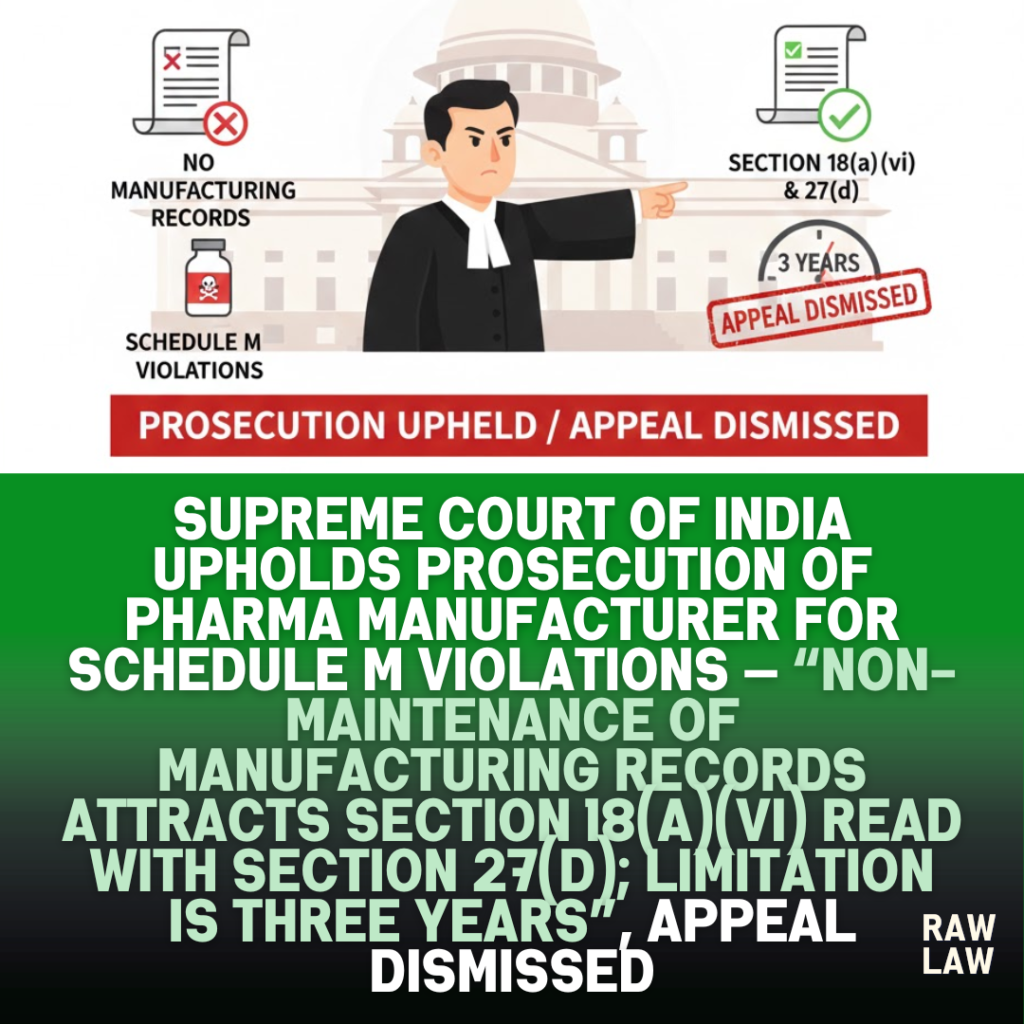
The Supreme Court of India dismissed the appeal filed by a pharmaceutical manufacturer and its partners seeking quashing of criminal proceedings under the Drugs and Cosmetics Act, 1940. The Court held that serious allegations of non-maintenance and manipulation of manufacturing and testing records under Schedule M and Schedule U amount to contravention of Section 18(a)(vi), punishable under Section 27(d) of the Act.
Rejecting the plea of limitation and jurisdiction, the Court ruled that where the complaint invokes Section 27(d), the limitation period is three years under Section 468 of the Code of Criminal Procedure, 1973. It further held that offences under Chapter IV are triable by a Court not inferior to a Court of Session. The appeal was dismissed.
Facts
The appellants operated a licensed pharmaceutical manufacturing unit in Himachal Pradesh. On 22 July 2014, a Drug Inspector conducted an inspection of the premises and examined records relating to manufacture and distribution of Pseudoephedrine Hydrochloride.
The inspection report recorded that mandatory records under Schedule M and Schedule U were not properly maintained. Discrepancies were allegedly found in purchase, consumption, manufacturing, and batch production records. The firm was directed not to dispose of stock and to furnish complete records.
Upon re-inspection on 5 August 2014, further discrepancies and alleged tampering in batch production records were noted. The drug stock and relevant documents were seized under Form-16. Prosecution sanction was granted on 15 September 2016, and complaint was filed in February 2017.
Issues
The Supreme Court addressed three principal legal issues:
- Whether failure to maintain manufacturing and testing records falls under Section 18(a)(vi) read with Rule 74 and Schedule M & U, punishable under Section 27(d), or only under Section 18-B punishable under Section 28-A.
- Whether the complaint was barred by limitation under Section 468 Cr.P.C.
- Whether the case was triable by a Judicial Magistrate or required committal to a Court of Session under Sections 32(2), 36-A and 36-AB of the Act.
Petitioner’s arguments
The appellants contended that the allegations pertained solely to non-maintenance and non-furnishing of records, which are specifically governed by Section 18-B and punishable under Section 28-A, carrying a maximum sentence of one year. Accordingly, the limitation period would be one year, rendering the complaint time-barred.
They argued that Section 18(a)(vi) concerns manufacture and sale of drugs in contravention of statutory provisions, not record-keeping deficiencies. The omission of Section 27(d) in the cognizance order was claimed to be fatal.
Further, it was argued that offences punishable with less than three years’ imprisonment should be tried summarily by a Magistrate under Section 36-A and not by a Court of Session. Reliance was placed on recent Supreme Court precedents concerning limitation.
Respondent’s arguments
The State contended that the allegations were not minor clerical lapses but serious violations involving manipulation of batch production records, non-maintenance of raw material registers, and discrepancies in manufacturing data. Such acts constituted contravention of Chapter IV and Rules framed thereunder.
It was submitted that Section 27(d) prescribes imprisonment up to two years, attracting a three-year limitation period. The complaint was filed within two years and six months of inspection.
The State further argued that Section 32(2) mandates that no court inferior to a Court of Session shall try offences under Chapter IV, and hence committal to the Special Judge was proper.
Analysis of the law
The Court examined Section 18(a)(vi), which prohibits manufacture or sale of drugs in contravention of Chapter IV or any rule made thereunder. It observed that Rule 74 and Schedule M & U prescribe detailed requirements for documentation, batch records, and raw material registers.
The Court held that failure to maintain such statutory manufacturing records directly affects regulatory oversight and quality control, and therefore constitutes contravention of Chapter IV, attracting Section 27(d).
While Section 18-B specifically mandates maintenance of records, the allegations in the complaint disclosed broader contraventions involving manipulation and misuse of a habit-forming drug. Hence, invocation of Section 27(d) was justified.
Precedent analysis
The Court considered its earlier rulings in Miteshbhai J. Patel v. Drug Inspector and Cheminova (India) Ltd. v. State of Punjab, both of which quashed complaints filed beyond the three-year limitation under Section 27.
Distinguishing those decisions, the Court noted that in the present case the complaint was filed within three years. It reaffirmed that offences punishable under Section 27 are governed by a three-year limitation under Section 468 Cr.P.C.
The Court also clarified that reliance on precedents dealing with delayed complaints was misplaced where the prosecution was instituted within statutory time.
Court’s reasoning
The Court found that the complaint specifically invoked Section 27(d) in its title and allegations. The omission of Section 27(d) in the handwritten cognizance order was treated as a clerical error, particularly since the committal order expressly referred to Section 27(d) read with Section 28-A.
On limitation, since Section 27(d) provides punishment up to two years, Section 468 Cr.P.C. prescribes a limitation of three years. The complaint filed within two years and six months was therefore within time.
Regarding jurisdiction, the Court harmonised Sections 32(2) and 36-A, holding that offences under Chapter IV are triable by a Court not inferior to a Court of Session. Section 36-A excludes offences triable by the Court of Session or Special Court. Hence, committal was proper.
Conclusion
The Supreme Court upheld the High Court’s refusal to quash the complaint and affirmed that allegations of non-maintenance and manipulation of statutory manufacturing records can attract Section 18(a)(vi) read with Section 27(d).
The plea of limitation was rejected, and the committal to the Special Judge was upheld. The appeal was dismissed, allowing the prosecution to proceed.
Implications
This ruling clarifies the legal position that violations of Schedule M and Schedule U relating to manufacturing documentation may constitute substantive contraventions under Section 18(a)(vi), not merely technical defaults under Section 18-B.
The judgment reinforces strict regulatory compliance for pharmaceutical manufacturers, especially concerning habit-forming drugs.
It also settles the procedural position that offences under Chapter IV, even if punishable with less than three years’ imprisonment, are triable by courts not inferior to a Court of Session, unless expressly excluded.
Case Law References
- Miteshbhai J. Patel v. Drug Inspector (2025 SCC OnLine SC 2203) – Complaint under Section 27 barred if filed beyond three years. Distinguished as complaint here was within limitation.
- Cheminova (India) Ltd. v. State of Punjab (2021) 8 SCC 818 – Proceedings quashed where complaint filed beyond statutory limitation. Held inapplicable.
The Court applied these authorities to reject the limitation challenge.
FAQs
1. Does failure to maintain manufacturing records attract Section 27(d) of the Drugs and Cosmetics Act?
Yes. If non-maintenance or manipulation of records constitutes contravention of Chapter IV and Rules such as Schedule M and Schedule U, it may attract Section 27(d).
2. What is the limitation period for offences under Section 27(d)?
Since Section 27(d) prescribes imprisonment up to two years, the limitation period under Section 468 Cr.P.C. is three years.
3. Are such offences triable by a Magistrate?
No. Under Section 32(2), offences under Chapter IV are triable by courts not inferior to a Court of Session, unless specifically excluded.