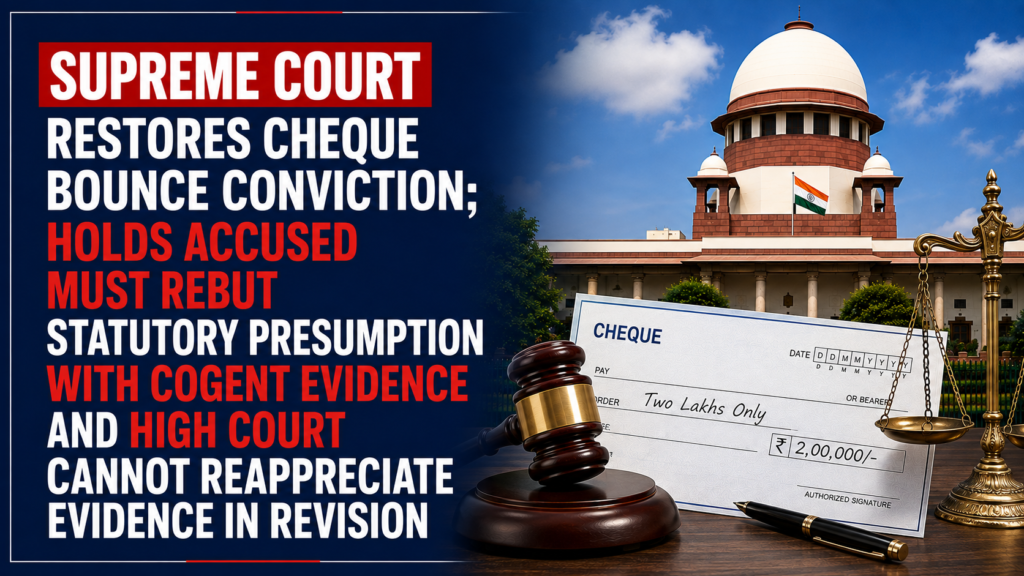
High Court Cannot Reappreciate Evidence in Revision to Acquit Cheque Bounce Accused, Rules Supreme Court
Facts
The complainant advanced a hand loan of ₹4,50,000 to the accused in December 2010 for purchasing a house site. To repay the loan, the accused issued a cheque dated 20 March 2013, which was dishonoured due to insufficient funds.
The complainant issued a statutory demand notice and, upon non-payment, filed a complaint under Section 138 of the Negotiable Instruments Act, 1881. The Trial Court convicted the accused, and the Sessions Court affirmed the conviction while reducing the amount of fine.
However, the Karnataka High Court, exercising revisional jurisdiction, set aside the conviction and acquitted the accused on the ground that the complainant had failed to establish his financial capacity to advance such a substantial loan.
The complainant challenged the acquittal before the Supreme Court.
Issues
- Whether the High Court was justified in acquitting the accused by doubting the complainant’s financial capacity despite statutory presumptions under the NI Act.
- Whether the accused successfully rebutted the presumptions under Sections 118 and 139 of the Negotiable Instruments Act.
- Whether the High Court exceeded the limits of its revisional jurisdiction by reappreciating evidence and reversing concurrent findings of conviction.
Petitioner’s Arguments
- The accused admitted his signature on the cheque, thereby attracting the statutory presumptions under Sections 118 and 139 of the NI Act.
- The accused failed to produce any cogent evidence to rebut those presumptions.
- The complainant had complied with every statutory requirement under Sections 138 to 142 of the NI Act.
- The High Court wrongly reassessed evidence and substituted its own conclusions despite concurrent findings of guilt recorded by the Trial Court and the Appellate Court.
Respondent’s Arguments
- The cheque was allegedly a blank security cheque given to another person for an earlier loan of ₹40,000 and was subsequently misused by the complainant.
- The complainant lacked the financial capacity to lend ₹4,50,000 because his monthly income was only ₹20,000–₹25,000.
- The complainant failed to prove the exact source and timeline of the alleged hand loan.
- No legally enforceable debt had been established.
Analysis of the Law
The Supreme Court extensively analysed Sections 138, 118 and 139 of the Negotiable Instruments Act.
The Court reiterated that once execution of the cheque and the drawer’s signature are admitted, statutory presumptions immediately arise that:
- the cheque was issued for consideration; and
- it was issued towards discharge of a legally enforceable debt.
These presumptions are mandatory though rebuttable. The burden then shifts entirely to the accused to rebut them through credible and probable evidence. Mere denial, conjecture or unsupported explanations are insufficient.
The Court also reiterated the essential ingredients necessary for constituting an offence under Section 138 and explained the legislative object of strengthening the credibility of cheque transactions in commercial dealings.
Precedent Analysis
The Supreme Court relied upon several leading authorities, including:
- Dalmia Cement (Bharat) Ltd. v. Galaxy Traders & Agencies Ltd. — object behind Chapter XVII of the NI Act.
- Kusum Ingots & Alloys Ltd. v. Pennar Peterson Securities Ltd. — ingredients of an offence under Section 138.
- Kumar Exports v. Sharma Carpets — scope of presumptions under Sections 118 and 139 and burden of rebuttal.
- State of Maharashtra v. Jagmohan Singh Kuldip Singh Anand — limits of revisional jurisdiction.
- State of Kerala v. Puttumana Illath Jathavedan Namboodiri — revisional court cannot act as an appellate court.
- Sanjabij Tari v. Kishore S. Borcar — High Courts should not upset concurrent convictions under Section 138 NI Act unless perversity is demonstrated.
Court’s Reasoning
The Supreme Court found that the accused admitted signing the cheque. Consequently, the statutory presumptions under Sections 118 and 139 automatically operated in favour of the complainant.
The Court held that the accused’s defence—that the cheque had been issued as security for an earlier loan and later misused—was unsupported by any documentary evidence. The legal notice relied upon by the accused had been issued only after commencement of the criminal proceedings and was therefore treated as an afterthought.
The Court also rejected the High Court’s conclusion regarding the complainant’s financial capacity. It observed that the complainant had explained the source of funds through assistance received from relatives and acquaintances, whose testimony remained unshaken during cross-examination.
Finally, the Court held that the High Court had virtually exercised appellate powers while sitting in revision by reappreciating evidence and overturning concurrent findings without identifying any perversity, illegality or miscarriage of justice. Such an approach was impermissible.
Conclusion
The Supreme Court allowed the appeal, set aside the Karnataka High Court’s judgment and restored the conviction recorded by the Trial Court and affirmed by the Sessions Court.
The Court reaffirmed that once the drawer admits the signature on a cheque, statutory presumptions under Sections 118 and 139 of the Negotiable Instruments Act operate in favour of the complainant, and the accused must rebut them through cogent evidence. It also reiterated that a High Court exercising revisional jurisdiction cannot reappreciate evidence merely because another view is possible.
Case Details
Case: Kuntegowda v. Thurubaiah
Court: Supreme Court of India
Case Number: Criminal Appeal of 2026 (Arising out of Special Leave Petition (Criminal) No. 2247 of 2024)
Judges: Justice B.V. Nagarathna and Justice Ujjal Bhuyan
Date: 4 August 2026
Result: Appeal Allowed; High Court’s acquittal set aside and the conviction and sentence recorded by the Trial Court, as affirmed by the Sessions Court, restored